Saturday, February 13, 2010

Windows XP patch fiasco gets even crazier, Microsoft now scrambling for solutions


If you ever needed a reason to go Linux, here you go. The noise surrounding this patently obscure Windows XP bug / patch fiasco has just reached a fever pitch, and now we've got engineers within Redmond scratching their heads, too. As the story goes, Microsoft recently patched a security hole that took care of an antediluvian DOS vulnerability, and in doing so, some users began to see BSODs and endless reboots. Today, we've learned that the patch has been yanked, and Microsoft is suggesting that malware is to blame. But here's the skinny -- the patch simply disturbed the malware, which called a specific kernel code that directs your PC to keel over; in other words, any application that calls that same code could theoretically leave your machine in dire straits. And that, friends, probably explains the software giant's following quote:
"In our continuing investigation in to the restart issues related to MS10-015 that a limited number of customers are experiencing, we have determined that malware on the system can cause the behavior. We are not yet ruling out other potential causes at this time and are still investigating."

Rock, meet hard place.
Read More

Nokia Feel Symbian app suggests activities based on what you feel

Ready for a new experimental app from Nokia Beta Labs? Meet Nokia Feel, an application that lets you tell your phone how you feel, and then suggests things that you could do.


The app includes a list of feelings that you can choose: Happy, Lucky, Lonely, Hungry, Energetic, Bored, Creative, Caring and so on. After you tell the application how you feel, it will suggest specific activities for each feeling.

For example, if you’re feeling creative, the app can suggest things like: write a story, “draw a nice picture”, or contribute to Wikipedia.

It’s not clear yet if Nokia Feel is compatible with all Symbian phones (probably not), but it should work with all the touch-enabled ones.

You can download Nokia Feel from the Beta Labs website – note that you need a Nokia Account to access the download link.


A video preview of the Nokia Feel application can be watched below:

Read More

Opera Mini reaches 50 million monthly unique users

Today, Opera Software announced that the Opera Mini mobile browser passed the 50 million unique monthly users mark last month (January).

This represents a 150% increase compared to January last year, when about 20 million users used Opera Mini to browser the Web on their phones and smartphones.

Opera says that, according to Gartner, “mobile phones will overtake PCs as the most common Web access device worldwide” by 2013 – which means that the adoption of Opera Mini will grow even more.


“Our original goal with Opera Mini was to make the Web available to everyone, regardless of their network or mobile phone. Fifty million active monthly users is a great start. Opera’s innovative nature and its popularity among users will help us make the mobile Web even more accessible and attractive to more people across the world,” declared Opera CEO Lars Boilesen.
Earlier this week, Opera announced that it would showcase a version of Opera Mini for iPhone at MWC, although it didn’t say when it would be publicly available.
Read More

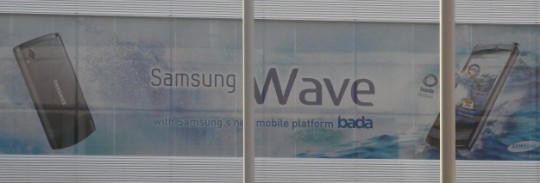
Samsung Wave Bada phone spotted already

If you want to keep your upcoming cellphone quiet until its triumphant MWC 2010 debut, it’s probably a bad idea to put up a huge banner showing it in all its glory. Unfortunately Samsung didn’t appear to get that memo, and so we have the first official shots of the Samsung Wave, running their new Bada platform.


the:unwired’s Arne Hess is already on the ground at MWC and the above photo showed up in his photo stream. Of course beyond the name and what we can glean from the images there’s no telling what the Wave’s full specifications might be; it’s obviously a full touchscreen device with a camera (and what looks like an LED flash) on the back, but we’ll have to wait until Samsung’s press conference to find out exact functionality.

As for Bada, we’re still not quite sure whether the cellphone market really needs a new platform. Samsung are positioning Bada as a smartphone OS for the everyman, bringing high-end features down to a hitherto featurephone price point, and they’re counting on their sales figures to make it a success.

[via Cellular Mania]
Read More

App Store Now Has 150,000 Apps. Great News For The iPad: Paid Books Rule.

During Apple’s iPad event in January, CEO Steve Jobs announced that Apple now had over 140,000 apps in the App Store (along with over 3 billion downloads). If the numbers by app analytics company Distimo are correct, that number is now past 150,000.

But the App Store is growing so big, so quickly that these milestones alone are hardly noteworthy anymore. But Distimo also offers up some nice data along with the milestone number. For example, of the 150,000 apps, some 75% are paid applications while only 25% are free. This is in stark contrast to the second largest app store, Android Market, where recent data suggests that over 60% of the app there are free.

Something else that’s very interesting is that the highest percentage of apps in the App Store are now paid book applications. In total, there are over 27,000 book apps in the store, and of those 92% are paid apps, according to Distimo’s data. That number bodes very well for Apple’s soon-to-be-released iPad, of which a big selling point will be the new iBooks application. There has been a lot of talk about how the iPad won’t hurt the Kindle because the Amazon device’s e-ink makes reading more enjoyable. And while it’s true that e-ink is easier on your eyes (thank a backlit screen), it seems that iPhone owners simply don’t care — again, great news for the iPad.

In terms of overall app numbers, games still rule, with over 28,000 of them in the store. But a much higher percentage of those are free versus the percentage of free book apps. All told, both games and book are far and away the two most popular categories in the App Store, with entertainment in third with just over 20,000 apps. And the numbers drop quickly from there. Education is the fourth most popular category, but that means only 10,000+ apps.


Read More

Thursday, February 11, 2010

Where Microsoft's Money Really Comes From

It's no shock to see that with unglamorous but vital products like Windows and Office, Microsoft is basically printing money. But where's the Xbox? The Zune? Windows Mobile? Bing? Oh, they're there. You just have to look a little closer.


Microsoft's most visible products that aren't Windows and Office fall under two divisions: Entertainment and Devices, and Online Services. Xbox, Zune (both services and devices), cellphone software and to some extend Media Center all fall under E&D, which has been skipping from minor profit to minor loss for years. Online services, like Bing and Hotmail, have a more consistent track record, steadily bleeding money from the company month after month, with only the slightest hints of stopping.

Granted, Silicon Alley Insider's chart only covers of Operating Profit, so it doesn't reflect how much revenue each division accounts for, or in a broader sense, how important and large each of these products is within Microsoft. (you can obviously assume that, even if its division isn't making much money, the Xbox is considered a major product.) But still, it's hard not to see a trend: exciting, risky products—some of the ones we spend the most time talking about—don't make money. [SAI]
Read More

Microsoft plans antipiracy update for Windows 7


An optional update to Windows closes a number of hacks that counterfeiters have used to bypass the product activation technologies built into Windows 7. With the update, Windows will try to restore Windows to its proper state, as well as marking tampered versions as non-genuine copies of the operating system.

Microsoft said on Thursday that it is planning an update to Windows 7 that will close a number of loopholes that counterfeiters had used to thwart the operating system's built-in antipiracy measures.

The Windows Activation Technologies Update for Windows 7, which will be released later this month, closes more than 70 "activation hacks," according to Joe Williams, general manager of Microsoft's Genuine Windows unit, responsible for anti-counterfeiting measures. The update will also check with a server periodically to see if there are further hacks that need to be addressed, though Williams said no personally identifiable information about the user will be sent to the server.

In an interview, Williams cautioned about the dangers that come with using nongenuine versions of the operating system, citing a German study that looked at several hundred copies of Windows 7 that were posted online and found that nearly a third had some type of malware.

"We do see malicious code--everything from easily discoverable malware to keyboard recording," he said. "There's all sorts of things we've seen that puts our customers at risk and their data at risk."

The update will be available for manual download from Microsoft's genuine Web site on Feb. 16 and from the Microsoft Download center the following day. Later this month, the update will also be offered through Windows Update as an "important" (but optional) update.

Williams said the new update will remain optional and that those who choose not to install it will still be able to get other Windows updates, a position that marks a fairly sharp contrast to the once hard line Microsoft was taking against piracy.

With the first release of Windows Vista, Microsoft took an aggressive stance, shifting users it determined to have nongenuine versions of the operating system into a severely limited "reduced functionality" mode. In that mode, all users could do was access the Internet for an hour a day.

However, Williams said that Microsoft heard from customers, businesses, and governments that the restrictions were to draconian and decided to try a different approach.

In the first update to Vista, Microsoft relaxed things considerably, choosing instead to just prominently notify users that their version was not genuine.

Starting with Vista Service Pack 1, users saw their background changed to black and a message that their version was nongenuine, as well as getting a dialog box encouraging them to activate a genuine copy. One could choose to do so immediately, or, after 15 seconds, could click an option to activate later.

With Windows 7, Microsoft eased things even more, allowing users to immediately choose to deal with the issue later, although those that choose that option are notified of some of the benefits of genuine software.

Williams declined to say whether Microsoft will close any of the activation hacks with the first service pack to Windows 7, noting that the company has not yet confirmed any plans for that update. Microsoft did close a number of activation holes in Vista with the service pack to that product.

Williams said Microsoft has put much of its focused on informing customers that may have been duped into buying a PC with non-genuine software.

"We are pretty realistic," Williams said. "People who are actively pirating will try to find ways to continue to pirate."
Read More

What if…Apple only offered the 64GB/3G iPad and sold it for $499

Even though the iPad is still more than a month away from shipping, iSuppli conducted a preliminary itemized parts breakdown. The results aren’t that surprising: Apple’s making a boatload on these things. iSuppli concluded that the $499 16GB/no 3G model only costs $229 to manufacturer with the $829 64GB/3G model costing only $117 more to make even though it carries a $329 premium. Nice, eh?

These numbers can be broken down even further showing Apple’s insane margins. The 3G module only costs $24.50, but Apple charges $129 more for the option. The NAND memory chips are really the only difference between all three options, but their real costs of $29 for 16GB, $59 for $32GB, and $119 for 64GB are nowhere near proportionate with the iPad’s prices. All this data shows that Apple’s abandoning its long-held K.I.S.S. strategy.

So what if Apple got back on the keeping it simple bandwagon, only offered the high-end 64GB with 3G iPad and still sold it for $499? After all, the company would still be making at least $153 on each iPad sold. Would that turn around the iPad’s outlook?

The vast majority that participated in our poll the other day said that the iPad needs a lower price, specifically $349 for the base model. That clearly shows people are not satisfied with what the iPad offers at its $499 price point when it only offers 16 GB of storage and without the 3G wireless option along with a host of other letdowns such as lack of USB, SD card inputs, and multitasking. Surely if the iPad were only offered in a 64GB/3G kit, at least more would be able to look past some of the other transgressions.

In fact this model structure of six different options for the same device is new for Apple as of late. Previously Apple was known for its no nonsense approach of just a high-end or low-end option. (MacBook or MacBook Pro, iMac or Mac Pro) Now consumers have to decide not only how much extra they want to spend for storage, but also if they want to spend $130 more for 3G access.

GPS units are known for this type of rubbish. There might be a dozen different models available, but each step up only adds one or two slight software or hardware change that’s a nominal cost difference, but seems to be enough justification for the gradual price increase up the model line. Only the iPhone and iPod touch share this type of pricing structure, but even though they share a lot of the same parts, their core functionalities are different, justifying the difference. That can’t be said about the iPad, where a unit without 3G will be severally limited compared to one with the option.

Maybe Apple doesn’t need one iPad option priced at $499, but rather only two with both offering 3G access, since it isn’t tied down with a wireless contract anyway. Offer the 32GB option for $399 and then the 64GB one for $549. Something needs to change as clearly consumers aren’t thrilled with the iPad’s current pricing, and now that the whole world can see that Apple is downright robbing buyers of the high-end model, that perception will not improve. Apple, get back to your roots and keep it simple, stupid.
Read More

Google Paying Apple More Than $100 Million Annually For iPhone Search Deal

The rumor that Apple is building its own search engine "isn't credible," according to a source familiar with Apple's operations.

Our source tells us "there's too many options" for search on the market, so there's no reason for Apple to build its own search engine.

Another reason Apple might not want to build its own search engine: It's getting over $100 million a year from Google in its revenue share deal, according to our source.

For Apple, that's not a lot of money. But, it's enough that it doesn't make sense for Apple to put considerable resources towards building its own Internet search engine. And, if Apple wanted more money or options, there's Microsoft — with Bing and a big checkbook.

While Apple isn't going to stomp into search, Apple's deals with Google have become more contentious lately, as the companies are increasingly competing with each other.

Our source tells us when Apple first introduced the iPhone, it hammered out its deal for Google Maps in two weeks. When Apple prepared to launch the iPhone 3G with GPS a year later, it was a six-month process "full of acrimony" to get the maps deal finished.

Google wanted access to all sorts of data from the maps, but Apple didn't want to give it up, according to this person.
Read More

360 Scores The Only Final Fantasy XIII Bundle Outsidfine Of Japan

Microsoft confirms the March 9th release of a Final Fantasy XIII 250GB Xbox 360 bundle, noting that it's the only console outside of Japan to come bundled with the game.


At the X10 event in San Francisco today, the company revealed that the rumored Xbox 360 North American Final Fantasy bundle is indeed a reality, and it will include exclusive downloadable avatar items in the box. Microsoft stresses that the Xbox 360 is the only console outside of Japan bundled with Square Enix's latest, which is a pretty big deal for Microsoft. Especially when you consider the console isn't even getting the game in Japan.

The bundle includes an unbranded 250GB Xbox 360, two wireless controllers (for a one-player game,) a standard edition copy of Final Fantasy XIII, and exclusive downloadable avatar items.

Oh wait, the console is Final Fantasy XII branded...in a place no one would ever look.


And yes, I suppose downloadable avatar items counts as downloadable content.

Microsoft has also revealed that a select number of Limited Edition Xbox 360 faceplates have been created by designer Tetsuya Nomura, to be distributed across select retailers in Europe, North America, Australia, and New Zealand.

Also notable, the listing for the system says it comes with a Standard Edition copy of the game. Why stress standard edition, if there is no limited edition? Interesting, isn't it?

And here's an image of the faceplate:

Read More

Motorola XT800 Android touchscreen phone hands-on in Shenzhen


Lusting for more Android love from Motorola? Then you should start searching for a Chinese soulmate. We've been told that this ?5,680 ($830) XT800 dual-SIM (one CDMA and one GSM) smartphone had been out for just a few days in Shenzhen -- right before the country shuts down for Chinese New Year on Sunday. Packing the same OMAP3430 core used by the Droid and Milestone, both the 2.0.1 firmware and a 720p sample video we watched were running smoothly on the lovely 3.7-inch 854x480 screen. The rubberized battery cover felt nice in our palm, too, but enough with the talking -- go gorge yourselves on the pics, won't you?


Read More

HTC Legend breaks cover on KPN's site for March launch


We've little doubt at this point that HTC's Legend is definitely real and likely coming to a shop near you, but now we've got what seems to be the first official confirmation by a company that would have authority on the matter. The Netherlands' KPN has thrown up the Legend on its site for availability likely in March, offering the Android-loving Dutch the opportunity to sign up for updates -- in other words, no money's exchanging hands just yet. As far as we can tell, these appear to be official shots of the phone offered up by HTC, so odds are good that KPN simply jumped the gun -- the phone is almost certainly destined for an official unveil either by HTC or a carrier partner at MWC in a few days' time. There are some specs here, too: 256MB of RAM and 512MB of ROM on board, AGPS, WiFi, an FM radio, 3.2-inch display and 5 megapixel camera, making this an honest-to-goodness Hero successor -- and it even looks like the Legend name will be carried over for launch. Any other carriers care to step up and help bust this thing wide open?
Read More