Showing posts with label Nokia. Show all posts

Saturday, February 13, 2010

Nokia Feel Symbian app suggests activities based on what you feel

Ready for a new experimental app from Nokia Beta Labs? Meet Nokia Feel, an application that lets you tell your phone how you feel, and then suggests things that you could do.


The app includes a list of feelings that you can choose: Happy, Lucky, Lonely, Hungry, Energetic, Bored, Creative, Caring and so on. After you tell the application how you feel, it will suggest specific activities for each feeling.

For example, if you’re feeling creative, the app can suggest things like: write a story, “draw a nice picture”, or contribute to Wikipedia.

It’s not clear yet if Nokia Feel is compatible with all Symbian phones (probably not), but it should work with all the touch-enabled ones.

You can download Nokia Feel from the Beta Labs website – note that you need a Nokia Account to access the download link.


A video preview of the Nokia Feel application can be watched below:

Read More

Thursday, February 11, 2010

Nokia N87 (Vasco) specs show up again, include AMOLED display

We’ve first reported about the possible specs of Nokia N87 in December last year. Well, things have changed a bit since then.


Apparently codenamed Nokia Vasco, the N87 may have a 3.7 inch AMOLED touchscreen display, and not a 3.2 inch one as previously believed.

Some leaked documents have appeared over at BeGeek, and while we can’t verify their authenticity, they seem to confirm the fact that the N87 has a 12MP camera (with Carl Zeiss optics and Xenon flash). Earlier today, we’ve heard that Nokia’s first 12MP phone would be the Nokia N8 – but, honestly, I think the N8 and N87 monikers are for the same device.

So here’s what the Nokia N87 should offer, apart from an AMOLED display and a 12MP camera:
Wi-Fi
GPS
HD video
FM radio and FM transmitter
ARM Cortex 8 CPU at 600MHz
Dedicated GPU (graphics processing unit)
256MB RAM
16GB / 32GB of internal memory


No word on when Nokia plans to announce the N87, but maybe it will do it at the same time with the Nokia N98.
Read More

Friday, February 05, 2010

Symbian tablets & netbooks “very likely” in next 1-2 years

Symbian has gone open-source, and talk is now of what sort of devices we could see the OS turn up on. According to Symbian Foundation chief executive Lee Williams, particularly likely are Symbian-based tablets; speaking with ZDNet UK, Williams revealed that the Foundation has had several inquiries from companies looking into tablet-style devices running ARM chipsets.


“A lot of companies are experimenting with PDA-tablet-style form factors, also for stereo systems, and internet-connected devices running low power on primarily ARM architecture — we do get occasional interest for a few of those” Lee Williams, CEO, Symbian Foundation

Nokia themselves showed off one such concept device late last year, as part of their “Vision of 2015″ video which you can see below. Williams reckons we will likely see Symbian tablets in the next 1-2 years, and the thought of a Tegra 2 or OMAP4 based device does have us salivating.

However, ARM architecture isn’t the only place Symbian is likely to make an appearance; as part of the Foundations “Wild Duck” side-project, the OS has already been ported to Intel’s Atom processor, which means netbooks could be in line. Wild Duck is basically a database of off-the-shelf hardware with which manufacturers could easily put together a working Symbian device.

Read More

Symbian opens up its source code, available now for your downloading pleasure


It is official. The Symbian Foundation has released Symbian as an open source product today, four months ahead of its scheduled mid-2010 completion date. As with other open source projects, the move will allow developers to modify and contribute to the source code in hopes of improving the overall quality and hastening the development of the operating system. An open source Symbian can also be installed on any compatible device for free which should help to further expand Symbian’s reach and solidify Symbian’s position as the dominant mobile OS worldwide. Beating Android to the punch, Symbian will publish its platform roadmap and planned features up to 2011, an outline which the Symbian Foundation notes can be modified and expanded based upon developer contributions to the mobile OS. The full Symbian source code is available for download now at Symbian’s developer website.

Read More Here
Read More

Wednesday, February 03, 2010

Symbian OS going free and open source for first time

Starting Thursday, the source code for Symbian’s operating system platform will become entirely open source and free (Symbian’s software currently powers most of the smartphones in the world, and is owned by Nokia). Tomorrow hence the day developers will be able to download, alter, and apply the software at no costs at all.


“The dominant operating system provider out there is Symbian,” says Lee Williams, executive director of the Symbian Foundation, “and now we are offering developers the ability to do so much more.”

Symbian software is used on over 330 million phones around the world, as stated by the Symbian Foundation. It’s facing increasingly dynamic competition in the smart phone arena from Apple’s iPhone OS platform as well as Google’s Android OS, the two front-runners at the moment. However, Symbian phones have never topped sales charts in the US – will that start to change soon?
Read More

Tuesday, February 02, 2010

Nokia reconfirms: Symbian^3 and Maemo 6 devices are coming this year

Michael Hsu, Nokia Taiwan’s general manager, has recently reconfirmed that Nokia will be skipping Symbian^2 and release only Symbian^3 smartphones this year – starting the third quarter.


Shortly after Symbian^3 handsets are released, Symbian^4 smartphones will be out, too – in late 2010 or early 2011. As we’ve reported earlier, Nokia is already working on Symbian^4, which will be based on Qt and feature multi-touch, free placement of homescreen widgets, redesigned Control Panel and so on.

Nokia’s first Maemo 6 device will also come in the second half of 2010. Since Maemo 6 and Symbian^4 are both based on Qt, developers will be able to create applications that simultaneously support the two platforms.

According to DigiTimes, Nokia’s 2011 phone portfolio should look like this: 55% of the devices will be based on Symbian; 35% of the handsets will be feature phones (S40?); 10% will be based on Maemo.
Read More

Saturday, January 30, 2010

Nokia, Nintendo, Netflix and E-Ink respond to the iPad


We're sure just about every company on the map has an opinion on Apple's new device, but a few big wigs have taken time out of their busy schedules to weigh in on the device. These are their stories.

  • Nokia's Mark Squires, Head of Social Media, was mainly confused by Apple's statement that it's the biggest mobile device manufacturer, surpassing Nokia in combined revenue on media players, phones and laptops. Mark argues that the accepted definition for "mobile devices" excludes laptops, and goes on to mention the undisputed fact that Nokia's still number one when it comes to number of devices sold.
  • Netflix CEO Reed Hastings, meanwhile, says that mobile devices aren't a priority for his company yet. They're fighting the good fight of the large screen, and once they feel comfortable in their various efforts there, then they'll move on to small screens. Netflix hasn't done or submitted an iPhone application, but Hastings did mention that he was optimistic that if Netflix did get into the game, the app would be approved for the App Store, and that it would run on both the iPhone and iPad.
  • Satura Iwata, president and CEO of Nintendo, took a much more directly critical approach to the device, calling it a "bigger iPod Touch," and that Apple delivered "no surprises." In the same interview he expressed skepticism as to the value of bringing a high definition Wii on the market, as well as expressing doubts about 3D glasses-based gaming. Iwata is clearly a tough man to please.
  • Perhaps most threatened by the iPad is Russ Wilcox, CEO of E-Ink. He says dedicated e-readers will outsell iPads due to "simple economics," and that the iPad is "great entertainment device," but it's "not the world's best reading device." His criticisms, mostly in juxtaposition to Kindle-style devices, abound, including price, weight, backlight and so on. He's right on the money about the shortfalls of a straightforward comparison, but we wonder if consumers will feel the same?

Nothing too salacious, unfortunately, and most of the points raised are pretty spot-on -- though we do wish Reed Hastings would rethink his priorities just a smidgen and get Netflix onto mobile devices sooner than later. We're needy like that.
Read More

Thursday, January 28, 2010

Nokia reports Q4 2009 results: 126.9 million phones sold, 39% market share

Nokia has just announced it financial results for the fourth quarter and full year 2009.

The Finnish company reports net sales of €12 billion for Q4 2009, and net sales of €40.9 billion for full 2009. The operating profit for Q4 was €1.14 billion, while the operating profit for full 2009 was of €1.19 billion (the Q4 2009 and full 2009 values are almost the same because Nokia actually lost money in the previous quarters).

Nokia sold 126.9 million phones in the fourth quarter of 2009 (17% more than in the third quarter of the year) and raised its market share to 39% (from 37.3% in the previous quarter).

20.8 million Nokia smartphones were shipped in Q4 2009, 4.6 million being Nseries, and 6.1 million being Eseries. Among the new smartphones introduced by Nokia last quarter we must mention Nokia E72, Nokia N97 mini and Nokia X6 (pictured below).


Overall, Nokia sold 431.8 million devices in 2009 (67.8 million of them were smartphones) – that’s a 7.8% decrease compared to the 468.4 million units sold in 2008.

Nokia estimates that the total number of mobile device shipped in 2009 (by all manufacturers) reached 1.14 billion units – a 6% decrease compared to 2008.
Read More

Thursday, January 21, 2010

Nokia smartphones to come with free GPS navigation – now official

Nokia is just about to announce “something big” related to its Ovi services, but, before this to happen, Reuters is reporting that the world’s largest handset maker plans to offer free GPS turn-by-turn navigation on its smartphones. Not in select markets, but worldwide.


The news comes several months after Google has announced its free navigation service for its also free Android operating system – in the US only.

Both Google’s and Nokia’s offerings are likely to harm big GPS services providers like Garmin and TomTom.

Nokia already has some phones that provide free navigation – like the 5800 Navigation Edition and the 2700 Navigation Edition.


Update: Nokia has just confirmed that “a new version of Ovi Maps” will include “high-end walk and drive navigation at no extra cost”, providing “ turn-by-turn voice guidance for 74 countries, in 46languages, and traffic information for more than 10 countries, as well as detailed maps for more than 180 countries”. Users can download the new Ovi Maps via its official website. Free Events guides, free Lonely Planet guides and free Michelin guides are included, too.

The list of supported phones currently includes:
Nokia X6
Nokia N97 Mini
Nokia E72
Nokia E55
Nokia E52
Nokia 6730 classic
Nokia 6710 Navigator
Nokia 5800 XpressMusic
Nokia 5800 Navigation Edition
Nokia 5230

As you can see, the N97 is not included in the list, and neither is the Maemo-based N900. Update 2: according to Nokia, Ovi Maps 3.0.3 for the N97 will be available starting January 28. However, the N900 will probably not get free navigation anytime soon.

Smartphones with the new Ovi Maps preinstalled will be launched by Nokia starting March.

A video promo of the new and free Nokia Ovi Maps can be watched below:

Read More

Saturday, January 16, 2010

Apple retaliates: requests US import ban on Nokia phones


As expected, Apple just responded to Nokia's ITC request to ban Apple device imports with a US embargo request of its very own. Notice of Apple's complaint (without any detail) was posted yesterday on the website of the International Trade Commission -- a government agency tasked with protecting the US market from unfair trade practices. As you might recall, the whole Nokia v. Apple legal spat started with Nokia suing Apple for infringing upon Nokia patents relating to GSM, UMTS, and WiFi; a claim later expanded to include "implementation patents" covering a wide range of items including camera sensors and touchscreens. While the ITC hasn't agreed to investigate either Nokia's or Apple's complaints, it is customary to do so with investigations usually taking about 15 months to complete. We'll post more when the details of Apple's patent infringement complaint are revealed.
Read More

Friday, January 15, 2010

Nokia shows off Symbian^4 UI concept proposal

Although Symbian^3 isn’t released yet, Nokia is already working on Symbian^4, and it recently presented a UI concept proposal for it.

Based on a Qt framework, Symbian^4 should simplify the S60 user experience by bringing renewed layouts, “free placement of Homescreen widgets”, “context menu support for list items”, four user-facing libraries (Contacts, Applications, Music and Photos), improved task switcher, redesigned Control Panel and so on.

Below you have some screenshots of the Symbian^4 UI concept proposal (the final version of the new OS may not look like this):


Symbian^4 should be functionally complete in by the end of 2010, although the first Nokia phones based on it will only be launched in 2011.
Read More

Monday, January 04, 2010

Nokia continues legal assault on Apple, files suit with ITC to ban Apple imports


Back in October we told you about Nokia filing suit against Apple over the iPhone, claiming that Apple’s mobile offering violated Nokia patents pertaining to GSM, UMTS and wireless LAN (WLAN) standards. Perhaps some legal posturing, we thought; a public and principled shot across the bow aimed at the Cupertino based tech company? Apparently not, as Nokia has taken off the gloves. In a December 29th filing with the International Trade Commission, Nokia seeks an immediate injunction that would ban the import of anything with a camera and an Apple logo on it: iPhones, iPod Touches, iMacs, Macbooks – you get the idea. The suit claims Apple is violating Nokia patents in its use of a combined camera chip which keeps the size and power usage of devices down, a voltage controlled oscillator (VOC) that “increases the efficiency of the wireless device and uses less power than traditional VCOs, thereby increasing battery life,” and the sensor technology used in the iPhone that turns the screen off when it is within proximity of your face to prevent accidental input. We’re not sure if Nokia’s strategy is a sound one, but we’ll stay on top of this one as the filings continue to mount. You can hit up the link to read the original article translated from Finnish.
Read More

Wednesday, December 30, 2009

LG Rumored to Join Nokia, Not Show Up to MWC 2010

When we first broke the news that Nokia would not be exhibiting at Mobile World Congress 2010 this upcoming February, I’m sure there were a lot of shocked people out there. Brace for another shocker, because if rumors are correct it would mean that another big name, LG Electronics, will be following in Nokia’s footsteps (the footsteps leading straight out the door).

Rumblings around the net indicate that LG is not planning on setting up a booth or showing anything at MWC 2010 due to the high costs of securing a pavilion at the show. According to the Dutch division of LG Mobile, whom AllAboutPhones contacted for information, it is true that they won’t be exhibiting, but just like Nokia will be in Barcelona for the show and putting on events in a separate location.

Since LG will still be there, it’s likely that the company will still have several new products available on showcase.
Read More

Tuesday, December 29, 2009

Nokia claim Apple infringe patents in all phones, PMPs & computers

The ongoing legal battle between Nokia and Apple has gained another layer of complexity today, as Nokia demand a United States International Trade Commission (ITC) investigation based on accusations of “Apple’s practice of building its business on Nokia’s proprietary innovation.” Distinct from the litigation in Delaware, which concerns Nokia’s wireless standard patents, this new investigation would concern UI, camera, antenna and power management technologies.

Such technology, Nokia claims, are what enables the Finnish company to make smaller, longer-lasting and cheaper handsets, with the company’s general manager in charge of patent licensing, Paul Melin, describing the IP as “pioneering”. ”Nokia has been the leading developer of many key technologies in small electronic devices” the executive claims.

Apple has already accused Nokia of “stealing” the Cupertino company’s technology, in response to the original Delaware suit. ”Other companies must compete with us by inventing their own technologies, not just by stealing ours,” said Bruce Sewell, Apple’s General Counsel and senior vice president.
Read More

Tuesday, December 22, 2009

Nokia Image Space app provides a new way of viewing photos

Nokia Image Space is the latest mobile app to come out of Nokia’s Beta Labs. Basically, this is an application that lets you take photos and instantly upload them on Flickr – but wait, there’s more: the app also allows “spatial browsing of photos”.


After you’ve taken a photo with a phone that has the Nokia Image Space Capture app, you can upload it on your Flickr account. The photo is geotagged and features orientation information in the metadata – this way, photos from different users can be contextually linked. If there are enough photos of a place, Nokia Image Space can even create a 3D view of said place.

To use the Nokia Image Space Capture app you’ll need an S60 (3.2 or 5.0) Nokia phone with built-in compass (like Nokia N97 mini, Nokia 6720 Classic, Nokia 6210 Navigator and Nokia 6710 Navigator). The Nokia Image Space browser requires Firefox, IE or Safari with Adobe Flash 10.

Nokia Image Space Capture can be downloaded from here. http://betalabs.nokia.com/apps/nokia-image-space

A video presentation of Nokia Image Space can be watched below:

Read More

Tuesday, December 15, 2009

Nokia and Samsung invest millions in Swype’s touchscreen typing technology

Swype, a Seattle-based company that develops a new way of typing on touchscreen displays, has secured a $5.6 million funding from Nokia and Samsung (via the companies’ subsidiaries Nokia Growth Partners and Samsung Ventures, respectively).


Reportedly, Swype allows users to write “over 40 words per minute on touchscreen devices” by intelligently guessing the words you want to type, and the new funding will further help it improve its technology.

For the moment, only one handset features Swype’s technology (Verizon’s Omnia II), but Swype plans to offer it to several other WM and Android smartphones next year – and maybe to Nokia’s touchscreen handsets, too.

What’s interesting is that Samsung has recently announced a partnership with Nuance, another provider of predictive text input software, saying that its phones (touchscreen ones included) will be shipped with the T9 and XT9 products.
Read More

Sunday, December 13, 2009

Can Nokia Recapture Its Glory Days?

IF there’s anywhere left in the world where it’s still impolite to flash a BlackBerry or an iPhone, it’s Nokia’s annual analyst meeting.

But earlier this month, as executives talked up the company’s plans for 2010, the optimistic message from the stage was belied by the behavior of the audience. In the back of the room, one money manager after another distractedly toyed with a competing device, typically a BlackBerry, even as cheery PowerPoint slides promoted Nokia’s latest offerings.

Francois Meunier, an analyst with Cazenove in London, whispered doubts about the presentation as he tried to catch the eye of one of the floor managers handing out microphones for the question-and-answer session. Finally, it was Mr. Meunier’s turn, but before he could ask an actual question, he couldn’t resist declaring publicly what he’d been muttering all afternoon.

“I don’t think anyone in this room is expecting an improvement in earnings next year,” he told the assembled executives, before asking whether Nokia’s 4 percent dividend is sustainable.

Mr. Meunier’s downbeat assessment of the once-mighty mobile phone maker’s prospects in 2010 comes after an equally gloomy 2009, a year the company would just as soon forget.

Although Nokia, based near Helsinki in Espoo, still commands 37 percent of the world’s handset market, it’s facing bruising competition in the lucrative high end of the industry, where Apple’s iPhone and Research in Motion’s BlackBerry have grabbed the cool factor in smartphones that can surf the Web and handle e-mail.

“The whole user experience is a nightmare,” moans Nick Jones, a senior analyst with Gartner, which tracks the technology sector. “It’s just not in any sense a competitive experience with iPhone.”

Olli-Pekka Kallasvuo, the company’s taciturn chief executive, admits the mood out there is gloomy, especially on Wall Street. “We are not getting the benefit of the doubt,” he said in an interview the day after the analysts’ meeting. “We need to change that.”

Nokia’s problems are especially acute in North America, where its hold on smartphones equals a barely visible 3.9 percent, compared with 51 percent for Research in Motion and 29.5 percent for Apple, according to Gartner. As if to underscore its problems in the United States, Nokia announced Thursday that it would shutter its flagship stores in New York and Chicago.

“We made wrong decisions in the American market,” says Kai Oistamo, executive vice president for devices. For example, Nokia was slow to make the change to so-called clamshell phones, sticking with “monoblock” models even as consumers abandoned them.

And while Nokia first offered touch-screen technology in 2004 — three years before the debut of the iPhone — Apple’s models quickly made Nokia’s competing products look stodgy. Most of Nokia’s touch-screen phones can’t quickly transform their screen with the jab of a finger, which is among the factors that make the iPhone seem so much more slick.

Until recently, according to both Nokia executives and industry experts, the company didn’t want to produce phones specifically tailored for American consumer tastes, and it resisted demands from the major carriers to come up with phones based around their brands and individual specifications.

“The market in the U.S. has always been dominated by the carriers, so they call the shots,” says Carolina Milanesi of Gartner. “And Nokia has had a difficult relationship with the carriers.”

Nokia has also been hobbled by its traditional weakness in phones employing C.D.M.A., the wireless technology offered by Sprint and Verizon Wireless that’s used by about 50 percent of American consumers. (Sprint’s current lineup does not include any Nokia models.) Nokia focuses instead on G.S.M. phones for AT&T and T-Mobile. However, AT&T’s exclusive deal with Apple has hurt Nokia in the high-end smartphone market.

And though Nokia sells a lot of smartphones elsewhere in the world, its share of the global smartphone market has fallen to 39.3 percent, down from 42.3 percent a year ago. Even in Nokia’s home base of Europe, the iPhone is rapidly gaining in popularity.

Nokia is finally responding — its lithe, BlackBerry-like E72 appeared in the United States on Tuesday — but it is facing looming threats in other segments.

Google is offering Android, a rival to Nokia’s own operating system, which has been picked up by competitors like HTC, Motorola and Dell, while Asian manufacturers are turning up the heat with low-priced handsets in emerging economies where Nokia has long enjoyed outsize market share. Meanwhile, Apple and Nokia are locked in a legal battle over patents.

“Nokia faces competition everywhere,” says Sherief Bakr, a Citigroup analyst. “At the high end from Apple, in the midrange by Research in Motion, and by the Koreans and the Chinese in the low end.”

ALL in all, it’s enough to make the mood as grim as a December day in Helsinki, where the sun struggles to get above the horizon by 9 a.m and night falls at 4 p.m.

Once a stock market darling, Nokia shares have fallen 20 percent since September even as the broader market has rallied. The company reported its first quarterly loss in more than a decade in October after a $1.3 billion write-down in its equipment business.

Here in Finland, Nokia’s problems are felt especially keenly. Nokia accounts for 25 percent of the Helsinki stock exchange’s capitalization and one-third of Finland’s total research and development spending, according to Jyrki Ali-Yrkko, of the private Research Institute of the Finnish Economy.

Deeper than the numbers, however, has been the damage to Nokia’s role as a wellspring of pride in a country historically known for exporting wood and paper products, not high tech.

Nokia’s roots go back to 1865, and as recently as the 1980s, its products included not only cable and telecom equipment but also rubber boots and toilet paper. But in the early 1990s, many businesses were spun off in favor of the growing cellphone sector. By the mid-1990s, under its former chief executive and current chairman, Jorma Ollila, the profits were rolling in.

Nokia quickly became one of Europe’s rare technology success stories, an exception in an industry dominated by American and Japanese giants. And in a traditional, social-democratic Nordic country where ostentatious displays of wealth are frowned upon, hundreds of long-time employees became Nokia millionaires, says Mr. Ali-Yrkko.

“Nokia has been the flagship of Finland in terms of a company succeeding on a global scale,” he says. “But that sense of glory we had has disappeared, or at least diminished.”

The problems have reached all the way to Finland’s national coffers. In 2007, Nokia paid 18 percent of Finland’s overall corporate taxes, but that dropped to 9 percent last year, and the contribution is expected to be even lower in 2009. The Finnish government may have to increase borrowing to make up for the shortfall, warns Mr. Ali-Yrkko.

A lawyer by training, the C.E.O. Mr. Kallasvuo is a much more cautious leader than his predecessor, the charismatic Mr. Ollila, who some Finns thought might go into politics after he stepped down as chief executive in 2006. At times, Mr. Kallasvuo seems uneasy when pressed for his vision of Nokia’s future, and repeated earnings disappointments have led many analysts to question whether his dour style is what’s needed as new competitors circle.

“The market believes this is a management team that can’t and won’t execute,” says Mr. Bakr. “There is a large element of investors who are not convinced that Kallasvuo is the man who can make this transition and compete with the likes of Steve Jobs.”

Despite the pessimism outside, Mr. Kallasvuo insists spirits are still high inside the company. “Competition is nothing new; we’ve been attacked by many players,” he says. And while last quarter’s performance “was difficult for me and the C.F.O., it wasn’t a difficult moment for an excited Nokia engineer who wants to change the world.”

IF Olli-Pekka Kallasvuo seems to have stepped off the set of an Ingmar Bergman movie, then Anssi Vanjoki’s charisma and sculpted features recall Michael Douglas. An 18-year veteran of Nokia, he is the executive vice president for markets as well as something of a standout in Nokia’s geeky culture. In a country where speeding tickets are directly tied to income on a sliding scale, he racked up a 116,000 euro ($170,000) fine racing his motorcycle through Helsinki, although he was able to negotiate that figure down somewhat.

Much more feisty than Mr. Kallasvuo, he is unwilling to admit Nokia has lost any of its competitive edge. “We have not lost our ability to innovate; we have not lost our ability to truly understand the consumer and make intuitive solutions for them,” Mr. Vanjoki says.

Indeed, for all the new competition in smartphones, Nokia remains the dominant player in conventional handsets, selling roughly 15 phones a second worldwide, according to the company, including the Nokia 1201, a basic model that is its best seller. Analysts project revenue in 2010 will top $60 billion, while profit is expected to equal $3.5 billion next year as the overall phone market grows 10 percent.

And while market share might be minuscule in North America, the company commands a whopping 62.3 percent of the market in the Middle East and Africa, as well as 48.5 percent in Eastern Europe and 41.8 percent in Asia. “We are the incumbent behemoth of the mobile arena,” Mr. Vanjoki boasts.

What’s more, Nokia has been written off before.

Citing past crises in 1998 (the advent of smaller phones), 2001 (the bursting of the tech bubble) and 2004 (the sudden popularity of flip phones), Mr. Vanjoki says. “we’ve always had points where technology hit a plateau and had to be reconfigured.”

SO why didn’t Nokia move more quickly to counter Apple and Research in Motion in smartphones? “We didn’t execute; we were aiming at too geeky a community,” he says. “Apple is made for the common man. It’s more for Joe Six-Pack than techno-geeks. But we understand Joe Six-Pack too.”

The coming 12 months will show whether Mr. Vanjoki’s confidence is warranted, and he better be right as far as shareholders are concerned, since smartphones are where the growth is.

By 2013, Gartner predicts smart device sales will represent 82.5 percent of the mobile phone business in Western Europe, and 58.2 percent of sales in North America and 18.2 percent in Asia. Nokia generated $5.6 billion in sales from conventional phones in the third quarter worldwide, compared to $4.6 billion for smartphones.

Nokia executives say new offerings like the N900, which is as much a mobile computer as it is a phone, or the N97 Mini, which combines touch-screen technology with a qwerty keyboard, will win back buzz from Apple and BlackBerry while appealing to the company’s 1.1 billion customers. Then there’s the X6, out this month, which includes Nokia’s Comes With Music plan, allowing users to choose from millions of songs they can download free from Nokia’s Music Store.

Another crucial development in 2010, according to Mr. Kallasvuo, will be a bigger push for North American market share, as Nokia works more closely with carriers and brings out more smartphones. “We have not invested enough there,” he says. “It’s a necessity for us.”

Although it’s still secret, Nokia executives are also promising a smartphone for next year that will update the company’s aging Symbian operating system, combining the touch-screen coolness of the iPhone with a BlackBerry-like e-mail solution. “We intend to give R.I.M. a run for their money,” says Mr. Kallasvuo.

And though Nokia’s flagship outlets in the United States may be folding, the Finnish giant is still trying to compete directly with Apple online, opening Ovi (“door” in Finnish) in May to compete with Apple’s hugely successful Apps Store.

Looking out further, Nokia’s engineers are promising nifty new features like the ability to simply point your phone at a friend to connect to the person’s Facebook page.

For all of Nokia’s mistakes, Citigroup’s Mr. Bakr says the company can bounce back yet again. “Sitting in London or New York, you don’t appreciate the dynamics of Nokia’s huge market share, especially in emerging markets,” he says. “I think they know what they’ve done wrong and what they need to do right. It’s just a question of whether they can execute in time.”
Read More

Friday, December 11, 2009

Apple Says Nokia Missed The Boat And “Chose To Copy The iPhone” Instead

Now that Apple has responded to Nokia’s patent lawsuit filed last October with its own countersuit today, we have a clearer picture of what the dispute is all about. As suspected, it is about money, specifically the patent licensing fees Nokia is trying to get out of Apple for wireless patents it holds and it alleges are infringed by the iPhone.

But more broadly, it is about Nokia missing the boat on the shift from conventional phones to mobile computers where the phone functionality is relegated to one of many features, and not the most important one at that. Apple lays this argument out in its countersuit, saying that Nokia tried to overcharge it on patent fees because it missed the boat on the shift to smartphones.

In Apple’s countersuit today, it accuses Nokia of attempting a “patent hold-up.” The patents in question are part of industry standards, and as such Nokia must license them under fair and reasonable terms, argues Apple. But instead, Nokia tried to put the squeeze on Apple. Apple states in its countersuit:

In dealing with Apple, Nokia has sought to gain an unjust competitive advantage over Apple by charging unwarranted fees to use patents that allegedly cover industry compatability standards.

Whether or not Apple’s arguments hold water is for a court to decide. But Apple takes the opportunity of this legal battle to make a swipe at Nokia as a flailing competitor. If you read between the lines of the suit, the reason Nokia is not willing to license its patents under “fair, reasonable, and non-discriminatory terms” to Apple is because while Apple was creating a “revolutionary change in the mobile phone category” with the iPhone, Nokia was sitting on its haunches:

In contrast, Nokia made a different business decision and remained focussed on traditional mobile wireless handsets with conventional user interfaces. As a result, Nokia has rapidly lost share in the market for high-end mobile phones. . . . In response, Nokia chose to copy the iPhone.

In other words, Nokia is losing in the marketplace so it is falling back on the only thing it has left—its patents. Apple is already more a profitable phone manufacturer than Nokia, and it has no intention of returning those profits via exorbitant patent fees. Now, what exactly those proposed fees are and whether they are in fact exorbitant we don’t know because the numbers are not in the suit. Presumably, those will come out at trial.

Apple could lose that trial or end up paying a huge settlement fee. Both of these suits are negotiations by other means. Regardless of the outcome, though, it feels like Apple has already won the bigger battle in the marketplace.
Read More

Apple and Nokia's battle hots up

The legal battle between Finland's Nokia and its US rival Apple has taken a new turn, with Apple countersuing Nokia over alleged patent violations.

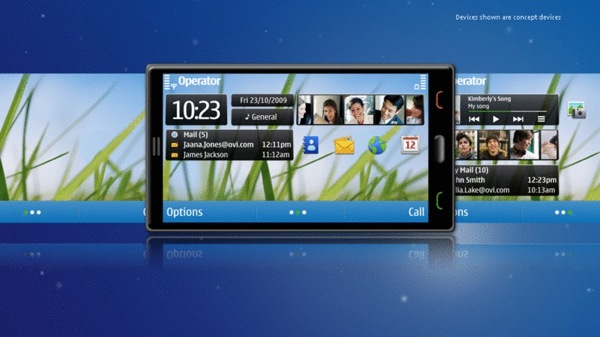
The move follows a Nokia lawsuit filed in October accusing iPhone maker Apple of 10 Nokia patent infringements.

Now Apple, in turn, is claiming that the Finnish phone firm is infringing 13 of its technology patents.

"Other companies must compete with us by inventing their own technologies, not just by stealing ours," Apple said.

Apple has not yet revealed which patents are at issue. Nokia was unavailable for comment.

In October, Nokia said it had not been compensated for its technology, and accused Apple of "trying to get a free ride on the back of Nokia's innovation".

The 10 alleged patent infringements by Apple involve wireless data, speech coding, security and encryption.

The breaches applied to all models of the iPhone since its launch in 2007, Nokia added.

Finland's Nokia said that it had agreements with about 40 firms allowing them to use the firm's technology, but that Apple had not signed an agreement.
Read More

Thursday, December 03, 2009

Nokia 2010 Symbian UI update gets previewed

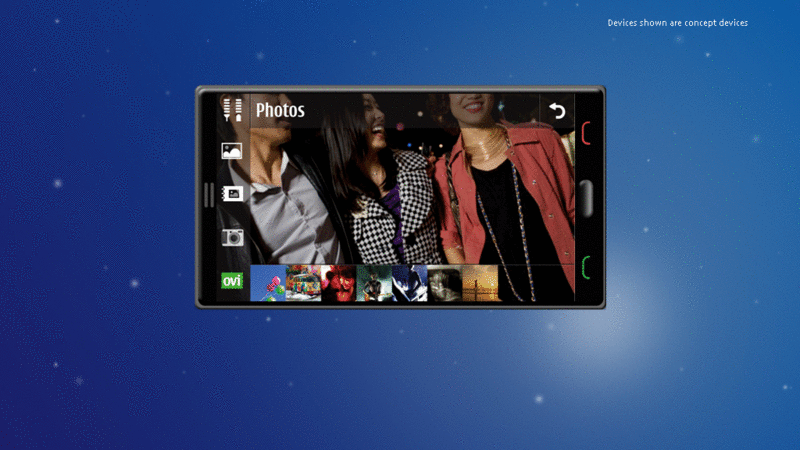
Nokia’s promise to overhaul the Symbian UI yesterday was heavy on stats but light on screenshots, but thankfully the company’s webcast is fair overflowing with concept renders. The Finnish company has promised not only to make the UI more attractive – by cutting out clutter and upping scrolling rates from 15fps to 60fps – but more functional too, slicing out the number of taps required to complete tasks or launch features, and giving users “large capacitive displays” to do that tapping on.


It’s probably too much to expect the slick concept device Nokia’s designers have thrown together to be anything like what the company have on the drawing boards, but we certainly wouldn’t argue with a keyboard-free capacitive version of the N900. One of the biggest changes, Nokia claims, will be removing some of the more frustrating user prompts, and with 350 of them that’s a decent move toward a less-frustrating owner experience.

In the end, we’ll have to see exactly what Nokia come up with on shipping devices; we’ve seen concept videos and mock-ups before, but there seems to be something stopping those excellent ideas from transitioning to production handsets. Still, with two “major product milestones” on the cards for 2010, and the UI project underway, Nokia don’t look to be taking their flattening market share lying down.


Read More