Showing posts with label Symbian. Show all posts

Saturday, February 13, 2010

Nokia Feel Symbian app suggests activities based on what you feel

Ready for a new experimental app from Nokia Beta Labs? Meet Nokia Feel, an application that lets you tell your phone how you feel, and then suggests things that you could do.


The app includes a list of feelings that you can choose: Happy, Lucky, Lonely, Hungry, Energetic, Bored, Creative, Caring and so on. After you tell the application how you feel, it will suggest specific activities for each feeling.

For example, if you’re feeling creative, the app can suggest things like: write a story, “draw a nice picture”, or contribute to Wikipedia.

It’s not clear yet if Nokia Feel is compatible with all Symbian phones (probably not), but it should work with all the touch-enabled ones.

You can download Nokia Feel from the Beta Labs website – note that you need a Nokia Account to access the download link.


A video preview of the Nokia Feel application can be watched below:

Read More

Friday, February 05, 2010

Symbian tablets & netbooks “very likely” in next 1-2 years

Symbian has gone open-source, and talk is now of what sort of devices we could see the OS turn up on. According to Symbian Foundation chief executive Lee Williams, particularly likely are Symbian-based tablets; speaking with ZDNet UK, Williams revealed that the Foundation has had several inquiries from companies looking into tablet-style devices running ARM chipsets.


“A lot of companies are experimenting with PDA-tablet-style form factors, also for stereo systems, and internet-connected devices running low power on primarily ARM architecture — we do get occasional interest for a few of those” Lee Williams, CEO, Symbian Foundation

Nokia themselves showed off one such concept device late last year, as part of their “Vision of 2015″ video which you can see below. Williams reckons we will likely see Symbian tablets in the next 1-2 years, and the thought of a Tegra 2 or OMAP4 based device does have us salivating.

However, ARM architecture isn’t the only place Symbian is likely to make an appearance; as part of the Foundations “Wild Duck” side-project, the OS has already been ported to Intel’s Atom processor, which means netbooks could be in line. Wild Duck is basically a database of off-the-shelf hardware with which manufacturers could easily put together a working Symbian device.

Read More

Symbian opens up its source code, available now for your downloading pleasure


It is official. The Symbian Foundation has released Symbian as an open source product today, four months ahead of its scheduled mid-2010 completion date. As with other open source projects, the move will allow developers to modify and contribute to the source code in hopes of improving the overall quality and hastening the development of the operating system. An open source Symbian can also be installed on any compatible device for free which should help to further expand Symbian’s reach and solidify Symbian’s position as the dominant mobile OS worldwide. Beating Android to the punch, Symbian will publish its platform roadmap and planned features up to 2011, an outline which the Symbian Foundation notes can be modified and expanded based upon developer contributions to the mobile OS. The full Symbian source code is available for download now at Symbian’s developer website.

Read More Here
Read More

Wednesday, February 03, 2010

Symbian OS going free and open source for first time

Starting Thursday, the source code for Symbian’s operating system platform will become entirely open source and free (Symbian’s software currently powers most of the smartphones in the world, and is owned by Nokia). Tomorrow hence the day developers will be able to download, alter, and apply the software at no costs at all.


“The dominant operating system provider out there is Symbian,” says Lee Williams, executive director of the Symbian Foundation, “and now we are offering developers the ability to do so much more.”

Symbian software is used on over 330 million phones around the world, as stated by the Symbian Foundation. It’s facing increasingly dynamic competition in the smart phone arena from Apple’s iPhone OS platform as well as Google’s Android OS, the two front-runners at the moment. However, Symbian phones have never topped sales charts in the US – will that start to change soon?
Read More

Tuesday, February 02, 2010

Nokia reconfirms: Symbian^3 and Maemo 6 devices are coming this year

Michael Hsu, Nokia Taiwan’s general manager, has recently reconfirmed that Nokia will be skipping Symbian^2 and release only Symbian^3 smartphones this year – starting the third quarter.


Shortly after Symbian^3 handsets are released, Symbian^4 smartphones will be out, too – in late 2010 or early 2011. As we’ve reported earlier, Nokia is already working on Symbian^4, which will be based on Qt and feature multi-touch, free placement of homescreen widgets, redesigned Control Panel and so on.

Nokia’s first Maemo 6 device will also come in the second half of 2010. Since Maemo 6 and Symbian^4 are both based on Qt, developers will be able to create applications that simultaneously support the two platforms.

According to DigiTimes, Nokia’s 2011 phone portfolio should look like this: 55% of the devices will be based on Symbian; 35% of the handsets will be feature phones (S40?); 10% will be based on Maemo.
Read More

Friday, January 15, 2010

Nokia shows off Symbian^4 UI concept proposal

Although Symbian^3 isn’t released yet, Nokia is already working on Symbian^4, and it recently presented a UI concept proposal for it.

Based on a Qt framework, Symbian^4 should simplify the S60 user experience by bringing renewed layouts, “free placement of Homescreen widgets”, “context menu support for list items”, four user-facing libraries (Contacts, Applications, Music and Photos), improved task switcher, redesigned Control Panel and so on.

Below you have some screenshots of the Symbian^4 UI concept proposal (the final version of the new OS may not look like this):


Symbian^4 should be functionally complete in by the end of 2010, although the first Nokia phones based on it will only be launched in 2011.
Read More

Thursday, December 03, 2009

Nokia 2010 Symbian UI update gets previewed

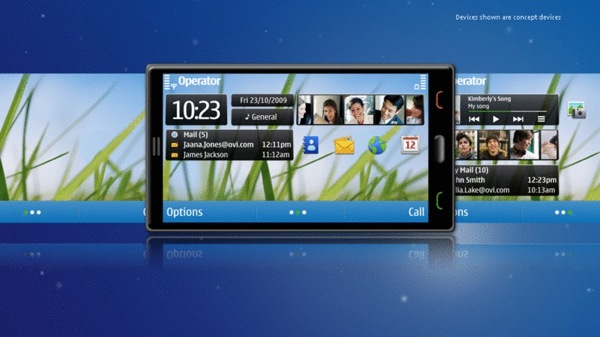
Nokia’s promise to overhaul the Symbian UI yesterday was heavy on stats but light on screenshots, but thankfully the company’s webcast is fair overflowing with concept renders. The Finnish company has promised not only to make the UI more attractive – by cutting out clutter and upping scrolling rates from 15fps to 60fps – but more functional too, slicing out the number of taps required to complete tasks or launch features, and giving users “large capacitive displays” to do that tapping on.


It’s probably too much to expect the slick concept device Nokia’s designers have thrown together to be anything like what the company have on the drawing boards, but we certainly wouldn’t argue with a keyboard-free capacitive version of the N900. One of the biggest changes, Nokia claims, will be removing some of the more frustrating user prompts, and with 350 of them that’s a decent move toward a less-frustrating owner experience.

In the end, we’ll have to see exactly what Nokia come up with on shipping devices; we’ve seen concept videos and mock-ups before, but there seems to be something stopping those excellent ideas from transitioning to production handsets. Still, with two “major product milestones” on the cards for 2010, and the UI project underway, Nokia don’t look to be taking their flattening market share lying down.


Read More

Wednesday, December 02, 2009

Nokia promises to take "Symbian user interface to a new level" in 2010, Maemo 6 in 2H


It's Nokia Capital Market Day again which means that the boys from Espoo are fawning over investors and giving them a reason to stick around in 2010. And you know what? It sure sounds promising for gadget nerds. Why the optimism? Easy: Nokia is hell-bent on redefining the user experience of its Symbian devices. To quote CEO, Olli-Pekka Kallasvuo, "In 2010, we will drive user experience improvements, and the progress we make will take the Symbian user interface to a new level." To bolster this proclamation, the very first bullet point listed under Nokia's Devices and Services operational priorities is "improve our user experience" -- something that would thrill us to no end if it happens.

The revamped Symbian UI is set to deliver on two "major product milestones" in the first and second halves of the year. Nokia will also deliver its first Maemo 6 "mobile computer" in the second half of 2010 flanked by a significantly increased proportion of "touch and/or QWERTY devices" in its smartphone portfolio. It's worth noting that all the discussion is around Symbian, just a single mention of Maemo and its "iconic user experience" in the forward looking press release. Developers will be happy to hear that Nokia will also continue to scale services geographically while continuing to enhance its developer tools like QT4.6 announced yesterday. Financially speaking, Nokia expects to see the erosion of its average selling price slowed compared to recent years. That's good as Nokia attempts to grow its margins. However, while Nokia expects mobile device volumes to be up approximately 10% in 2010 across the industry, it sees its own mobile device volume market share as flat in 2010, compared to 2009.

Be clear on this though: our incredibly frustrating S60 5th user experience was by far the biggest complaint we had when reviewing Nokia's flagship N97 -- having the most bullet points on a list of features is not what it takes to lure consumers anymore (if ever). If Nokia can better the best in class experiences carved out by Apple, Palm, and HTC with its Sense UI then consumer mindshare, and our hearts, will follow.
Read More

Friday, November 27, 2009

Should Nokia Abandon Symbian S60 for Maemo Linux?

Nokia has a problem: it is both the largest handset vendor in the world, by a significant margin, and the largest smartphone vendor in the world – again, by a significant margin. Yet it has never managed to crack the U.S. smartphone market, and it has begun losing market share even in its European strongholds, primarily to Apple, though RIM, Samsung, and HTC are also threats. Nokia admits that it was caught sleeping while Apple first redefined the mobile user experience with the iPhone, and then again when Apple reenergized app development with the App Store. Nokia’s initial response has been lackluster: adapting its existing Symbian S60 OS to support touch, applying that to a few phones (the 5800 and the N97), and stumbling in its initial launch of the Ovi Store.

Despite shortcomings in Symbian S60 (where apps and settings are located appears to have been chosen at random) and a wildly inconsistent touch experience, the 5800 and N97 have sold over 10 million units. Nokia has sold well over 100 million Symbian S60 phones overall, which puts it in a classic case of what Clayton Christensen calls the Innovator’s Dilemma: Nokia’s existing customers are happy with S60, so Nokia has resisted cannibalizing it. However, the iPhone may have launched without 3G or corporate email, but Apple keeps adding features with each new version, so when S60 users are ready to buy a new phone, they are increasingly picking one from Apple or one of Apple’s competitors. (It is also worth noting that arguments against cannibalizing S60 can only be made for Europe – in the U.S., S60 has never had any traction whatsoever.)

The solution to the Innovator’s Dilemma is to fund skunkworks development or a spin-off that attacks the new technology on its own terms. While initially planned as a way to get Nokia’s feet wet in open source software, Nokia does have another OS, Maemo Linux, that it has been quietly using for its line of Internet tablets (770, N800, and N810). At Nokia World in early September, Nokia announced Maemo 5 and the N900, the first Maemo phone. When I first saw Maemo 5 demonstrated just ahead of Nokia World, my first reaction was to question why Nokia would limit Maemo to pricey, high end devices. After all, S60 isn’t competitive, and Maemo looks really, really cool. Why not just kill S60 and switch to Maemo?

After playing with a production N900 for the past couple of weeks, I have discovered the answer: Maemo is nowhere near ready for mainstream consumers.

There was reason for my initial optimism: the OS has power to spare; it is basically a desktop Linux system in a tiny package. Maemo can handle multiple live apps minimized to little cards (similar to Palm’s webOS); the browser is unadulterated Mozilla code and includes support for a full implementation of Flash 9. The N900 has a high resolution 800×480 screen, TI OMAP3 (Cortex A8) processor, 32 GB flash storage plus an empty microSD card slot, forward facing VGA camera, and 5 MP camera on the rear with dual LED flashes and Carl Zeiss branding. There is a sliding physical QWERTY keyboard, and, for watching media, a pull out kickstand. The N900 has WiFi, quadband GSM and Triband HSPA 900/1700/2100, making it perfect for T-Mobile’s 3G network in the U.S.

Unfortunately, the whole is much less than the sum of its parts. The user interface is maddeningly inconsistent and opaque, and while you can learn to live with its quirks after a while, why should you have to? Nearly every mobile OS does a better job of making it easy to navigate; the iPhone is the easiest (at the expense of efficiency) and Palm’s webOS is the most elegant. Nokia needs to add hard buttons or dedicated screen real estate for navigating and launching options menus. For example, touching the top left corner is usually the “go back” area. Except when touching the blank space in between app tiles backs you out. Except when you’re in a web browser, and a link is occupying the top left, then there’s really no way to get back at all without first minimizing the view. The resistive touchscreen is another problem – even when you push in the right spot, it doesn’t always register. I find myself repeatedly pulling out the stylus, and that should simply never happen on a modern smartphone.

There are no SEND or END keys (Motorola’s DROID has this problem, too), and there is no permanent place for the soft keys – depending where you are in the UI, it can be awfully hard just to find the dialer. This is the first phone I have used in a while where making a phone call isn’t just a secondary use case, but is barely a use case at all.

Web browsing is good, though navigating around a web page is not as smooth as Apple’s Safari. Still, this is one area where the N900 can do things no other phone on the market can do, at least until Adobe rolls out Flash 10 support broadly next year. YouTube videos play smoothly, and navigating around Flash-heavy sites is possible. (Theoretically, you should even be able to watch Hulu on the N900. Practically, it doesn’t work, even over WiFi – the video loads, slowly, then… stops.)

While I encountered system messages that would terrify non-technical users (do you want to update your phone’s SSL sockets? Who knows?), the N900 is better than previous Maemo Linux devices. For example, downloading and installing applications is a simple process now. But there aren’t that many apps yet, and Nokia’s Ovi Store still has a “Coming Soon” banner. Nokia is providing for cross platform (Symbian and Maemo) development with upcoming versions of its QT tools, but Nokia’s focus with developers is still on Symbian.

This leaves Nokia with some tortured market positioning: Nokia told me it is firmly committed to Symbian as its smartphone platform of choice, while Maemo will be relegated to high end devices and aimed at consumers who want more of a computer and less of a phone. The latter description fits every iPhone, Android, and webOS user (and those handsets start at just $100 after carrier subsidies). Nokia needs something better than S60 with touch. Maemo Linux could be that thing, but it isn’t yet, and it doesn’t look like Nokia really wants it to succeed broadly.
Read More

Wednesday, November 18, 2009

Nokia: Symbian death in 2012 on Nseries speculation is “completely premature”

Oh dear, it looks like someone in the Maemo marketing team had a few too many drinks last night and said something they shouldn’t have. Having heard earlier on today that Nokia were planning to ditch Symbian on their Nseries devices by 2012, the Finnish company has now issued a statement calling any such speculation “completely premature”. Symbian, they say, is about “bringing smartphones to the masses”, while Maemo is targeted at “devices based on technology that you’d typically find inside a desktop computer”.

“While it is our policy not to disclose details of our product roadmap, we’d like to explicitly communicate that we remain firmly committed to Symbian as our smartphone platform of choice. Any speculation on what our 2012 roadmap, including operating systems and product branding, are completely premature.

As we have stated earlier, Nokia has multiple platforms to serve different purposes and address different markets. Symbian is more successful than ever in bringing smartphones to the masses. Maemo is our software of choice for devices based on technology that you’d typically find inside a desktop computer. It delivers a different user experience and enables us to widen the market we can address.” Nokia statement

While at first glance the statement appears to disagree with the earlier speculation, there are still a few wriggle holes in place. Nokia have already gone public regarding their intention to filter S60 down through the ranks of devices, just as S40 did before it, catering for different and evolving user models in an ever-maturing user ecosystem. In its place will come Maemo, though they’ve also been open about the fact that, in its current form at least, the OS is targeted more at enthusiasts than the mainstream.

So, calling the death of S60 as a smartphone platform might be “completely premature”, but that doesn’t mean it’s not accurate; it just means Nokia don’t want to talk about it today. Will Maemo be consumer-friendly by 2012 and ready to take up position in Nseries handsets? We’d certainly expect so.
Read More