Showing posts with label Apple iPad. Show all posts

Saturday, February 13, 2010

App Store Now Has 150,000 Apps. Great News For The iPad: Paid Books Rule.

During Apple’s iPad event in January, CEO Steve Jobs announced that Apple now had over 140,000 apps in the App Store (along with over 3 billion downloads). If the numbers by app analytics company Distimo are correct, that number is now past 150,000.

But the App Store is growing so big, so quickly that these milestones alone are hardly noteworthy anymore. But Distimo also offers up some nice data along with the milestone number. For example, of the 150,000 apps, some 75% are paid applications while only 25% are free. This is in stark contrast to the second largest app store, Android Market, where recent data suggests that over 60% of the app there are free.

Something else that’s very interesting is that the highest percentage of apps in the App Store are now paid book applications. In total, there are over 27,000 book apps in the store, and of those 92% are paid apps, according to Distimo’s data. That number bodes very well for Apple’s soon-to-be-released iPad, of which a big selling point will be the new iBooks application. There has been a lot of talk about how the iPad won’t hurt the Kindle because the Amazon device’s e-ink makes reading more enjoyable. And while it’s true that e-ink is easier on your eyes (thank a backlit screen), it seems that iPhone owners simply don’t care — again, great news for the iPad.

In terms of overall app numbers, games still rule, with over 28,000 of them in the store. But a much higher percentage of those are free versus the percentage of free book apps. All told, both games and book are far and away the two most popular categories in the App Store, with entertainment in third with just over 20,000 apps. And the numbers drop quickly from there. Education is the fourth most popular category, but that means only 10,000+ apps.


Read More

Thursday, February 11, 2010

What if…Apple only offered the 64GB/3G iPad and sold it for $499

Even though the iPad is still more than a month away from shipping, iSuppli conducted a preliminary itemized parts breakdown. The results aren’t that surprising: Apple’s making a boatload on these things. iSuppli concluded that the $499 16GB/no 3G model only costs $229 to manufacturer with the $829 64GB/3G model costing only $117 more to make even though it carries a $329 premium. Nice, eh?

These numbers can be broken down even further showing Apple’s insane margins. The 3G module only costs $24.50, but Apple charges $129 more for the option. The NAND memory chips are really the only difference between all three options, but their real costs of $29 for 16GB, $59 for $32GB, and $119 for 64GB are nowhere near proportionate with the iPad’s prices. All this data shows that Apple’s abandoning its long-held K.I.S.S. strategy.

So what if Apple got back on the keeping it simple bandwagon, only offered the high-end 64GB with 3G iPad and still sold it for $499? After all, the company would still be making at least $153 on each iPad sold. Would that turn around the iPad’s outlook?

The vast majority that participated in our poll the other day said that the iPad needs a lower price, specifically $349 for the base model. That clearly shows people are not satisfied with what the iPad offers at its $499 price point when it only offers 16 GB of storage and without the 3G wireless option along with a host of other letdowns such as lack of USB, SD card inputs, and multitasking. Surely if the iPad were only offered in a 64GB/3G kit, at least more would be able to look past some of the other transgressions.

In fact this model structure of six different options for the same device is new for Apple as of late. Previously Apple was known for its no nonsense approach of just a high-end or low-end option. (MacBook or MacBook Pro, iMac or Mac Pro) Now consumers have to decide not only how much extra they want to spend for storage, but also if they want to spend $130 more for 3G access.

GPS units are known for this type of rubbish. There might be a dozen different models available, but each step up only adds one or two slight software or hardware change that’s a nominal cost difference, but seems to be enough justification for the gradual price increase up the model line. Only the iPhone and iPod touch share this type of pricing structure, but even though they share a lot of the same parts, their core functionalities are different, justifying the difference. That can’t be said about the iPad, where a unit without 3G will be severally limited compared to one with the option.

Maybe Apple doesn’t need one iPad option priced at $499, but rather only two with both offering 3G access, since it isn’t tied down with a wireless contract anyway. Offer the 32GB option for $399 and then the 64GB one for $549. Something needs to change as clearly consumers aren’t thrilled with the iPad’s current pricing, and now that the whole world can see that Apple is downright robbing buyers of the high-end model, that perception will not improve. Apple, get back to your roots and keep it simple, stupid.
Read More

Wednesday, February 10, 2010

Hulu Could Still Launch On The iPad

When Steve Jobs unveiled the iPad last month, one notable potential partner absent from the stage was Hulu, now the second-largest video site on the Web. The launch event focussed more on the iPad as an eBook reader to rival the Kindle, but watching videos on it will be just as important. The TV shows on Hulu would be perfect on the iPad. There is just one hitch: the iPad doesn’t support Flash, and all of Hulu’s videos currently run inside a Flash player.

But that could change by the time the iPad launches in March. One rumor I’ve heard from an industry insider is that Hulu is working on an iPad-friendly version of its site that should be ready by the time the iPad hits the market. Hulu itself is still vague about its plans. When asked directly by Om Malik whether Hulu has any plans for the iPad, CEO Jason Kilar recently hemmed and hawed about how he is a big believer in mobile, but wouldn’t confirm or deny anything.

Putting Hulu on the iPad boils down to a business decision, not a technical one. Getting Hulu to work on the iPad would not take as much work as some might expect. The biggest challenge to getting a large video library to play on the iPad (or iPhone) is to convert the underlying video files to the H.264 standard. Fortunately for Hulu, its videos are already encoded in H.264 and have been since the summer of 2008. So it doesn’t have to go back and re-encode all of its videos. But on the front-end, it would have to create a non-Flash player (Flash plays videos encoded in H.264 as does the Quicktime player on the iPad and iPhone).

Getting Hulu’s videos to play on the iPad is not that big a deal. They could just do what YouTube does and pop open the Quicktime player when a viewer tries to click on a video in their browser. But making people switch applications every time they want to watch a video isn’t the best experience. Hulu could rectify that in two ways: build a custom iPad/iPhone app with its own player, or rewrite its site in Javascript for the iPad/iPhone browser.

Here’s where things get a little tricky. Hulu’s familiar look and feel is all built into its custom Flash player. It would have to try to reproduce that as much as it can using HTML5, and it might not look as good (for more on HTML5 Vs. Flash and the future of mobile apps, read this post). More importantly, all the ads that run on Hulu are designed for Flash, especially interactive ads like overlays. The ad code, business logic, and underlying analytics would all have to be rewritten for a Javascript player. Frankly, this is the biggest hurdle.

So porting Hulu to the iPad is not completely trivial, but Hulu has a large engineering group (including a group in China) more than capable of doing the work. The question is, with more than a billion streams a month and growing via the good ol’ Web and Flash, is it worth it to put engineering resources just for the iPad. At this point, the iPad needs Hulu more than Hulu needs the iPad.


Read More

Bill Gates on the iPad: "It's a Nice Reader, But..."

Bill Gates doesn't seem very impressed with the iPad. Sure he's throwing out some nice compliments to Apple, remarking about how great the iPhone is, and all that. But beneath all the pleasantries, he's pretty much dismissing the product.


You know, I'm a big believer in touch and digital reading, but I still think that some mixture of voice, the pen and a real keyboard – in other words a netbook – will be the mainstream on that.

Youch. Of course, as AllThingD's John Paczkowski remarks: Bill Gates has made similar remarks in the past. In fact, when the iPod first came out he was noted as saying that "there's nothing that the iPod does that [he would] say, ‘Oh, wow, I don't think we can do that.'" Deja vu. [BNET via All Things D]
Read More

The iPad Costs Apple As Little As $229.35 to Build


The $500 16GB, Wi-Fi only iPad costs Apple less than half that to build, according to a recent component breakdown from iSuppli. And for the 64GB 3G iPad, Apple clears nearly $500 in profit. Here's how it breaks down:

Apple iPad Estimated Bill-of-Materials and Manufacturing Cost Analysis:


This will no doubt be updated once iSuppli and others are able to do a teardown of an actual device, but those estimated profit margins are pretty stunning, particularly on the higher-end models. iSuppli also points out that the 32GB versions of the iPad only cost $30 more to make than their 16GB counterparts, yet retail for $100 more—a good indication that that's where they expect the sweet spot to be in the market.
Read More

Tuesday, February 09, 2010

Apple Job Posting Hints at Webcam in Future iPad

We all know the iPad is eventually going to gain a camera at some point. (Apple’s iPhones, iMacs, MacBooks and iPod Nanos have cameras, so why not?) The better question is when? An Apple job listing suggests not too soon.


Apple has posted a job listing seeking a performance and quality-assurance engineer for the “iPad Media” division to test still, video and audio capture and playback. Sounds like a webcam for video conferencing.

“Build on your QA experience and knowledge of digital camera technology (still and video) to develop and maintain testing frameworks for both capture and playback pipelines,” the posting reads.

The iPad’s lack of a camera is near the top of critics’ lists of complaints about Apple’s new device. Wired.com’s Charlie Sorrel believes Apple omitted the camera in order to hit the surprisingly low $500 starting price of the iPad. It appears evident from this job listing, however, that Apple is planning to include a camera in future generations of the iPad (perhaps the second-gen). Another clue was the appearance of a “Take Photo” button in the iPad’s Contacts app.
Read More

Monday, February 08, 2010

Apple iPad Prices Could Change

Well, well, well. According to a report in the Wall Street Journal today, Apple management is going to remain "nimble" in iPad pricing if sales start off slow. Hey, wait a minute—are you thinking what I'm thinking?

The scoop originates from a Credit Suisse analyst, who apparently met with Apple executives recently to discuss all things tablet. In addition to the execs pitching how the iPad wouldn't cannibalize Apple's other product lines, they outright stated that they'll adjust pricing if they have to:

"While it remains to be seen how much traction the iPad gets initially, management noted that it will remain nimble (pricing could change if the company is not attracting as many customers as anticipated)."

This actually isn't all that surprising, if you think back to the iPhone's launch in 2007 and the dramatic $200 price cut that followed just a few months later. That caused sales to surge 200% and garnered no small amount of publicity for the new device.

Bottom line: I don't exactly have $500 to $830 burning a hole in my pocket to spend on a first-gen device. So spread the word! And for goodness sake, stay strong and don't buy an iPad. Yet.

[WSJ]
Read More

The iPad Tweet That Enraged Steve Jobs?

There was inevitably some cultural friction when Apple's secretive CEO took his new iPad around to New York's professionally indiscreet media. Exhibit A is a single tweet from a Wall Street Journal editor, which purportedly made Steve Jobs go ballistic:


The Journal's online executive editor Alan Murray quickly deleted the Feb. 4 tweet, which, it is now obvious, was issued during Apple CEO Jobs' show-and-tell with select Journal staff. A tipster told us the deletion ultimately traces back to a furious Jobs. We asked Murray for comment, and he wrote back "I would love to talk about this, but can't." In a later email, he added:


I will say that Apple's general paranoia about news coverage is truly extraordinary— but that's not telling you anything you didn't already know.

Indeed, Apple is a notoriously tight-lipped company, particularly under Jobs, and is constantly trying to control the flow of news about its product. Apple sued a teenaged blogger who published scoops about unreleased products; it lied about Jobs' health problems; Jobs called a New York Times columnist a "slime bucket" for writing about said health problems; and an employee of key Apple contractor Foxconn had his apartment illegally searched after losing an iPhone prototype (he later committed suicide amid intense pressure from his employer).

If Jobs did give Murray a tongue lashing — his withering verbal abuse is infamous — the editor can console himself with the knowledge that this is is an especially touchy time of year for the paranoiac. And not just because of the pressures of shepherding and unveiling a new product.

At Jobs' meeting at the Times, the CEO was mostly on point, painting a utopian picture of happy future world awash in iPads. But at one juncture in the meeting, we hear, he took a detour, telling assembled newspaper staff that he gets tons of hate mail from people whenever he launches a new product — people who have never even used it, including angry Apple "fans." Jobs reportedly described the mail as "really nasty stuff... [things] like 'Fuck you and your family.'"

It sounds like Jobs has been fighting this sort of backlash his whole career, judging from this 1994 Rolling Stone interview:

"I've always been attracted to the more revolutionary changes. I don't know why. Because they're harder. They're much more stressful emotionally. And you usually go through a period where everybody tells you that you've completely failed."

Of course, "fuck you and your family" sound less like fanboys than regretful stock speculators. That's the sort of e-note to go ballistic over.
Read More

Saturday, February 06, 2010

iPad hype drives away consumers, survey says

Sky-high expectations blamed as would-be buyers decide they don't need iPad

When the over-the-top hype met the reality of Apple's iPad, a majority of consumers decided they didn't need, and wouldn't buy, the new device, according to a survey published today.

"There was too much hoopla," said Manish Rathi, co-founder of Sunnyvale, Calif.-based online retailer Retrevo, which conducted two polls of more than 1,000 American consumers each -- one before the iPad's Jan. 27 unveiling, the other after. "There was so much [hype] that afterward, people were underwhelmed because they expected it would slice bread."

Retrevo's two surveys spotlighted the before-and-after differences in consumers' attitudes toward the iPad. Before Jan. 27, 26% of those polled said they had heard of the iPad but weren't interested in buying it; that number doubled to 52% after Apple CEO Steve Jobs took the stage in San Francisco and unveiled the iPad.

"That was the biggest number," said Rathi. "When the product came out, more than half said 'I don't need it.'"

There was a silver lining for Apple in the survey results: The percentage who said they would buy one tripled from 3% before the announcement to 9% after.

"But 52% is a pretty large number," cautioned Rathi. "It's not what you'd expect from the media hype that was delivered." That was one reason why Rathi joined others in arguing that the iPad would not do what the iPhone did: revolutionize a product category. "I don't see this as a game-changer," he added.

Rathi said there was lots of blame to go around for the increase in consumer "no" votes: lack of support for Flash and multitasking, lack of a killer application, and the $130 surcharge for an iPad that includes 3G connectivity. But he credited the preannouncement hype for most of the upturn in negativity. "It just seemed underwhelming to a lot of consumers," he said.

More troubling for Apple, said Rathi, were the results from another survey question asked before and after the iPad's appearance. When asked "From what you've heard about the tablet, do you think you need one?" 49% answered "No" before Jan. 27. After the iPad event, however, the number ballooned to 61%.

The percentage of those who answered "Maybe" remained flat, while the "Yes, definitely" votes increased from 3% before to 5% after.

Rathi interpreted the 49%-to-61% change as evidence that Apple has lost the battle to convince consumers that they need a device between a smartphone and a laptop. "Consumers are saying, 'All it offers, I can already do,'" said Rathi. "There's just no killer app that goes on the tablet."

In addition, Apple's decision to add a $130 surcharge on 3G-capable iPads didn't make it many friends. According to Retrevo's polling, 59% of respondents wouldn't pay the extra money for 3G; only 12% said they would fork over the $130. Others have called the higher cost "ridiculous" because the necessary parts cost Apple less than $20.

Rathi said he believes there is more to it than the $130 that buyers would have to pay Apple. "There's also an overwhelming discomfort with signing up with another data plan," he said.

Retrevo also asked consumers if they saw the iPad as a replacement for an e-book reader or netbook. About 30% said they would consider the iPad as an e-reader replacement, but less than 20% said the same for a netbook. The latter is no surprise: Even though Apple touted a reworked iWork suite for the iPad, analysts quickly dissed the tablet as a substitute for a true netbook, citing the device's lack of multitasking and its price as factors.

Overall, said Rathi, the surveys' results point out that it's unlikely Apple will reinvent the tablet category, as it did in the smartphone market with the iPhone. "We asked people if they were planning on standing in line for an iPad, and the results weren't statistically interesting," Rathi noted. "This will not be in line with the iPhone launch. And that opens the gate to others -- the Androids and the Sonys and the Microsofts of the world."

Apple has said it will start shipping Wi-Fi-only iPads late next month. It is not yet accepting preorders, because it is awaiting approval from the Federal Communications Commission for the device, a prerequisite to sales.
Read More

Wednesday, February 03, 2010

Is this how gamers will use Apple's iPad?

I would rather eat someone else's rain gear than play video games for 10 hours a day. But I will defend the right of everyone to play, as long as they aren't getting on my nerves on an airplane.

So while I know that many have focused their enthusiasm for Apple's new iPad on drooling over its potential as a device for consuming books and movies, below is some footage that might make gamers feel somewhat tingly, too.

I was directed to this Warcraft III video by Cody Brown, an NYU Social Entrepreneurship undergraduate and founder of Kommons.com.


And though this might all seem very normal to you, every time I saw the man in this film punching the screen as if he was playing Whac-a-Mole, I wondered whether the iPad's build could stand such an idiosyncratically charming display of violence.

Saturo Iwata, Nintendo's president, has dismissed the idea of the iPad as a gaming device.

However, watching this mesmerizing display of digital dexterity, I wonder whether airports, doctors' waiting rooms and, who knows, Golden State Warriors games might soon be full of fingers dancing across screens like ants on coke.
Read More

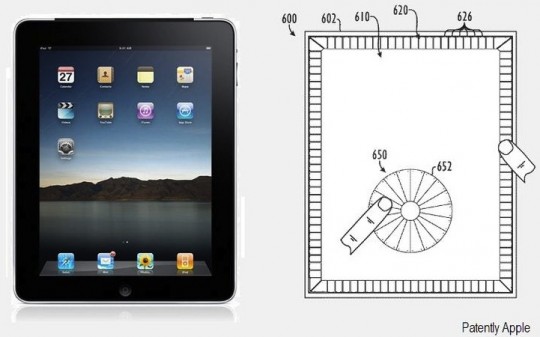
Apple patent suggests iPad bezel touch-controls

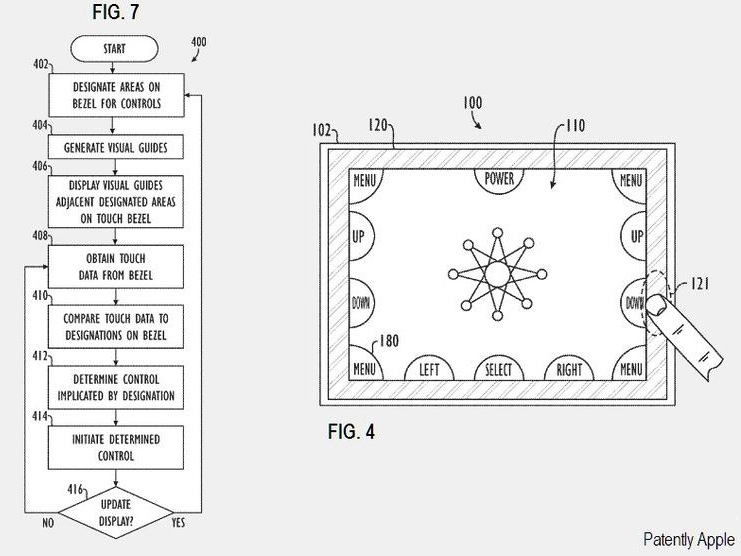
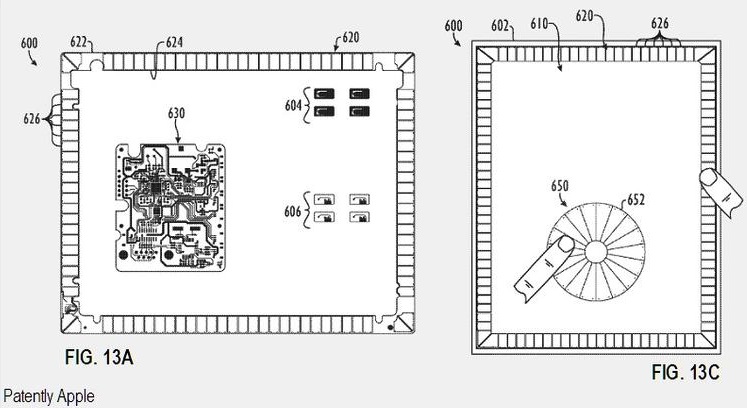
The broad bezel around the iPad’s touchscreen led some to criticize Apple’s industrial design last week, but judging by a recently published patent the Cupertino company may have plans for that empty expanse. A system whereby capacitive touch sensors are embedded in a tablet or digital photo frame screen bezel is described, linked to various contextual controls shown around the edges of the display. That way, the device can have minimal hardware controls on the fascia, and instead make use of dynamically resizable on-screen controls suited to whatever the current application.


Since another pretty important function of the bezel is to give a user somewhere to grip onto the iPad, Apple’s patent also includes technology to discriminate between input and mere contact. This could either be based on length of touch – if you grab an edge and use it to hold the tablet, after a brief period the iPad ignores that area of contact – or by selectively turning off sections of touch-sensitivity based on the orientation of the iPad.

Meanwhile the controls – and their on-screen labels – would automatically rotate to suit any rotation of the tablet itself, and there could be links between on-screen controls and where the user is touching around the edge of the display (e.g. calling up a volume wheel by tapping a certain corner of the bezel, and then changing that volume by drawing a finger around the on-screen wheel). While we’d love to see something like this in the first-gen iPad, we don’t imagine there’ll be capacitive strips to be found during the inevitable iPad teardowns.


Read More

Tuesday, February 02, 2010

Microsoft Could Make the iPad a Great Business Tool

Apple has made a bone-head play that damages the iPad's potential for business. But, Microsoft, believe it or not, could come to the rescue. Here's why:

Apple put iWork--not a great tool to begin with--on the iPad. It's better than nothing, but while iWork can read Microsoft Office formats, it can't be set to save DOC files by default. What a mistake. While Apple's home and student customers may be fine with this annoying limitation, business users can't be endlessly exporting documents to share with colleagues and customers. Unless Apple makes this important change to iWork on the iPad, the forthcoming tablet will be a good device to view written content, but will fall flat when it comes to creating it.

But suppose Microsoft (hold the boos, please) decided there was money to be made here, and created a version of Office for the tablet? Given the relative lack of storage and so on, iPad Office couldn't be full-featured, but since most of us only use a fraction of Office's capabilities, that wouldn't be a show stopper. In fact, we'd have a device that would be useful for small business, and would probably cut deeply into sales of netbooks.

Apple has some additional work to do as well. If the iPad is to become the super-light computing device of choice, it has to support a full-featured browser, and that means supporting Flash. Whether Apple likes it or not, Flash is ubiquitous, and going to a Web site and getting that annoying error message and chunk of blank screen is a bummer.

Google Docs and ZOHO: Online But Not Offline

Am I serious about Microsoft stepping in? Yes, it would be a great idea, and it would make money for Microsoft. But I'd be surprised if Ballmer & Co. had the imagination to make that move. So, I don't expect it to happen, at least not immediately.

But there are alternatives, albeit limited, you can likely use as soon as the iPad hits the stores.

Google Docs would probably run fairly well on the iPad, but there are two caveats. The first has to do with screen real estate, the second with Google Gears.

When the iPad is in the editing or writing mode, a virtual keyboard pops up, making it hard to see the tools you need to write and edit a document. You might be able to work around this issue, but it would certainly slow you down.

More serious, I think, is the lack of support for Google Gears, which is necessary to run Google docs offline. Without that capability, there's no way to work on documents on an airplane, for example, which is a mighty big downside. When Google and the somewhat similar ZOHO are used offline, they can later be synched with the cloud versions, ensuring that you have the current versions of your documents. (Thanks to Harry McCracken of Technologizer for mentioning these points to me.)

ZOHO also needs Google gears to work offline. However, since the Safari browser already supports parts of the developing HTML 5 standard, it shouldn't be too long until ZOHO, and likely Google, will work offline on the iPad, says Raju Vegesna, ZOHO's chief evangelist.

HTML 5 is expected to reduce or even eliminate the need for the many of the plugins needed today by browsers. Indeed, HTML 5, which is strongly backed by Apple, should ultimately make the Flash-support issue disappear, Vegesna says. But how long that will take is unclear.

QuickOffice and Roambi Could Help

Then there's QuickOffice, a nifty little app that runs on the iPhone and a number of its competitors. It gives basic editing capabilities to use with Word and Excel documents, and allows you to view (but not edit) PowerPoints.

Clearly, that's not the way you want to work all the time, but I find QuickOffice helpful even when used on the small iPhone screen. It should be quite a bit better after the company tweaks its app to take advantage of the comparatively huge iPad. That should happen by the time the tablet reaches consumers, the company told me on Monday.

Roambi produces colorful charts and graphs from your spreadsheets and business intelligence reports, making complex data readable on the small iPhone screen, so it should work on the iPad. The processing occurs on Roambi's secure server. Like QuickOffice, it is available from the iTunes app store.
Read More

Monday, February 01, 2010

Windows 7 Running on the Apple iPad via Citrix

Trumpets playing, bloody moons, seas of fire, cats cohabiting with dogs, and Windows 7 running on the Apple iPad right on the day it launches. That's how the Universe ends, my dearly beloved, and you can blame Citrix for it:


It turns out the 9.7 inch display on the iPad with a 1024x768 screen resolution works great for a full VDI XenDesktop. Windows applications run unmodified and securely in the data center, and even multiple applications at once.

The iPhone restrictions of screen size and small keyboards are overcome with the iPad. The iPad looks to be an ideal end-point device that can empower users to be productive wherever they are and IT will be able to safely deliver company-hosted virtual desktops and apps without worry.

Those are the wet words of Chris Fleck, the vicepresident of virtualization and remote software company Citrix. And what you are seeing above is Windows 7 running on the iPad SDK simulator, thanks to Citrix Receiver and XenDesktop 4—running meaning that it's executed on a server and remotely displayed on the iPad at full resolution.

Fleck sounds excited on his blog, and points out that the software will be ready for the launch of Apple's JesusTablet. Personally, I can't wait for other remote desktop applications to be adapted for the iPad full resolution.

[Citrix via PC World]
Read More

Apple rumored to be working on another larger tablet, possibly based on Mac OS X

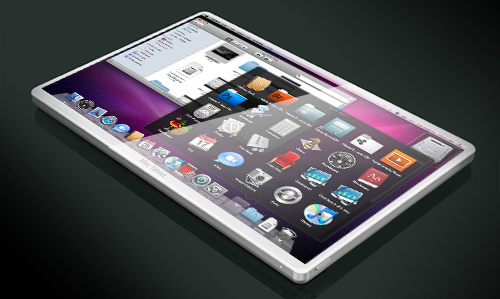
Those wanting to get their hands on an iPad have a 60 day wait starting from last Thursday, but a rumor has surfaced that Apple is said to be developing a more advanced tablet model. The new model is said to be much larger in dimensions, and more likely to run software akin to Mac OS X instead of the iPhone OS. Oh, and it would launch within the year. iPad buyers may possibly want to wait this out.


According to MG Siegler over at Techcrunch, he’s corroborated some of the main details with several sources, although like every other piece of juicy news, this also should be taken with a grain of salt.

This is one of the problems I have with the iPad – the iPhone OS is limited in the sense that it can only run stripped down apps ported from the iPhone/iPod Touch, and even further development solely for the iPad still would reek of such. With some version of the Mac OS X, an Apple tablet could be more than a half-baked idea, as it is now with the iPad.

[via everything iPad]
Read More

War of Words Between Apple and Adobe Heats Up

There's been no love lost between Apple and Adobe for a while now, ever since Apple decided to not allow Flash on the iPhone. But since the iPad was announced with an equal lack of Flash, things have gotten ugly.


First, Adobe posted a screed about how lame it was that Apple wasn't including Flash on the iPad. Then, Steve Jobs himself called Adobe "lazy" and blaming Flash for most Mac crashes. Now, Adobe is back to its Flash blog with another salvo.

First, they address and attempt to debunk the various reasons Apple has for blacklisting Flash. Then, they go for the heart of the matter:

But I want to be very clear. My concern isn't just about Flash on the iPad. It's about a disturbing trend where Apple is starting to inhibit broad categories of innovation on their platforms. On the iPad, it looks like developers won't be able to write applications in Java, .net, Python, Ruby, Perl, or any number of other languages (including Flash). And users won't be able to install Firefox, Opera,IE, or any third party browser. There are countless other examples of applications and technologies that Apple doesn't allow. Why? Apple won't say.

And innovation isn't just about technology, it's also about business models. Developers on this new platform aren't able to innovate there either. At best, developers targeting the iPad are subject to a 30% Apple Tax in the App Store. And at worst, developers invest time and money building a product that can never be brought to market, because the only channel is one that is centrally controlled and entirely opaque. In every case, Apple is a gatekeeper on how developers are able to deliver content to their consumers.

Over time, restrictions on technology and business opportunity have a chilling effect on innovation on closed platforms.

In the end, this is a tricky situation. On the one hand, Flash is a relatively insecure and resource-heavy plugin that would invariably cause some problems if used on the iPad. In a year or so, HTML5 will be replacing it for most of its biggest uses, such as streaming video.

However, it isn't a year from now, and Flash is still heavily used all around the web. It's just a fact of life that if you want a full internet experience right now, you need to have Flash.

So neither side is entirely right or entirely wrong. But something tells me that Apple isn't going to cave, and as HTML5 gets rolled out over the next year, they'll have fewer and fewer reasons to even consider it. Sorry, Adobe.

[Adobe]
Read More

Sunday, January 31, 2010

Steve Jobs: Google's "Don't Be Evil" Mantra is "Bulls***"

During that Apple town hall meeting we mentioned earlier this week CEO Steve Jobs reportedly had some choice words regarding Google that left little doubt about how the outspoken executive sees the competition. Updated.

That "Don't be evil" slogan Google's known for? "Bullshit" Jobs said, after which he was reportedly rewarded with a big round of applause from the gathered throng of Apple employees.

Also about Google, Jobs said that company "entered the phone business. Make no mistake they want to kill the iPhone. We won't let them."

Jobs also singled out Adobe, calling the company "lazy" because, in his opinion, "they have all this potential to do interesting things but they just refuse to do it." Jobs also criticized Flash for being buggy. When a Mac crashes, it's usually because of Flash, he reportedly told the crowd. "The world is moving to HTML5", he said.

Reports that the town hall meeting was adjourned with a gavel that made a loud Bing sound were completely fabricated and made up by me just now.

Update: Mac Rumors and Daring Fireball have an update on this. Most of Wired's quotes are paraphrased, and with that came some discrepancies between what may have been said and what was written to page. One change being "bullshit" was probably more along the lines of "full of crap." So, same sentiment, different word choice. Also, while the lazy quote hasn't been disputed, the tone may have been. Daring Fireball's John Gruber said an attendee wrote to say Jobs was actually very nostalgic about the "kick ass Adobe of old."

Update 2: We're now learning that the next iPhone update with be an "A+ update" (which probably means "substantial," but that's no surprise). Furthermore, on that front, the updates will be such that Google/Android "won't be able to keep up" with them (meaning competition lit a fire, perhaps?).

Other juicy tidbits:

- The Lala folks are probably destined for the iTunes team
- The Macs for 2010 are "going to take Apple to the next level" (???)
- And, Blu-Ray software "is a mess," and Apple will continue to keep its distance until sales take off

[Wired]
Read More

Why My Mom’s Next Computer Is Going To Be An iPad

The Internet is a funny place. After Apple announced its new iPad, I cringed at the hate being directed its way on sites such as Slashdot and Digg. Even the guys at Penny Arcade, whom I normally agree with, said “that iPad presentation had to be the worst thing I’ve even seen on on the Apple stage” and that Apple had failed to make a case for the device.

If you believe them, the iPad is going to be a massive flop.

Well, the unwashed masses on the Internet also predicted that the iPod would be a failure. They were wrong then, and they are wrong now.

The iPad is a computer for people who don’t like computers. People who don’t like the idea of upgrading their 3D drivers, or adjusting their screen resolution, or installing new memory. Who don’t understand why their computer gets slower and slower the longer they own it, who have 25 icons in their system tray and have to wait ten minutes for their system to boot up every day.

For what most of these people need a computer for, the iPad is perfect. It doesn’t do as many things as a “real” computer does, but the things it does do it does in a way even non-tech-savvy people can figure out, and there are far fewer ways to screw it up. So if you have managed to convince yourself that the iPad is a useless, locked-up DRM-laden failure of a ‘computer’ before even touching one, I have two words for you:

My mom.

My mother is a lovely lady in her sixties who is… well, “not computer savvy” is probably a good way to put it. I regularly have to figure out why her computer is running incredibly slowly, or why it won’t print, or any of the million other random things that happen when people who don’t live and breathe computers sit down at one daily.

The iPad is perfect for her. It does exactly what she needs. It will let her watch movies and listen to music and read books on long flights. It will make using a computer fun instead of an annoying chore.

But it also won’t allow her to install umpteen news and weather gadgets that start up on boot and slow her computer to a crawl. It won’t suddenly forget how to talk to a network, or get so confused by all of the software installs and uninstalls that you finally have to break down and reinstall the system from scratch. In other words, my mother’s next computer is going to be an iPad, and I dream of the day when I can finally throw off the oppressive chains of being the one guy in the family who knows how to actually keep a computer working.

And you know what? There are millions upon millions of people just like her out there. They outnumber us. And they finally have a chance to become productive, self-sufficient computer users instead of constantly asking family members to fix their computers or, even worse, keeping the Geek Squad in business.

No, the iPad isn’t for everyone. But I’m going to go on record as saying that, for non-computer-geeks everywhere, the iPad is going to redefine computing.

[Techcrunch]
Read More

Stephen Colbert rocks the Grammys with an Apple iPad


We didn’t think we’d see an iPad surface so soon… If you were keeping up with the Grammys, you were probably just as shocked as we were when Stephen Colbert pulled one out to present Song of the Year. And of course, the iPad’s cameo wouldn’t be complete without a little gloating from Colbert himself. “Jay Z, did you not get one of these in your gift bag? Am I cooler than you?!” Bravo, Stephen Colbert. Hit the break for a video clip.

Read More

Apple's entrance into gaming market drives consumers to PSP

Um, okay? Just days after Apple introduced its exceedingly underwhelming iPad while simultaneously attempting to convince that masses that said product was the portable gaming device they had been waiting their whole lives for, Sony's own hardware marketing honcho has come forward and extolled Cupertino's decision to finally make the gaming leap. In a recent interview, John stated the following:

"Apple's entrance into the portable gaming space has been a net positive for Sony. When people want a deeper, richer console, they start playing on a PSP."

While we can't seem to shake the suspicion that Mr. Koller is drawing links that probably don't exist (at least fully) in reality, research firm NPD does show that sales of the PSP have "nearly tripled since the iPhone went on sale in June 2007." Of course, it's not like the PSP has gained functionality, become the home of more than a few killer titles and spawned a UMD-less sibling since the heydays of '07, but hey -- who are we to question the suit?
Read More

How to make the iPad a better music device

I was at Apple's iPad launch on Wednesday, and maybe it was just Steve Jobs' reality distortion field, but I don't quite understand why the haters are piling on. A lot of PC-centric commentators are dismissing the iPad as an overpriced gadget, wondering why it's lacking features that are standard on even the cheapest notebook computers, like Flash support, multitasking, USB inputs to connect peripherals, and video outputs (HDMI would be nice). These are legitimate complaints--for a notebook replacement. But the iPad isn't a notebook replacement, and I don't think users will carry it with them on business trips. (Apple's iWork demo confused matters, admittedly.)

Instead, I agree with CNET's Ina Fried and Business Insider's Henry Blodget: this is a consumer electronics device for puttering around the house and leisure time--reading books and Web sites on the couch, showing pictures off to friends, catching up on the latest Web videos. And, yes, listening to music.

It's also a golden opportunity for Apple to fix some of the glaring shortcomings in its portable music experience. Here are five things I'd like to see the iPad incorporate, perhaps through the next update to the iPhone OS (which it uses).

Wireless sync. The iPad is not a Mac. That means it doesn't run the full iTunes client, so you can't share music from another computer over your home network. Instead, like an iPod or iPhone, you must physically connect it to the computer on which your music is stored, then wait for the music to travel over the wire. This is, frankly, absurd. If you want me to use the iPad to listen to music in my home, don't make me walk over to my computer and attach it every time I want to load some new tunes. Wireless sync would also be great for syncing other material like pictures, videos, and apps. How hard can it be? Microsoft's Zune player has had wireless sync for three iterations and more than two years.

Cloud-based music service. Even if the iPad had wireless sync, the most affordable model has only 16GB of storage. This isn't enough for most music lovers' digital collections, especially if they're going to use the iPad for other functions like electronic books and photos. So how about taking that Lala acquisition and using it? Instead of having to load music onto the iPad itself, I could sync it from my computer to Lala's online music locker service, then stream it over the Web directly to my device. Bye-bye, storage limits. Best of all, every time I update my music collection, it's updated everywhere simultaneously. This is such a no-brainer I'd be stunned if Apple doesn't make it available shortly after the iPad launches.

Music-sharing with third-party apps. There are some surprisingly sophisticated DJ apps for iPhone, like TouchDJ and DJ Mixer, that let you play two songs at the same time and mix them together like a mulitrack DJ set-up. These apps would be much easier to use on the iPad's 9.7-inch screen. But they all share one big shortcoming: they can't just play songs that you've already loaded onto your device. Instead, you have to re-load songs into the DJ apps, either from a sync application running on your computer or over a Web server. This isn't the fault of the app designers--it's a limitation that Apple places on the iPhone and iPod Touch. I hope Apple figures out a way around it soon.

Queuing. I like to play DJ. As one song plays, it sparks associations with other songs. It would be nice to be able to load these other songs into a "now playing" queue. The Zune's had this feature since its inception, but I can't do it on the iPod Touch or the iPhone--instead, I have to wait for the current song to end, then start up a new song. (And no, I don't want to do this with playlists on the computer and then sync those playlists to the device. That misses the entire point of spontaneity.)

Decent speakers (and amp). Naturally, the first thing I did with the iPad was check out its music playback. I could barely hear it, even with the volume maxed out. It's true that the room was crowded with gadget fans scrambling for their first look at the device, but even so, the speakers sounded no louder than the iPhone's. But this isn't a phone. It's also not a Mac, where music isn't the primary focus for most users. It's a consumer electronics device. It would be great if I could set it up in my living room or bedroom without having to attach it to another device. Peripheral makers might complain--iHome does great work creating audio accessories for the iPhone--but if this is truly going to be a new product category, Apple should treat it like one. Alas, I'm going to have to wait for v.2 for this feature.
Read More