Showing posts with label Featured Stories. Show all posts

Saturday, February 13, 2010

Google Buzz Privacy Issues Have Real Life Implications

Merging something designed for public broadcasting (Buzz) with something inherently private (Gmail) was just looking for trouble.

Google is -deservedly – getting a lot of heat for the fact that its latest social product has a number of privacy flaws baked into it by design.

They’ve since made some improvements to the product, but that’s not where the story ends.

Some people think the complaints are unwarranted and the issues not all that bad, while some think it’s mostly annoying and others don’t even know there are issues yet (or that Google launched something new at all). And then there those whose lives are already being impacted by the privacy loopholes in Google Buzz – and not all in a good way.

See for example this story of an anonymous woman who writes a (self-proclaimed) feminist blog, which she started after leaving an abusive marriage. (found on Hacker News)

Hint: the title is ‘Fuck you, Google’.

An excerpt:

I use my private Gmail account to email my boyfriend and my mother.

There’s a BIG drop-off between them and my other “most frequent” contacts.

You know who my third most frequent contact is?

My abusive ex-husband.

Which is why it’s SO EXCITING, Google, that you AUTOMATICALLY allowed all my most frequent contacts access to my Reader, including all the comments I’ve made on Reader items, usually shared with my boyfriend, who I had NO REASON to hide my current location or workplace from, and never did.

You can read the rest of the story in the blog post, but needless to say this woman is justifiably very angry with the Mountain View company.

Now, I’m sure some of our readers will have an answer ready. That she should have changed this setting or not have touched that one, but that would be beside the point. Which is that even with the improvements that were made to the Buzz product, Google is confusing the hell out of people here – and make some lives hell for them to boot.

Expect more stories like this.
Read More

Thursday, February 11, 2010

Microsoft plans antipiracy update for Windows 7


An optional update to Windows closes a number of hacks that counterfeiters have used to bypass the product activation technologies built into Windows 7. With the update, Windows will try to restore Windows to its proper state, as well as marking tampered versions as non-genuine copies of the operating system.

Microsoft said on Thursday that it is planning an update to Windows 7 that will close a number of loopholes that counterfeiters had used to thwart the operating system's built-in antipiracy measures.

The Windows Activation Technologies Update for Windows 7, which will be released later this month, closes more than 70 "activation hacks," according to Joe Williams, general manager of Microsoft's Genuine Windows unit, responsible for anti-counterfeiting measures. The update will also check with a server periodically to see if there are further hacks that need to be addressed, though Williams said no personally identifiable information about the user will be sent to the server.

In an interview, Williams cautioned about the dangers that come with using nongenuine versions of the operating system, citing a German study that looked at several hundred copies of Windows 7 that were posted online and found that nearly a third had some type of malware.

"We do see malicious code--everything from easily discoverable malware to keyboard recording," he said. "There's all sorts of things we've seen that puts our customers at risk and their data at risk."

The update will be available for manual download from Microsoft's genuine Web site on Feb. 16 and from the Microsoft Download center the following day. Later this month, the update will also be offered through Windows Update as an "important" (but optional) update.

Williams said the new update will remain optional and that those who choose not to install it will still be able to get other Windows updates, a position that marks a fairly sharp contrast to the once hard line Microsoft was taking against piracy.

With the first release of Windows Vista, Microsoft took an aggressive stance, shifting users it determined to have nongenuine versions of the operating system into a severely limited "reduced functionality" mode. In that mode, all users could do was access the Internet for an hour a day.

However, Williams said that Microsoft heard from customers, businesses, and governments that the restrictions were to draconian and decided to try a different approach.

In the first update to Vista, Microsoft relaxed things considerably, choosing instead to just prominently notify users that their version was not genuine.

Starting with Vista Service Pack 1, users saw their background changed to black and a message that their version was nongenuine, as well as getting a dialog box encouraging them to activate a genuine copy. One could choose to do so immediately, or, after 15 seconds, could click an option to activate later.

With Windows 7, Microsoft eased things even more, allowing users to immediately choose to deal with the issue later, although those that choose that option are notified of some of the benefits of genuine software.

Williams declined to say whether Microsoft will close any of the activation hacks with the first service pack to Windows 7, noting that the company has not yet confirmed any plans for that update. Microsoft did close a number of activation holes in Vista with the service pack to that product.

Williams said Microsoft has put much of its focused on informing customers that may have been duped into buying a PC with non-genuine software.

"We are pretty realistic," Williams said. "People who are actively pirating will try to find ways to continue to pirate."
Read More

Wednesday, February 10, 2010

The iPad Costs Apple As Little As $229.35 to Build


The $500 16GB, Wi-Fi only iPad costs Apple less than half that to build, according to a recent component breakdown from iSuppli. And for the 64GB 3G iPad, Apple clears nearly $500 in profit. Here's how it breaks down:

Apple iPad Estimated Bill-of-Materials and Manufacturing Cost Analysis:


This will no doubt be updated once iSuppli and others are able to do a teardown of an actual device, but those estimated profit margins are pretty stunning, particularly on the higher-end models. iSuppli also points out that the 32GB versions of the iPad only cost $30 more to make than their 16GB counterparts, yet retail for $100 more—a good indication that that's where they expect the sweet spot to be in the market.
Read More

Tuesday, February 09, 2010

Google Buzz Launch

Google has a problem. Despite having their hands in just about everything online, they’ve never been able to tackle what is a key part of the fabric of the web: social. Yes, they have Orkut and OpenSocial, but no one actually uses them. Okay, some people use them, but not in the meaningful social ways that people use Facebook or even Twitter. Today, Google may have just solved their social problem.

Google Buzz is easily the company’s boldest attempt yet to build a social network. Imagine taking elements of Twitter, Yammer, Foursquare, Yelp, and other social services, and shoving them together into one package. Now imagine covering that package in a layer that looks a lot like FriendFeed. Now imagine shoving that package inside of Gmail. That’s Buzz. If Google Wave is the future, Google Buzz is the present.

FriendFeed Reborn. On Growth Hormone.

Fundamentally, Buzz is a stream of status updates, pictures, links, and videos from your friends. You can “like” these items and you can comment on them. And if you use Flickr, Picasa, Google Reader, or Twitter, you can also automatically have those items imported into your stream. And Buzz will recommend items you might like based on your friends’ activity.

Yes, again, it sounds a lot like FriendFeed. But it has a critical component that FriendFeed never had prior to its acquisition by Facebook: a massive installed user base. Maybe you missed the key bit of wording above: it resides inside of Gmail. Rather than trying to build its own new social service from scratch, Google is making Buzz a key part of their email service (right below the Inbox tab) that 176 million unique visitors each month, according to comScore.


Social Curation

Buzz also wants to differentiate itself another way: social curation. As Mike wrote about the other night, the social web right now is largely a mess. There’s simply too much going on, and no one is really working to sort it all out. Google is trying to do that with Buzz by allowing you to import items from services like Twitter, but only show you the best ones. For example, Google says it will hide quick messages like “brb.” The plan is to also auto-collapse items that don’t have a lot of comment activity.

For now, this data is sadly only a one-way street. That is to say, you won’t be able to update your Twitter account from Google Buzz, we’re told. But Google seems to be indicating that this functionality will be included eventually, and that overall they’d like the product to be as open as possible. And yes, there will be plenty of APIs. But one company noticeably absent from all this talk of importing and exporting data is the 800-pound social gorilla in the room: Facebook.

The Big Mobile Social Play

Listening to Google tell it, you’d almost think Buzz is just as much of a mobile product, as a social tool inside Gmail. And it just may be. Google is heavily touting the ability to use Buzz immediately on the mobile web if you’re using an Android phone or an iPhone. The reason they’re singling out those two phones is that their HTML5-compatible browsers support location. Location is a big component of Buzz on the go because Google not only want users to update their statuses, but to tag them with where they are when they leave it.

And while Google has its own location app, Latitude, Buzz works a lot more like Foursquare in that you select places to say where you are rather than a specific coordinate. This is an extension of the Places pages in Google Maps that were launched late last year. The use of Buzz alongside these locations make them ever more powerful. You can search to see only the Buzzes written from certain places, for example.

Buzz will also work within the Maps app on certain phones (such as Android phones, but not the iPhone — at least, not yet). And it will work inside the Google Search apps on the iPhone and Android. Perhaps the coolest thing about that is that you can use the voice search functionality to speak your buzz update if you just say “post buzz” and then say your buzz out loud.

Social Issues

Some big question marks remain for Google. First of all, one big reason they’ve flopped in the past with social implementation is because they seemed to have fundamentally flawed views about what a social graph should be. For example, when they first tried to make Google Reader more social, they automatically ported over your Gmail contacts to give you friends. The problem with this was that they auto-chose people who you were in contact with often based on emails and IMs. But in some case that may be your boss, or someone else that you’re not actually friends with.

With Buzz, Google is giving users more granular controls for friend settings, but they’re still suggesting people based on your Gmail social graph, which may or may not reflect your actual desired social graph.

Also, believe it or not, there are plenty of people without Gmail accounts. Are they going to sign up and start using an email service just because of Buzz? People certainly haven’t started using Yahoo Mail just because it added social features.

The One Stop Shop

Another problem Google has had when it comes to social elements is that they’ve never really had one place to let users share all their social data. Now they have that with Google profiles, which apparently, Google Buzz will be built into. Still, because Profiles are separate from Buzz in Gmail, it might be a little tricky for some users to figure out.

Complexity

Speaking of complexity, overall it’s another issue that Google Buzz may run into. Twitter works because it’s so simple, if you have a public account, your tweets go to anyone who is following you. Buzz is not that simple. There can be public or private buzzes. The plan is to also have buzzes for enterprise and educational users. In those cases, public buzzes may only be available within your company or school, while private would still be private to other individuals in your network. You can see how the social graph is starting to get a little more complicated.

Another thing is if someone comments on one of your buzzes, it will leave the Buzz area of Gmail and go into the Inbox area of Gmail, so you know someone is talking to you. That actually sounds pretty cool, and even better, you can reply right from there (another feature taken from FriendFeed), but I could also see that getting a bit confusing for some users.

The Battle

Without having had a chance to play with it yet, it would seem that the core idea behind Buzz is to take on Twitter and Facebook as the easiest way to share content online. Google is offering a number of compelling features such as smart curation (it gets better as you tell it what you like and what you don’t), and a rich mobile experience including location.

Because of the features it adds on to what Twitter does, and its overall look, it’s hard not to compare Buzz to FriendFeed. That service was arguably the better product than Twitter, but never took off in the same way for whatever reason (though I would argue that simplicity was a big factor). You could say the same thing for Twitter rivals Pownce and Jaiku (which Google actually bought) in the past. But by adding it to Gmail, Google is giving Buzz a great weapon to succeed where all of those others could not.

The big question is: will Gmail users buy into this quick sharing? Google thinks so because it’s a part of the evolution from email, to IM, to status updates. It’s also, in their eyes, a part of the evolution to the next step, Google Wave. So far, the public has proven to be not ready for Wave yet. But Buzz might be the perfect tool in getting people to think about communicating in a way beyond email and IM. Or it may be another misstep in Google’s social quest.
Read More

Monday, February 08, 2010

Windows 7 stability update makes PCs unstable, users report

Microsoft says not a 'major issue,' sees no evidence Jan. 25 patch at fault

Some Windows 7 users have reported that their PCs started to freeze or randomly display the infamous "Blue screen of death" after applying a January update Microsoft billed as a stability and reliability fix.

Microsoft today said it doesn't consider the problem a "major issue," but acknowledged it's investigating.

As first noticed by Ars Technica, a short thread on Microsoft's Windows 7 support forum discusses the update, which Microsoft issued two weeks ago, on Jan. 25.

The update is designed for both the 32- and 64-bit versions of Windows 7, as well as Windows Server 2008 R2.

"I just installed this update and my system hangs/freeze[es] at the Windows bootup screen," said a user identified as "Kamonk2" on the support thread Jan. 27.

"I had the same issue on my brand new laptop," echoed "MacPCGraphics" on Jan. 29. "It worked fine until the Auto Update kicked in and installed an update. Started hanging and freezing after that."

Another user offered an even more detailed description of the update's impact.

"Windows Update installs the KB977074 update but after rebooting, my system hangs. To be more specific, the computer boots up and begins to start Win7...I then get a message to say that 'Windows is installing updates...Do not turn off your computer...0 (zero) %,'" said "dunghoaxinh" on Jan. 30. "Unfortunately, it just stays on '0%' and the system seems to hang here. The only way to get around this is by cold reboot and system restore to before the update."

Several of the users affected by the update reported that they regained control of the machine by uninstalling the Jan. 25 stability and reliability update. "I also removed KB977074, which fixed my problems," said "bob_az" on the thread a week ago.

A Microsoft-employed forum moderator had other advice. "For the people who installed [the update but] cannot start the computer normally, it is better to wait for the next stability and reliability update," said Arthur Li on Feb. 1. "Since there are thousands of different hardware and software configurations, it is hard for Microsoft to test the updates on all the different hardware and software configurations."

Today, Microsoft downplayed the problem and denied that there's any evidence the Jan. 25 update is ot blame. "We have not seen customer problems with KB977074 as a major issue within our customer support channels," a company spokeswoman said in an e-mail. "We are aware that some customers are having issues and are working to identify the cause. At this point, there is no indication that this specific update is the cause of install, stability or reliability issues with Windows 7."

Windows upgrades and updates occasionally run amok. Last fall, for example, Microsoft's support forum lit up with complaints from customers whose machines were trapped in endless reboots after an attempt to upgrade from Windows Vista to the then-brand-new Windows 7.
Read More

New iPhone (4G) – taller than the older iPhones?

We still don’t know the final name of Apple’s fourth generation iPhone (expected to be released in June or July), so until something official comes up, we’ll call it iPhone 4G.


Well, the iPhone 4G might be a bit different than the older iPhone models (including the 3G and 3GS), which all look about the same.

The folks over at iResQ have posted some photos that reportedly show parts of the new iPhone. It looks like the iPhone 4G is about 1/4 inch taller than the previous iPhones (which are all 115mm tall).

Another difference is that the new iPhone has a small reflective surface above the speaker (this might be just a proximity sensor). Also, “the LCD appears to be factory glued to the digitizer,” this making the iPhone 4G more similar to the first-gen iPhone than to the 3G and 3GS models.

iResQ says that this may not be the final design of Apple’s new iPhone, and even that the parts may be “for another product completely,” so for now we should be skeptical about all this.
Read More

Saturday, February 06, 2010

Windows Phone 7 details leak: No multitasking, UI lock-down & Zune/Xbox integration?


Microsoft have already confirmed that Windows Mobile 7 is going to make at least a partial debut at Mobile World Congress 2010 in a little over a week’s time, but so far all we’ve had is rumors as to what exactly they’ll be showing off. Now, according to PPCGeeks’ sources, more details are known: they reckon the new Windows Phone 7 UI will be the main draw at MWC, with Microsoft holding off on specific functionality, but they do have a run-down of what we can expect from the updated smartphone platform. Unfortunately, not all of it fills us with glee.

As we’ve heard rumored, there’s a lot borrowed from the Zune platform injected into Windows Phone 7. The smartphone UI – apparently codenamed “METRO” – looks much like that of the Zune HD we’re told, with a fresh new Start screen; it’s described variously as “very clean”, “soulful” and “alive”. Hopefully it really will be, since third-party or OEM UIs are apparently not to be permitted; that means no HTC Sense and no other apps such as SPB Mobile Shell.

What we do get, we’re told, is full Zune integration, with the Zune desktop software taking the place of Windows Mobile Device Center when it comes to synchronizing and other matters. There’s also full Xbox gaming integration, with on-device access to gamer tags, achievements, friends, avatars and merchandising, together with “full support” for social networking; we’re guessing the latter means integration of things like Facebook friends with the native address book.

What there won’t be is Flash – apparently a casualty of the timescale, but which sounds like it will be following on after the initial launch – nor NetCF backwards compatibility; that means no backward compatibility for existing applications, which is unlikely to impress Windows Mobile developers. Windows Marketplace for Mobile will support “try before you buy” as well as an API, which is handy since Microsoft have apparently also removed the ability to side-load applications. Apps can only be installed through service-based delivery, not loaded from a memory card. Another casualty – bizarre if true – is multitasking, with Microsoft playing the iPhone OS game and “pausing” apps in the background; push notifications will have to suffice for any necessary updates while they don’t have focus.

Finally, there’s a launch window tipped, with Microsoft apparently expecting to have devices ready by September 2010. Now it’s worth repeating that none of this has been confirmed in any way by Microsoft themselves, and we’ll have to wait for official word before we know what’s actually going on. It sounds, just from reading through the various leaked details, more like Microsoft’s much-rumored consumer platform – known previously as Project Pink – rather than their next-gen Windows Mobile 7 OS; that would certainly be a better fit for a more locked-down, Microsoft-branded experience. If it actually does turn out to be true, it seems Microsoft have sacrificed much of what makes Windows Mobile flexible in an attempt to better manage the OS’ unruly reputation.
Read More

iPad hype drives away consumers, survey says

Sky-high expectations blamed as would-be buyers decide they don't need iPad

When the over-the-top hype met the reality of Apple's iPad, a majority of consumers decided they didn't need, and wouldn't buy, the new device, according to a survey published today.

"There was too much hoopla," said Manish Rathi, co-founder of Sunnyvale, Calif.-based online retailer Retrevo, which conducted two polls of more than 1,000 American consumers each -- one before the iPad's Jan. 27 unveiling, the other after. "There was so much [hype] that afterward, people were underwhelmed because they expected it would slice bread."

Retrevo's two surveys spotlighted the before-and-after differences in consumers' attitudes toward the iPad. Before Jan. 27, 26% of those polled said they had heard of the iPad but weren't interested in buying it; that number doubled to 52% after Apple CEO Steve Jobs took the stage in San Francisco and unveiled the iPad.

"That was the biggest number," said Rathi. "When the product came out, more than half said 'I don't need it.'"

There was a silver lining for Apple in the survey results: The percentage who said they would buy one tripled from 3% before the announcement to 9% after.

"But 52% is a pretty large number," cautioned Rathi. "It's not what you'd expect from the media hype that was delivered." That was one reason why Rathi joined others in arguing that the iPad would not do what the iPhone did: revolutionize a product category. "I don't see this as a game-changer," he added.

Rathi said there was lots of blame to go around for the increase in consumer "no" votes: lack of support for Flash and multitasking, lack of a killer application, and the $130 surcharge for an iPad that includes 3G connectivity. But he credited the preannouncement hype for most of the upturn in negativity. "It just seemed underwhelming to a lot of consumers," he said.

More troubling for Apple, said Rathi, were the results from another survey question asked before and after the iPad's appearance. When asked "From what you've heard about the tablet, do you think you need one?" 49% answered "No" before Jan. 27. After the iPad event, however, the number ballooned to 61%.

The percentage of those who answered "Maybe" remained flat, while the "Yes, definitely" votes increased from 3% before to 5% after.

Rathi interpreted the 49%-to-61% change as evidence that Apple has lost the battle to convince consumers that they need a device between a smartphone and a laptop. "Consumers are saying, 'All it offers, I can already do,'" said Rathi. "There's just no killer app that goes on the tablet."

In addition, Apple's decision to add a $130 surcharge on 3G-capable iPads didn't make it many friends. According to Retrevo's polling, 59% of respondents wouldn't pay the extra money for 3G; only 12% said they would fork over the $130. Others have called the higher cost "ridiculous" because the necessary parts cost Apple less than $20.

Rathi said he believes there is more to it than the $130 that buyers would have to pay Apple. "There's also an overwhelming discomfort with signing up with another data plan," he said.

Retrevo also asked consumers if they saw the iPad as a replacement for an e-book reader or netbook. About 30% said they would consider the iPad as an e-reader replacement, but less than 20% said the same for a netbook. The latter is no surprise: Even though Apple touted a reworked iWork suite for the iPad, analysts quickly dissed the tablet as a substitute for a true netbook, citing the device's lack of multitasking and its price as factors.

Overall, said Rathi, the surveys' results point out that it's unlikely Apple will reinvent the tablet category, as it did in the smartphone market with the iPhone. "We asked people if they were planning on standing in line for an iPad, and the results weren't statistically interesting," Rathi noted. "This will not be in line with the iPhone launch. And that opens the gate to others -- the Androids and the Sonys and the Microsofts of the world."

Apple has said it will start shipping Wi-Fi-only iPads late next month. It is not yet accepting preorders, because it is awaiting approval from the Federal Communications Commission for the device, a prerequisite to sales.
Read More

Friday, February 05, 2010

The Future of Web Content – HTML5, Flash & Mobile Apps

The recent introduction of the new Apple iPad has stirred the discussion over the future of web content and application runtime formats, and shone light onto the political and business battles emerging between Apple, Adobe and Google. These discussion are often highly polarized and irrational. My hope in this post is to help provide some balance and clarity onto this discussion.

I have a particularly unique perspective, stake and role in this discussion. My first company (Allaire) was born during the advent of the Web, with the idea that a browser and HTML could form the basis for creating content-rich, interactive software applications, ones that didn’t require native code and could be platform and operating system independent. We built ColdFusion as a way to realize this vision. We later became deeply committed to the world of HTML as a developer format, acquiring and building HomeSite, what was the world’s dominant Windows-based HTML authoring application.

In 2000, it became clear to me that web applications and runtimes were not advancing fast enough, and that with the emerging world of broadband internet connectivity that an entirely new realm of rich internet applications would be possible. We (Allaire and Macromedia) merged our companies with the vision that a new class of browser-based applications would emerge, and that we could evolve Macromedia Flash Player from its origins as an animation and motion-graphics engine into a real application platform and rich client runtime that fused media (text, audio, images, video), communications (web services, real-time APIs) and interactivity (rich client-side object model and UI component framework). In March of 2002 we launched the Macromedia MX Platform, anchored around the new Flash runtime, and realized this vision for the transformation of the Web experience and enabling a new class of rich, browser-based applications.

For several years, the Flash Platform was unique in its ability to create highly interactive browser based applications. Around 2003-2004 HTML/JavaScript (Ajax) started to meaningfully emerge as a competing approach to building apps on the Web. Meanwhile, as new Flash Players shipped, it’s ubiquity ensured that the birth of the online video industry would be largely built on Flash. This gave birth to everything from YouTube and Brightcove and Hulu, to hundreds of other online video companies.

Today, my company sits at the center of these new battles over the future of web content and app formats and runtimes. We work with thousands of media publishers who aim to maximize the distribution, reach and user opportunities with their content. This new re-fracturing of web content runtimes is creating challenges (and opportunities) for us and our peers.

A Battle for the Hearts and Minds of Developers (and Audiences!)

I think it’s critical to first frame and understand this discussion with the broader political economy of Internet software platforms. Most of the debate and discussion over HTML5 vs. Flash vs. Native Apps has little to do with what is the right technical approach, or whether something is open or closed, it has to do with the expressions of power and control that drive the businesses of the Internet’s dominant platform companies — Apple, Adobe, Google and Microsoft.

Each of these companies seeks to create unique runtimes and APIs that provide a strategic wedge that can drive other aspects of their business. At one level this is a battle for the hearts and minds of developers and ISVs, but these developers are merely a means to an end. Gaining broad adoption for their runtime platforms translates into their ability to create massive derivative value through downstream products and services. For Apple, this is hardware and paid media (content and apps) sales. For Google, this is about creating massive reach for their advertising platforms and products. For Adobe, this about creating major new applications businesses based on their platform. For Microsoft, it is about driving unit sales of their core OS and business applications.

Web Apps and Content

I’m often asked “Will HTML5 replace Flash?” on the Web. The quick answer is no. However, there is a lot of nuance here and it’s helpful to make the distinction between two broad classes of content applications that are deployed in browsers.

First, there are what I would call Web Productivity Apps. These kinds of applications require responsive, cross-platform, desktop like and highly interactive experiences. They often require seamless integration with existing web content and data. For several years, the Flash Platform was the best platform for creating these types of applications (per above). However, in the past several years, HTML+JavaScript (Ajax) and now HTML5 have created a highly compelling framework to build these applications, and for a large number of web productivity apps, the HTML5 approach will become the preferred model. The best examples are Google Apps, Salesforce.com, and even Microsoft’s forthcoming Office Online. There are also a class of Web Productivity Apps where Flash is the preferred runtime, especially those that involve working with and manipulating media such as images, audio and video. We, like many companies, are pragmatic and use both Flash and HTML as the technology needs require. Other examples of this include rich data visualization applications, where Flash has gained prominence inside of enterprises because of its rich data and visualization features.

The second broad class of applications are what I would call Rich Media Apps. These kinds of applications include largely consumer-facing, audience and media centric experiences. In particular, this includes online video, rich media advertising and marketing, and online games (casual games). All of these kinds of applications are highly focused on having a great and immersive experience that just works, and the creators of these apps are very focused on audience reach — anything that impedes 100% consumer acceptance is a significant concern. Here, Flash is dominant. The unique runtime characteristics of Flash, combined with its incredible reach, has led these types of apps to become highly dependent on Flash, and massive amounts of the broadband economy are dependent on it. It seems unlikely that HTML5 would be at all positioned to replace Flash for these categories, though it is clearly worth watching how consistent rich media runtimes find their way into the HTML5+ standard. Right now, it is a non starter.

The Handheld Disruption

Much of the above classes of content applications are in reference to the PC/Browser-based Web. The explosive growth in hand-held computing has introduced an entirely new dynamic into the content and app run-time battles which in turn will have a cascading impact on the PC Web. Hand-held computing includes smartphones (iPhone, Android, Nokia, et. al), portable music/entertainment devices and tablet computing devices (iPad and Android devices).

In many respects, the successful launch and growth of these devices has created an entirely new and largely blank canvas for content and applications. First, these devices offer new native services and OS-specific features (location, multi-touch UI, local media, wireless networking APIs, cameras, offline) that are giving birth to a massive new class of non-Web Apps that are built using proprietary native-code APIs and runtimes. Because of always-on broadband connectivity and easy to discovery App Stores, there has been rapid adoption of these new “disposable content apps”.

Hand-held platforms create a new opportunity for platform vendors to disrupt runtime hegemony from platforms that have seen ascendance on the PC/Web, and controlling these new run-times and developer adoption of these runtimes has a direct impact on these platform vendors ability to own audience relationships and monetization opportunities. For example, a web-centric, HTML5-centric handheld world favors Google because it can leverage it’s existing dominance in search and web advertising. A proprietary App-centric universe favors Apple because it can become the primary gatekeeper to reaching the mobile audience and already has a pole position in integrating payments and advertising into content applications.

In the case of hand-held platforms, however, it seems quite apparent that it is not a zero-sum game. Three runtime platforms will gain adoption and often even inter-mingle — HTML5 content and apps, Native Apps (that may contain Flash and HTML content), and HTML5 apps that contain and leverage Flash Player. There is a rich pallet of capabilities emerging, and each developer will need to consider what will be appropriate for their specific audience or application. It is also clear that the adoption of these diverse run-time platforms has the real potential to reconstitute fundamental relationships to audiences and monetization systems.

Video as a Cornerstone Issue

I’m also often asked “Will HTML5 Video replace Flash Video?”. Posited as a winner-take-all, absolute, the answer is clearly no. But like the nuance of HTML5 vs. Flash on the Web, there is also a very nuanced and complex evolving landscape in the video format world.

On the PC/Web, video has gained enormous momentum as a fundamental media type for all content on the Web. This has largely been driven by the adoption of Flash Video, which has approximately 75% market-share for online video. For most web and content app developers, this is fine, it is a great run-time and offers an excellent user experience and Adobe has done a very good job keeping the platform contemporary with the most demanding needs of video delivery and quality.

It is the rapid emergence of hand-held devices, however, that is bringing this issue to the forefront. With massive growth in hand-held web browsing from smartphones, iTouch devices and the pending iPad product, this has raised a deeper issue for media publishers who are eager to have their content be accessible to end-users. In particular, it is the show-down between Apple, Google and Adobe over who can control video formats on these devices that is creating challenges. Again, this is not about “what is the right technical solution”, it is about the political economy of who controls the formats that in turn lead to owning downstream audience and monetization opportunities.

The basic idea behind HTML5 video is that there would be a common video format that could be placed and rendered into any compatible web browser, conceptually replacing the need for the Flash run-time to render video in browsers. But there are enormous challenges with this, some political, some technical and some based on audience behavior.

First, right now, there is a lack of common approach among browser makers on what format to use for the HTML video object. This lack of agreement represents a proxy for broader political battles. Apple promotes MPEG-4/H.264, which it uses for it’s device platforms. Microsoft promotes VC-1, it’s own standard video codec. Google has yet to fully weigh-in on what format to support, which leads me to speculate that they will soon introduce a new format, based on On2 VP8, but under a broad open source license to the format and technology. Firefox, with 24% share of the browser market, proposes to use the open source Ogg Vorbis codec. What few people realize is that while H.264 appears to be an open and free standard, in actuality it is not. It is a standard provided by the MPEG-LA consortsia, and is governed by commercial and IP restrictions, which will in 2014 impose a royalty and license requirement on all users of the technology. How can the open Web adopt a format that has such restrictions? It can’t. Google will make an end-run on this by launching an open format with an open source license for the technology, which according to industry experts delivers almost all of the same technical benefits as H.264. All of this is a long way of saying that there is still significant format tension and that it will take a long time for it to be resolved in next-gen browsers.

Second, but related, is the raw reality of browser adoption and churn cycles, and the fact that online video publishers will only adopt standards that have extremely broad adoption. Until penetration rates consistently reach 80%, it will be hard for publishers to switch and adopt a single, new solution. It is more likely that HTML5 Video adoption will reach that critical mass on hand-held devices before it does on the PC/Web.

Third, and equally important, is the more practical issue of the massive industry-wide ecosystem support for Flash Video. From advertising formats, to business logic for the interaction of video with ads and analytics, hundreds of 3rd party technology companies who have built solutions around online video that are built on Flash, not to mention high quality design and authoring tools that sit at the center of a large labor market for Flash design and development; all of this creates inertia for Flash and a relatively high industry-wide switching cost.

But stepping back and looking at this specifically in the context of hand-held computing, where Apple is politically motivated to block the Flash runtime, it is apparent video publishers will be driven to build and operate solutions that leverage HTML5 Video on mobile and iPad browsing environments.

It’s All About Reach

Whether on the supply side of content and applications, or on the distribution and run-time side of the equation, what is abundantly clear is that reach is still king. For platform makers, these battles will continue as they all seek to drive sufficient reach for their open and proprietary standards such that they can exploit this distribution for their core commercial goals. Likewise, and more important, whatever standards and models deliver the broadest reach will ultimately drive what is adopted by publishers, developers and ISVs.

While it is easy to take a binary position in the future of content applications and run-times, it is evident that the competing interests of platform vendors, consumers and app and content publishers will ensure that this remains a fragmented and competitive environment for many years to come.

[Jeremy Allaire, TechCrunch]
Read More

IE more popular than you think, researcher says

Since many enterprise users run multiple browsers, IE's use is under-reported

Microsoft's Internet Explorer (IE) is used much more often than most assume, a researcher asserted today.

According Devil Mountain Software, nearly 57% of the 23,0000 PCs in the company's community-based Exo.performance.network (XPnet) run at least two browsers: IE and either Mozilla's Firefox, Google's Chrome, Opera Software's Opera or Apple's Safari for Windows.

New mining of XPnet's data has revealed a more precise accounting of the multiple-browser phenomenon in the enterprise, said Craig Barth, the CTO at Devil Mountain.

More than 32% of the machines that Devil Mountain monitors run both IE and a version of Firefox, said Barth, making Mozilla's browser the top No. 2 browser in corporations. Google's Chrome is the No. 2 second browser: 18% of the systems run both IE and Chrome. Opera and Safari are far behind Firefox and Chrome, running in conjunction with IE on only 4% and 3% of the machines, respectively.

Barth argued that the numbers challenge the conventional thinking regarding browser usage share, as regularly spelled out by the likes of NetApplications.com, a California company that measures traffic to some 40,000 Web sites to determine each browser's share of the total.

"While IE's presence across the broader Internet may have declined in recent years, its stranglehold on enterprise IT application compatibility, development practices and in-house deployment standards remains as firm as ever," Barth wrote in a blog posted today.

"When users can install another browser, and not all can, they're still forced to deal with IE with internal applications or sites," Barth said in an interview today. "IT forces them to use IE during the day within the company, but when they want to browse the [external] Web -- if they can -- they want to use another browser like Firefox or Chrome."

Because Internet metrics firms measure browser usage on only the public part of the Web, they're not seeing the true usage trends of IE, Barth argued.

For example, NetApplications' most recent data claimed that IE accounted for 62% of all browsers used worldwide last month, down 10% from the year before. In comparison, XPnet says nearly 80% of all PCs in business run Microsoft's browser, with that number barely budging of late.

NetApplications agreed with Barth. "[While] we believe determining which browser is actually being used to visit Web sites is a more useful measurement than which browsers are installed & I would suspect that IE is installed on a far higher percentage of devices than our reported usage market share for IE," said Vince Vizzaccaro, executive vice president of NetApplications.

"The enterprise is a huge stronghold for Microsoft," said Barth. "Microsoft hasn't aggressively tried to move people off IE, or even older editions of IE. They don't have to. For their bread and butter, corporations, IE is still the dominant browser."

Barth has a point. While Microsoft has publicly urged consumers to upgrade from IE6, it has admitted it can't and won't push businesses as hard. The nearly-nine-year-old browser has had more than its share of vulnerabilities, including high-profile Chinese attacks against Google. "While we recommend Internet Explorer 8 to all customers, we understand we have a number of corporate customers for whom broad deployment of new technologies across their desktops requires more planning" a Microsoft spokeswoman said earlier this week.

The XPnet data also shows rapid adoption of Google's Chrome as a second browser, Barth added. "Chrome is going gangbusters," he said, noting that 24% of all the machines monitored run Chrome during a typical workday. (That 24% includes the 18% who run both IE and Chrome, Barth added.)

On Chrome at least, XPnet and NetApplications agree: The latter has tracked a doubling of the Google browser's share in the last six months.

In comparison, Barth called Firefox's usage within XPnet as "essentially flat" for the last several months. "Firefox is the one to worry," Barth said today, repeating comments he made last month when he said, "If anyone is going to get their lunch eaten, it's Firefox."

Users who want to contribute to Xpnet's data collective can do so by downloading and installing a small utility, DMS Clarity Tracker Agent, from Devil Mountain's site.
Read More

Thursday, February 04, 2010

Hey, Google! Why No Multitouch for the Droid?

History will note that Steve Jobs was right: Google can be evil. And what it's doing to Android is a case-in-point.


Only Nexus One customers are getting new multitouch features, all you Droid customers are just out of luck.

Multitouch was one of several updates to its Nexus One smartphone that Google released Wednesday. The company did not provide the update to other top-tier Android smartphones, such as the Motorola Droid.

CNET reported that Google is blaming the feature disparity on the difference in processor speed between the two handsets. Yesterday, my former CNET colleague, Molly Wood, offered wonderful details on how Android is being undercut by Google.

The Droid supposedly doesn't have the necessary horsepower for touchscreen gestures, such as pinching to zoom. But, how does that explain that the European version of the Droid already has multitouch?

As do other less-powerful handsets, such as the Palm Pre and Android-based HTC Hero.

Maybe this is all just a misunderstanding and the Droid will soon gain feature parity with the Nexus One. But, I'm not holding my breath.

It looks like Google led Motorola down a path that resulted in the Droid and then decided to take Android semi-proprietary by introducing its own handset, the Nexus One. Now Google is adding a key feature to the Nexus One that the Droid may never get (at least in the U.S.).

If that isn't evil, well, it's certainly not a way to manage a platform you expect to receive wide industry support.

Google should be uniting the Android platform, not fragmenting it.

That may not, however, be what Google sees as its best interest. Now that it has phones to sell, it may turn out that the most current Android will only be available on Google-branded devices.

Droid customers: If you feel like Google has jerked you around, you're probably right. Make a statement: Start using Bing.

This is not the first time I've wondered whether Android will survive fragmentation as each vendor tugs the open-source operating system in its own direction.

Having so many different versions (1.5-2.1) of the OS available simultaneously doesn't help the Android brand. Watch for the soon-to-be-released Motorola Devour, a throw-back to Android 1.6, to further muddy the waters.

Because Google isn't willing to exercise control over Android, customers can have no expectation that different Android phones will have the same features or even run the same applications. That Google is seemingly willing to toy with key partners, such as Motorola, only makes this worse.

Google ought to require that all new handsets must be released with the then-current version of the operating system. That alone would go a long way toward making Android a meaningful brand for consumers (and developers).

What's happening now is just the opposite.

Android means different things on different phones, and even the most current models--the Droid and Nexus One--can be significantly different. This would seem to undercut applications development and certainly makes it harder to purchase an Android handset.

Unless, of course, you purchase the Google-branded model, which presumably will now always and forever be ahead of anyone else's Android devices. So much for the supposed wonders of open source.

If this is how Android is to evolve, the iPhone has nothing to fear.
Read More

The Money Behind the New Computing War

I love when tech companies go to war. And this one is going to be huge. No, not huge: Gigapocalyptical. The domination of a new age of computing is at stake, and Apple, Google, and Microsoft want to win.


This is the money they can play with. First, Microsoft with $40.4 billion in the bank. That's actual rupees plus short and long term securities. Apple follows up closely with $39.8 billion, while Google trails way behind with only $24 billion. And the almighty Intel? $18.9 billion.

Yes baby. I can't wait for the nuclear ballistic missiles to start filling the skies.

[Silicon Insider]
Read More

Wednesday, February 03, 2010

HTML vs. Flash: Can a turf war be avoided?

A difference of opinion among developers has become a high-profile debate over the future of the Web: should programmers continue using Adobe Systems' Flash or embrace newer Web technology instead?

The debate has gone on for years, but last week's debut of Apple's iPad--which like the iPhone doesn't support Flash--turned up the heat. Before that, Adobe had been saying with some restraint that it's happy to bring Flash to the iPhone when Apple gives the go-ahead.

But Chief Technology Officer Kevin Lynch took the gloves off Tuesday with a blog post that said Apple's reluctance to include Flash on its "magical device" means iPad buyers will effectively see a crippled Web. And he played the Google Nexus One card, too.

"We are now on the verge of delivering Flash Player 10.1 for smartphones with all but one of the top manufacturers," Lynch said, specifically mentioning the Nexus One as one such device and adding that the software also works on tablets, Netbooks, and Net-enabled TVs. "Flash in the browser provides a competitive advantage to these devices because it will enable their customers to browse the whole Web...We are ready to enable Flash in the browser on these devices if and when Apple chooses to allow that for its users, but to date we have not had the required cooperation from Apple to make this happen."

Flash has indeed spread to near-ubiquity on computers, with better than 98 percent penetration, according to Adobe's statistics. Its roots lay with graphical animations, but its success was cemented by providing an easy streaming video mechanism to a Web that had been plagued with obstreperous and incompatible technology from Microsoft, Apple, and Real.

But a collection of new technologies--including a rejuvenated HTML (Hypertext Markup Language) standard used to write Web pages--are aiming to reproduce some of what Flash offers.

Bruce Lawson, Web standards evangelist for browser maker Opera Software, believes HTML and the other technologies inevitably will replace Flash and already collectively are "very close" to reproducing today's Flash abilities.

"The Web (including video, games, animation) is too vital a platform for business, communication, and society to be in the hands of any single vendor," Lawson said. "But it'll be a while; there is a huge body of existing content that uses Flash."

It's not just a matter of the installed base of Flash on the Web, though. Although HTML5 and its associated technologies are maturing rapidly, and because they evolve concurrently with browser support, they're arriving and relevant now even though incomplete. But many developers are likely to sit on the sidelines until things settle down in 2010 and perhaps beyond.

Open Web allies

After years of HTML standardization disarray, browser makers Apple, Opera, Mozilla, and most recently Google now are hammering out new directions for Web standards.

Perhaps the most visible HTML5 aspect is built-in support for audio and video, but there are other HTML abilities under way: storing data on a computer for use by an application, Web Sockets for periodically pushing updates to a browser, Web Workers for letting Web programs perform multiple tasks at once, and Canvas for better two-dimensional graphics.

At the same time, these allies marching under the "Open Web" banner also are creating new standards such as WebGL for accelerated 3D graphics on the Web, enabling better typography through CSS (Cascading Style Sheets) and Web fonts, beefing up support for others including SVG (Scalable Vector Graphics), and improving the power of JavaScript for writing Web-based programs.

Even Microsoft, despite sitting out much of the last decade's browser development activity and having a Flash rival called Silverlight to promote, is getting involved. It pledges interest in Web standards and in recent months engaged in HTML and SVG development. "The positive response has been overwhelming," said Patrick Dengler, a senior program manager on the IE team, in a blog post Monday about SVG Microsoft's SVG involvement.

In addition to some philosophical opposition to Adobe's proprietary Flash software, there's a practical complaint, too: crashes. It's a major reason Mozilla is rushing out a new "Lorentz" version of Firefox that isolates plug-ins into a separate computing process so problems don't bring down the whole browser.

Here's one new example in action: a browser application that lets people drag an image onto the browser, which stores it locally on the computer, enables various editing abilities, resizes it to a small size, and uploads it to TwitPic using Twitter login credentials. And some more: a Star Wars imperial walker animated in CSS, Windows 3.1 reconstructed in JavaScript, and a first-person gifter game using Canvas.

But there are real-world sites, too, that forsake Flash. For example, the iPhone Google Voice application runs in the browser.

Flash advantages

It's far from game-over for Flash, though.

The Open Web work is chaotic, fluid, and scattered, and browser support for its various elements is inconsistent when it exists at all. Flash is a single browser plug-in that provides consistency from one computer to the next. And unlike with browsers, where Microsoft's 2001-era Internet Explorer 6 has only recently been dethroned as the most-used browser, most people upgrade to new Flash versions relatively rapidly.

Formal standardization proceeds slowly. HTML5 editor and Google employee Ian Hickson opened the last call for HTML5 comments in October for WHATWG (Web Hypertext Application Technology Working Group), which has been working on HTML5 for years. But that group works jointly with the more straight-laced W3C (World Wide Web Consortium) to come up with the standard.

So today, if you're publishing The New York Times' graphical tour of the federal budget proposal, Flash is the obvious choice.

The difficulties of HTML5 video is a good illustration of difficulty of matching Flash. Flash video can use a variety of "codecs" for encoding an decoding video as it's sent from server to viewer. Viewers don't need to know anything beyond how to click a video's "play" button, a contrast to Net video's incompatibility-fraught early days.

But with HTML5, though, there are two prevailing codecs right now: H.264, supported by Apple's Safari and Google's Chrome, and Ogg Theora, supported by Firefox, Chrome, and, according to plan, Opera. IE, the dominant browser, doesn't support any at HTML5 video at present.

What's a video streamer to do? If a Web site supports HTML5 video at all--YouTube just started experimenting with it--it's safest to include Flash as a fallback for the vast number of people whose browsers today can't use HTML5 yet.

Another thing: the Open Web allies may be close to reproducing what Flash has today--but not necessarily what it's getting tomorrow. Adobe's Lynch last year pledged to advance Flash, keeping it "a leading agent in terms of exploring what's possible in the Web."

Finally, programming tools aren't as mature for the hodgepodge of Open Web tools.

One reason for that immaturity is that HTML5 and related technologies aren't finalized yet, Lawson said. Another: "You're relying on browsers interoperating--which historically has never been the cleverest bet, although as the specs become final there's a better chance," he said.

Cooler heads

HTML vs. Flash has the potential to become a religious war. As long as there have been programming languages, there have been arguments about which tool is the best for getting the job done, and this issue has some extra elements that add some emotion to the mix.

There are plenty of Firefox-using open-source fans who chafe at proprietary plug-ins, and they're accustomed to making their opinions heard. Another group enjoys bashing Flash as a conduit for in-your-face online advertising. Add a little Apple iPad love-hate invective into the mix, and you've got great potential for Flash bashing.

"People want a certain 'killer' narrative: Good guys vs. bad guys, open vs. proprietary, blah blah," said John Nack, Adobe's Photoshop principal product manager but also a defender of Flash in his spare time.

Indeed, it's probably wiser to take a deep breath and accept that both technologies will prevail and neither will conquer the other any time soon.

Perhaps the gulf isn't as wide as it appears. Don't forget that Adobe has HTML authoring tools as well, and its AIR (Adobe Integrated Runtime) software foundation includes not just a Flash player, but also the WebKit HTML-handling engine that's also in Safari and Chrome. Adobe has a big investment in Flash, but count on its HTML interest increasing as that technology matures.

In the big picture, Adobe sees a place for both but not a day when the Web can dispense with Flash.

"Longer term, some point to HTML as eventually supplanting the need for Flash, particularly with the more recent developments coming in HTML with version 5," Lynch said. "I don't see this as one replacing the other, certainly not today nor even in the foreseeable future."
Read More

Monday, February 01, 2010

Windows 7 adoption swells, as XP suffers record drop

Mobile operating systems make more gains, Mac OS X up slightly

Microsoft's Windows 7 took just three months to reach a penetration benchmark that Vista needed almost a year to make, Web measurement firm NetApplications.com said today.

Windows 7 finished January with a 7.5% usage share, a mark the little-loved Windows Vista didn't attain until 11 months after its January 2007 debut.

"There's no slowing of the Windows 7 growth curve," said Vince Vizzaccaro, executive vice president with Net Applications, who also noted that on Sunday Microsoft's newest OS accounted for more than 10% of all machines that were online. Windows 7's share typically climbs on weekends and holidays, as more of the people online are running home computers, which are more likely to run the new operating system.

During January, Windows 7's weekly averages increased steadily from 7.2% to 7.4%, then to 7.6% and finally to 8% in the final week. For the month, Windows 7 was up 1.8 percentage points, its second-biggest one-month increase.

As in recent months, both Windows XP and Windows Vista lost share in January as Windows 7 gained ground. Windows XP slid to 66.3%, down 1.46 percentage points, a new single-month record that erased the 1.43-point decline of November 2009. Vista, meanwhile, lost 0.5 of a percentage point to end at 17.4%. Vista has now lost usage share three months in a row, and in four of the last five months, solidifying the trend that points to a permanent decline as users abandon it for Windows 7.

If the trends of the last three months persist, Windows 7 will overtake Vista as the second-most popular operating system -- and grab the No. 2 spot behind XP -- in June.

This isn't the first time that NetApplications has compared the uptake of Windows 7 with its predecessor. Last November, Vizzaccaro noted that Windows 7 had reached a 4% share in just three weeks, a mark Vista needed five months to hit.

The bulk of Windows 7's gains have come at XP's expense, not surprising since the eight-year-old-and-counting OS is the most popular on the planet by a huge margin. Since Windows 7's late October 2009 debut, Windows XP's share has dropped nearly three times more than Vista's.

Apple's Mac OS X climbed slightly last month, finishing December with a 5.13% share after an increase of just 0.02 of a percentage point. It was the first gain posted by Mac OS X in NetApplications' data since October. The small rise is no indicator of Mac sales, of course, which Apple announced last week had set a new single-quarter record of nearly 3.4 million units worldwide.

Vizzaccaro again pointed out the mobile category as the one to watch. "This is the beginning of a shift to a lot more mobile operating systems on the Web," he said. "The trend from desktop to mobile, month to month, is a curve that looks like it's going to continue to go up."

In January, mobile operating systems powered 1.5% of all the hardware that browsed the Web during the month, Vizzaccaro said, an increase of 0.13 of a percentage point over December.

"The iPhone and iPod Touch are doing extremely well, " said Vizzaccaro. "So is Symbian and even BlackBerry. But the Android curve seems to have peaked during the month."

He was at a loss to explain the flattening of the growth of Google's Android operating system, although he mentioned the introduction of the Nexus One and the resulting complaints when customers weren't able to reach support. "A lack of customer support may work okay with beta software, but not with a cell phone," Vizzaccaro said. "No one wants to wait two weeks for an e-mail reply to a question about their phone."

NetApplications will start tracking Apple's iPad Web usage when it starts shipping in late March, said Vizzaccaro. He was pessimistic that the tablet would show a measurable share for some time, however.

NetApplications measures operating system usage by tracking the machines that browse the 40,000 sites it monitors for clients, which results in a pool of about 160 million unique visitors each month. It then weights share by the estimated size of each country's Internet population.

January's operating system data can be found on the NetApplications.com site.
Read More

War of Words Between Apple and Adobe Heats Up

There's been no love lost between Apple and Adobe for a while now, ever since Apple decided to not allow Flash on the iPhone. But since the iPad was announced with an equal lack of Flash, things have gotten ugly.


First, Adobe posted a screed about how lame it was that Apple wasn't including Flash on the iPad. Then, Steve Jobs himself called Adobe "lazy" and blaming Flash for most Mac crashes. Now, Adobe is back to its Flash blog with another salvo.

First, they address and attempt to debunk the various reasons Apple has for blacklisting Flash. Then, they go for the heart of the matter:

But I want to be very clear. My concern isn't just about Flash on the iPad. It's about a disturbing trend where Apple is starting to inhibit broad categories of innovation on their platforms. On the iPad, it looks like developers won't be able to write applications in Java, .net, Python, Ruby, Perl, or any number of other languages (including Flash). And users won't be able to install Firefox, Opera,IE, or any third party browser. There are countless other examples of applications and technologies that Apple doesn't allow. Why? Apple won't say.

And innovation isn't just about technology, it's also about business models. Developers on this new platform aren't able to innovate there either. At best, developers targeting the iPad are subject to a 30% Apple Tax in the App Store. And at worst, developers invest time and money building a product that can never be brought to market, because the only channel is one that is centrally controlled and entirely opaque. In every case, Apple is a gatekeeper on how developers are able to deliver content to their consumers.

Over time, restrictions on technology and business opportunity have a chilling effect on innovation on closed platforms.

In the end, this is a tricky situation. On the one hand, Flash is a relatively insecure and resource-heavy plugin that would invariably cause some problems if used on the iPad. In a year or so, HTML5 will be replacing it for most of its biggest uses, such as streaming video.

However, it isn't a year from now, and Flash is still heavily used all around the web. It's just a fact of life that if you want a full internet experience right now, you need to have Flash.

So neither side is entirely right or entirely wrong. But something tells me that Apple isn't going to cave, and as HTML5 gets rolled out over the next year, they'll have fewer and fewer reasons to even consider it. Sorry, Adobe.

[Adobe]
Read More

Chrome snatches share from IE, Firefox

Google's browser makes 5% mark as most rivals see usage share slip

Google's Chrome gained browser market share in January at the expense of both Microsoft's Internet Explorer and IE's biggest rival, Mozilla's Firefox, according to data published today.

Chrome, which only recently grabbed the No. 3 spot from Apple's Safari, ended January with a share of 5.2%, up 0.6 of a percentage point, said Web metrics company NetApplications.com. The increase, although slightly less than Chrome's jump during December, was the browser's second-largest since Google debuted the program in September 2008. Chrome has doubled its share since July 2009.

IE, meanwhile, lost half a percentage point to end January with a share of 62.2%, another record low in a long decline that cost Microsoft's browser 10% of its share in the past year alone. If IE maintains the pace of the last three months, the browser will slip below the 50% mark in April 2011.

Firefox's share also dropped in January, the second monthly decline in a row. This was only the second time in more than two years that Firefox had lost ground in two consecutive months. Firefox ended January down 0.2 of a percentage point, to 24.4%. According to NetApplications, Firefox has yet to hit the magic 25% mark, having come closest in November 2009 before growth stalled.

Although Firefox 3.6, which Mozilla released Jan. 21, grew by 0.7 of a percentage point and ended the month with a 1.1% share, the new version's launch couldn't stem the losses for the open-source browser overall.

Safari's share was up slightly, to 4.5%, while Opera Software's desktop browser was down slightly to 2.4%.

Microsoft's IE6 -- which Google recently announced it would stop supporting in some of its services -- again lost share last month, dropping 0.9 of a point to 20.1%. The newer IE7 also again fell, losing 1 percentage point and finishing January with a 14.6% share. Both declines were somewhat under the torrid pace of the last three months, when each edition lost more than a point per month.

IE8, the browser Microsoft issued in March 2009, captured some but not all of its siblings' losses: IE8 ended January with a share of 22.3%, up 1.5 points.

When NetApplications accounted for IE8's "compatibility view" -- a feature that lets users display sites as rendered by the older, and often Web standard-incompatible IE6 and IE7 -- Microsoft's newest browser owned a 25.1% share, making it the most popular single edition of any browser by a five-point margin.

The persistent decline of IE has long been a bane to Microsoft and a boon to rivals. But in the last two months, Firefox -- normally the browser to reap the most from IE's fall -- has been shoved aside by the newcomer Chrome. Over the last three months, Chrome has outgained Firefox by 5:1, posting an increase of 1.62 points to Firefox's 0.32 point. Even over a longer run, Chrome has boosted its share more than Mozilla's: Over the last 12 months, Chrome has gained 3.68 points, Firefox 2.3 points.

Chrome has already met the first goal that Google set last year when the browser's engineering director said Chrome would own 5% of the market by September 2010, and 10% by September 2011. If Chrome can keep up the pace it's made during the last three months, it will break the 10% mark in November, 10 months ahead of schedule.

NetApplications.com measures browser usage share by collecting systems data from the computers that visit the 40,000 sites it monitors for clients.

January's browser data is available on NetApplications' site.
Read More

Sunday, January 31, 2010

Steve Jobs: Google's "Don't Be Evil" Mantra is "Bulls***"

During that Apple town hall meeting we mentioned earlier this week CEO Steve Jobs reportedly had some choice words regarding Google that left little doubt about how the outspoken executive sees the competition. Updated.

That "Don't be evil" slogan Google's known for? "Bullshit" Jobs said, after which he was reportedly rewarded with a big round of applause from the gathered throng of Apple employees.

Also about Google, Jobs said that company "entered the phone business. Make no mistake they want to kill the iPhone. We won't let them."

Jobs also singled out Adobe, calling the company "lazy" because, in his opinion, "they have all this potential to do interesting things but they just refuse to do it." Jobs also criticized Flash for being buggy. When a Mac crashes, it's usually because of Flash, he reportedly told the crowd. "The world is moving to HTML5", he said.

Reports that the town hall meeting was adjourned with a gavel that made a loud Bing sound were completely fabricated and made up by me just now.

Update: Mac Rumors and Daring Fireball have an update on this. Most of Wired's quotes are paraphrased, and with that came some discrepancies between what may have been said and what was written to page. One change being "bullshit" was probably more along the lines of "full of crap." So, same sentiment, different word choice. Also, while the lazy quote hasn't been disputed, the tone may have been. Daring Fireball's John Gruber said an attendee wrote to say Jobs was actually very nostalgic about the "kick ass Adobe of old."

Update 2: We're now learning that the next iPhone update with be an "A+ update" (which probably means "substantial," but that's no surprise). Furthermore, on that front, the updates will be such that Google/Android "won't be able to keep up" with them (meaning competition lit a fire, perhaps?).

Other juicy tidbits:

- The Lala folks are probably destined for the iTunes team
- The Macs for 2010 are "going to take Apple to the next level" (???)
- And, Blu-Ray software "is a mess," and Apple will continue to keep its distance until sales take off

[Wired]
Read More

Saturday, January 30, 2010

Why Bigger Is Better: The iPad And The Arc of Computing

Earlier last week, as the day was coming to an end and I was speaking with my 5 year old at bedtime we shared the highlights of our day. I started by telling him the company that created the iPhone is about to come out with . . . I paused—how do I describe it?—well, a “big iPhone” I said. About this big, I gestured holding my hands about 10 inches apart. “Wow, Amazing!” was his instant reaction as his eyes lit up. Even my 5-year-old knows that bigger is better, especially when it comes to tactile interfaces. In fact, the advantages are probably more obvious to his generation than it is to ours.

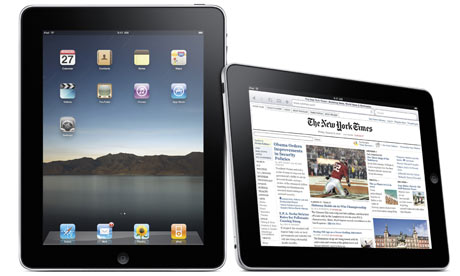
For this first generation born into a world of the iPhone, Wii and soon the Xbox’s Project Natal, the distance between the metaphor created by these devices and the reality of their interaction is constantly shrinking. My wife is currently doing her PhD research on the merits of tangible interfaces for young children in education and the data is telling. There is no doubt that there is great potential to enhance learning with tactile computing. Through that lens the “Bigger iPhone” is akin to a bigger yard to play in or a bigger room. This insight is telling. For these kids the iPhone’s primary function is by no means a phone. It is first and formost a gaming device, followed by a networked camera, followed by everything else. Through this lens one can see the importance of the iPad in the historical trajectory of our human-computer interaction. What’s lost in all the complaints about what the iPad is lacking (multitasking, camera, etc.) is that people need to view the iPad on more than its merits as a first-generation product. Rather, they need to understand it in context of the evolutionary arc of computing.

Don’t think about the iPad as just a computer. Its true potential lies in its potential as a communications device. Already, it functions as an electronic reader, helping to bring the world of books to computers. But there is video and audio too, with the potential for VoIP apps and even one day a camera for video messaging. The artificial walls that separate our notion of communications and computing are being broken. It is time for the dawning of communications apps. Think about it. It makes absolutely no sense that we have these parallel universes on our devices that are relics of technologies past. The notion of voice as one stack of technologies and the rest must perish. Communications, both audio and video, will be weaved into the fabric of the app space. For example, an API should allow developers to integrate Skype-like P2P communications into their apps opening a new world of utility.

Only a company like Apple can have this kind of leverage over the telcos and only in the very near future will they be able to bring about this change. This goes for the iPhone as well as the iPad. The two are joined at the hip through 140,000 shared apps. In their dash to fortify their lead against the hordes dressed in Google colors, Apple must use its window of opportunity to push the envelope on what one can do with a touchscreen computer, but not yet with an Android-powered device. They must learn from their OS wars with Microsoft. Google will continue to copy their every move as did Microsoft before it. Fueled by their advertising money printing presses, Google gives away what Apple attempts to sell. This means Apple must drill deeper into the telco stack. Think of visual voicemail as a simple prelude. But they will have to go much deeper, making the communication experience itself evolve. Video calling will be made a reality with iChat for iPhone OS, and not just one-to-one calling but conference calling. Many claim that video calling is just a gimick and that it has never really caught on despite being available decades in one form or another. To them I would argued that it has never been attempted by a company with product-design excellence like Apple and furthermore it has never been integrated into a vibrant app ecology with tens of thousands of developers applying their creativity.

By opening up the communications stack via the API in a holistic way and introducing video and P2P realtime data transport, Apple will open a new world of communications apps that will further blur the lines between computers and communications devices. Imagine Xbox Live-type experiences where a group of teenagers fire away while being on a group audio chat, calling Hertz to reserve a car while seeing the agent and using swipe gestures to choose your car, even playing REAL strip poker (see illustration).


Utilitarian business communications, social interaction and gaming will all evolve and co-mingle on the platform. The iPad doesn’t need anything other than a data connection to function as a phone as well as everything else.

Whether they like it or not, the telcos will be relegated to running efficient data pipes competing on price and service. The iPad will further blur the lines between device categories and contribute to the coming confusion. As I wrote in a prior post this will significantly impact the media world as well.

Here’s another prediction: the coming iPad and next iPhone will have a front-facing camera and rest assured it will be put to good use. The lines between a device you put up to your face (a phone) and a next-gen communication device you speak at will continue to collapse. The fact you put it in your pocket or carry it around will also not define it as a “phone” anymore. In many ways the legacy technologies are coming full circle. You can be sure that when the inventors of the Internet sat down and brainstormed the topology of the network they used the metaphor of a phone number to explain the notion of it being a phone number of a computer. Now the phone number is the IP address of a person. It follows you in a nomadic form that is true to the human condition.

Extending this metaphor one can recognize another potential gap in the strengths of the forces aligning themselves against Apple. Namely, Facebook monopolizing the social graph. We carry with us on our “phones” our most intimate of social networks. Your contact list coupled with the frequency of communication you have with those people on your device makes for the most useful social graph of all. Without users needing to do anything they don’t do already, that social graph could be made extremely useful. Not a network of hundreds of people you didn’t want to say “No” to and friended despite your better judgement, but rather an intimate network of your real friends and family with a simple proximity threshold based on communication frequencies. Having someone’s nomadic IP (phone number) is an indication of a real relationship. Apple is in a position to capture that and control this namespace and add value to it. They already own Me.com and can build out that core MobileMe service to become the equivalent of a DNS service for telephone numbers by resolving them to peoples names. Think of it, a phone number is unique and is mapped to a person. It’s not so useless after all. With number portability people are holding on to these numbers with the same vigilance that some IT folks hold on to our static IPs.

What Apple should do is move Me.com to a freemium model ASAP and start amassing a high value social graph that will have increasing returns for the future of its platform. There is no reason for them to give up the addressable space of users to Facebook and Google when they own the point of origination and the best way to access consumers, their nomadic IPs. So there you have it: the path for Apple to combat the two other majors, who are all inching onto each others turf in more ways then one.

The winners, like with all such competitions (as long as no one wins), will be us. Welcome, iPad. Me and the kids are waiting.
Read More

Switched On: Tabula rasa

When Apple introduced the iPod in 2001 -- some 250 million units ago, as Steve Jobs noted -- it began with a laser-like focus on digital music. Swap out a hard drive and FireWire port for a cassette collection, and the product was clearly the reinvention of the Walkman. The first Switched On in 2004 pondered the iPod photo as a stepping stone to video. And by 2007, the iPhone and iPod touch had become capable of playing a broad array of content and would soon be able to extend their capabilities dramatically via apps.

Nonetheless, while the iPhone and iPod touch were nearly as close cousins as the 3G and non-3G flavors of the iPad, they were each rooted firmly in the existing categories of smartphones and MP3 players and positioned against products in that space. Despite its limited app support, nobody thinks of the Zune HD as a handheld tablet; it's a digital media player that competes against the iPod touch.

No such backdrop exists for the iPad, which will be Apple's most ambitious category-creation initiative since the days of Newton -- Apple's previous large slate device. The iPad, though, varies in its competitiveness versus alternatives. In its favor, its 9.7-inch screen should provide a strong personal entertainment experience for video -- it's a long overdue solid state successor to portable DVD players -- and games, where it's clearly differentiated from smaller-screened Nintendo and Sony devices. It also takes aim at Amazon's Kindle, offering color, backlighting and animation -- but at a higher price, non-free 3G access, and a book selection that won't necessarily appeal to more than those already interested in dedicated e-readers.

As for the browser, its lack of Adobe Flash handicaps its ability to display many Web sites -- notably Hulu, which would greatly enhance its value as, say, an exercise bike fixture. Even Apple's well-rehearsed introduction demonstrations could not avoid the popular plug-in on the Web site of the New York Times. And most of the other bundled apps of the iPad are supersized versions of those that consumers have long enjoyed on Apple's handhelds. While it draws heavily from the iPhone's industrial design, user interface, and developer support, the iPad is a rolling stone, an unapologetic convergence device.

This is why third-party apps will play a much larger role in defining the iPad's identity -- and ultimately, its level of success -- than they have for the iPhone and iPod touch. The iPad represents the other shoe dropping, something we've been waiting for since Apple first introduced iWork for the Mac; the iPad versions are destined to become the MacWrite and MacPaint of Apple's new platform. Another great example was Brushes, the finger-painting app for the iPhone that now turns the iPad into a more credible creative canvas.

And creativity will be key if the iPad is to avoid becoming another in the long line of failed tweener devices. Apple may knock the usability of netbooks as vigorously as their manufacturers bemoan their profitability, but consumers have flocked to them as they are well-understood as small and cheap notebook PCs with all the compromises that entails.

Invoking the history of its event's host city, Apple portrayed the iPad as the next gold rush opportunity. But this time, instead of panning freely from the rushing waters of the iPod's legacy or the iPhone's subsidized ubiquity, developers will have to help Apple dig the riverbed.
Read More

Apple's iPad: What's it really for?

It's a way to showcase multi-touch tech, open new doors for Apple

If there's one thing Apple is good at, it's keeping the rest of world guessing about new products while generating more buzz than the New Orleans Saints making it to the Super Bowl for the first time. Even though the world knew Apple CEO Steve Jobs would unveil a tablet on Wednesday, the announcement created enough of a stir to take down Twitter briefly and slow Web traffic on a lot of sites.

Post-buzz, reaction to the iPad seems to be mixed. I don't think you can really dispute the cool factor. After seeing even a handful of videos or screenshots showing the new device, most anyone would recognize that Apple is once again reframing how we handle all the data and media that now make up our digital lives.

Post-hype letdown?


But after my "I can't wait to play with this" moment, a slight sense of disappointment and confusion set in. Some of it was inevitable after all the hype and rumors of the past several weeks. When many of the dreamed-of features (multitasking, still or video cameras, the possibility of wireless carriers other than AT&T) turned out to be just that -- dreams -- and there was no preview of iPhone OS 4.0 as many expected, some people were bound to feel like a kid who gets sweaters at Christmas instead of a Wii.

Beyond that, though, the target market for the iPad isn't as clearly defined as it is for most Apple products. Is it appropriate for business use? Is it a media player or e-reader? How would it be used in educational environments? Is it just an oversized iPod Touch? Exactly what needs does it meet that a smartphone or notebook can't fulfill?

We won't fully know the answer to those questions until the iPad hits the market in March or April or for a little while after it's released. But maybe the point isn't what the iPad is, but what it represents.

Whatever the intended market (I'll speculate a little more on that in a minute), the iPad represents a lot of important things for Apple. It shows that Apple is still looking to lead and innovate in a wide array of areas, both technically and in terms of how people use technology.

Multi-touch magic

The iPad is the latest and most striking example of Apple's use of multi-touch technology. True multi-touch capability was more concept than reality before the iPhone's debut in 2007. In less than three years, Apple has taken that technology and baked it into every one of its product lines. After the iPhone came multi-touch trackpads on Apple's laptops. Then, last fall, came the new magic mouse. And now it's being used in a full tablet. With each advance, Apple rolls out new ways to interact with devices.

I don't know if Apple will eventually build a true touch-screen Mac, but the iPad certainly shows that it could and that it would be more than just another touch-screen computer. And along the way, Apple is leading the mobile device and computing market down a multi-touch path.

The iPad's arrival also demonstrates Apple's continued ability to push the envelope in other technologies, including battery life. Over the past year or so, Apple has pioneered the concept that innovative battery design can lead to better battery life and better design. Not everyone is happy about the trend toward built-in, nonreplaceable batteries, but Apple at least makes the concept seem feasible, and even desirable.

Finally, the iPad is proof positive that Apple has the financial resources to develop completely new products from the ground up. The fact that Apple designed and manufactured its own processor specifically for the iPad speaks volumes about the company's vitality, even in an uncertain economy. And it bodes well for Apple's ability to innovate in the years ahead.

Beyond just a symbol of things to come

All that said, I have no doubt that even if the immediate market for the iPad isn't obvious, Apple wouldn't have developed the device without believing it could be a vital product. (There was no talk of the iPad as a "hobby," as there is around the Apple TV.) So, what sweet spot is Apple aiming for?

My first thought is that Apple is gunning for entertainment convergence, the ability to couch-surf, play games and do basic Internet tasks almost anywhere and in the coolest way possible. Yes, you can do these already with a notebook or a netbook, but if you want to be able to do them in the coolest way possible, the iPad will have obvious appeal. (Never underestimate the power of cool when it comes to bringing technology to the public.) There's the lure of e-books and the potential to use the iPad as an e-reader. And, perhaps most important, there's the price.

If you have a limited budget, the iPad is going to appeal to you. With a starting price of $499, Apple is under the magic $500 mark that analysts have long touted as an important psychological barrier for tech consumers. It doesn't matter that you aren't buying a full-fledged computer; chances are, you already have a another computer to sync it with that can do all the real computing tasks the iPad can't handle. And at that price, what better way to get Apple's OS (whether iPhone-derived or Mac OS X) in front of more people than with the iPad?

What about business...

Now, when it comes to business or education, Apple (or a third party) needs to fill some gaps before the iPad is likely to see wide deployments in the enterprise or in large-scale classroom settings.

The big challenges in either of these types of environments is the need to do mass deployments, enforce security policies, integrate with existing systems and offer options for wide-scale device management as well as for handling security breaches if a device is lost or stolen. In other words, the things that have kept sysadmins from fully embracing the iPhone will also hold true for the iPad.

That's the one thing that's been most confusing about the initial burst of information about the iPad. Apple has been steadily building many of those enterprise-grade deployment, management and security features into the iPhone and iPod Touch for the past couple of years. So, the assumption that it can't or won't do so with the iPad seems strange.

And that makes me wonder: Is this potential enterprise-worthy goodness simply not vetted broadly enough yet to announce? If that's the case, it might make it into a shipping product at launch or via a later update (as happened with the last two iPhone OS releases). Or it could mean that Apple has an iPad Pro up its sleeve for later introduction, perhaps with additional business features as well as more enterprise-level security and management tools.

One thing's for sure: If the iPhone's growing popularity in the workplace -- whether it's officially supported or not -- is any indication, you'll be seeing iPads in a cubicle near you soon enough.

...And education?

Even if Apple isn't looking to make the iPad a business-oriented device, it's hard to think that Jobs and company haven't thought about it for education, where it would shine as both an Internet/basic computing device and electronic textbook reader. Given Apple's strong position in many education markets, I can't imagine that there hasn't been a discussion of the laptop carts that Apple sells to K-12 schools being replaced by or augmented with iPads. For many schools, even providing an iPad to every student would be more economical than providing them with individual laptops (something now increasingly common). But, just like businesses, schools need to be able to secure and manage their devices.

An even more intriguing thought is that Apple may have some new security tools for working with the iPad. One point I've seen made a lot this past week concerns the iPad's apparent lack of VPN support. What's interesting to me about that is that with the current release of Apple's Mac OS X Snow Leopard Server, the company introduced a feature called Mobile Access Server that uses TLS (transport-level security) to allow secure access to all of the built-in collaborative services without using a VPN. Mobile Access Server is already supported on the iPhone, iPod Touch and Snow Leopard Macs.

All in all, the reaction to the iPad unveiling after all this waiting and speculation may not have elicited the gasps of joy you might have expected, given the hype. But, just because we've seen video of the product (and some of us have been lucky enough to see one in person), I'm willing to bet that there's a lot more that we're going to find out over the next few months as the iPad matures and an iPad-specific developer community evolves.
Read More