Showing posts with label Intel. Show all posts

Thursday, February 04, 2010

The Money Behind the New Computing War

I love when tech companies go to war. And this one is going to be huge. No, not huge: Gigapocalyptical. The domination of a new age of computing is at stake, and Apple, Google, and Microsoft want to win.


This is the money they can play with. First, Microsoft with $40.4 billion in the bank. That's actual rupees plus short and long term securities. Apple follows up closely with $39.8 billion, while Google trails way behind with only $24 billion. And the almighty Intel? $18.9 billion.

Yes baby. I can't wait for the nuclear ballistic missiles to start filling the skies.

[Silicon Insider]
Read More

Thursday, January 14, 2010

Intel Q4 net income $2.3 billion, up 875%

This hot off the Intel press release:

Revenue $10.6 Billion, up $2.3 Billion and 28% Year-over-Year
Record Gross Margin of 65%, up 12 Points Year-over-Year
Operating Income $2.5 Billion, up $958 Million and 62% Year-over-Year
Net Income $2.3 Billion, up $2.0 Billion and 875% Year-over-Year

“Intel’s strong 2009 results reflect our investment in industry-leading manufacturing and product innovation,” said Paul Otellini, Intel president and CEO. “This strategy has enabled us to generate unprecedented operating efficiencies while growing our traditional businesses and creating exciting new market opportunities, even in difficult economic times. Our ability to weather this business cycle demonstrates that microprocessors are indispensable in our modern world. Looking forward, we plan to deliver the benefits of computing to an expanding set of products, markets and customers.”

I think that counts are a very good quarter for Intel.
Read More

Saturday, December 26, 2009

Microsoft, Intel to cede tablet market to Apple?

If the Apple tablet emerges as expected, this will be another big device market, following smartphones, that the PC industry cedes to Apple.

The writing is already on the wall already for Microsoft and smartphones, as spelled out in a previous post and as documented in shrinking market share numbers.

That's not to say that Microsoft, Compaq (later Hewlett-Packard), and Intel didn't have a chance. Remember the Compaq iPAQ PDA that debuted way back in 2000, powered by an Intel StrongARM chip running an early version of Windows Mobile?

That device had a lot of potential. The operative word being "potential." An iPAQ could have been an iPhone. Or at the very least an iPod. And everybody could be drooling over iPAQs today instead of iPhones. Or using iPAQs instead of BlackBerrys. But of course things didn't turn out that way.

Fast forward to 2010 (January?). Apple announces a tablet and suddenly everyone wants a tablet.

And what have Microsoft, Intel, HP, and others been offering in the interim years when they had every opportunity to come out with a blockbuster tablet? Unattractive, bulky, half-baked convertible laptops that, let's put it this way, have not taken the PC market by storm.

So, here's the $64,000 question, uh, make that the $64 billion question. Why can't the combined R&D smarts, market clout, and overall technological resources of Microsoft-Intel-HP-Dell come up with a thin, sexy compelling tablet and/or media pad that will turn heads and convince the unbelievers (the average why-would-I-need-something-like-that consumer) that a tablet is a must-have product?

Answer: Because Apple will.

Here's a not unlikely scenario. Apple brings out the tablet/media pad, wows U.S. (and world?) consumers, sells a ton of units, Microsoft-Intel-HP-Dell follow suit with slavishly copied devices that don't sell very well comparatively.

That's how the market for successful newfangled devices works these days. Apple creates the market and everyone else follows in a panic.

Then there's the Intel factor. Intel also wants to be a player in this space. But Intel and its coterie of PC makers can't get off the traditional-design laptop gravy train. Plus, as formidable a chipmaker as Intel is, it is still behind the Qualcomms and Texas Instruments of the world in building the power-efficient system-on-a-chip silicon that goes into smartphones and will likely go into tablets.

So, here's my question for Intel et al: How many people will be buying Netbooks or Intel-based MIDs (mobile Internet devices) in 2011 if Apple has a more compelling alternative? Answer: a lot less if the Apple tablet exists.

And add Asia-based device makers offering tablets using an Nvidia Tegra 2 chip to that. A number of these tablets are expected too in 2010. In fact, Nvidia is already doing what Intel should have finished doing a long time ago: make a competitive system-on-a-chip that powers small devices. Intel had the chance to make XScale (what StrongARM eventually became) into something big for small devices six years ago. But it didn't. And now Intel is trying to reinvent the wheel by squeezing the upcoming "Moorestown" Atom chip into smartphones.

Intel, I'm sure you think Moorestown is a great idea, but it's a little late. Apple beat you to it by about three years.
Read More

Sunday, November 29, 2009

Intel's desktop roadmap leaked, with faster i5 and i7, introduction of i3


Just when you thought you had enough gigahertz in your life, along come the folks at Impress to blow the doors off Intel's upcoming crop of desktop processors. In the highly detailed charts there's wild talk of a low-powered "S" version of Core i5 that lowers the chip from 95W to 82W, a new Core i3 line that strips out the Turbo Boost technology and dips into budget-priced territory, and word that at the time of this roadmap at least the Core i9 "Gulftown" chip isn't slated for until Q2 of next year. We could probably bore you all day with the details, so hit up the source link for all the sordid details before we get ourselves too worked up.
Read More

Monday, November 23, 2009

Intel Core i9: Six-Cores Of Speed

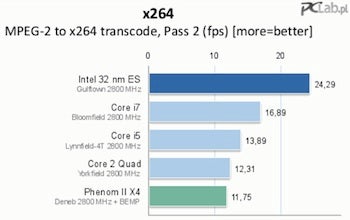
Intel's Core i9 chips won't hit the market for a few more months, but that hasn't stopped Polish site PCLab from putting the new 32 nanometer processors through its paces in a recent series of benchmark tests.


While testing pre-release 2.8 GHz Gulftown chips, PCLab found a significant speed increase with certain applications. According to their report, certain resource-intensive tasks tasks, such as editing video or 3D modelling, perform up to 50% faster than Intel's currently available Core i7 chip.

Unfortunately, the chips didn't shine in all areas; its performance is similar to that of older Core i7 chips when handling less demanding general activities.

However, the Core i9 CPUs fared well when it came to power usage, using less power and running cooler in comparison to older chips.

These results, which you can read in full here, could change before the Core i9's release in the first quarter of next year, so watch this space.
Read More

Saturday, November 14, 2009

$1.25 billion later, can AMD take business from Intel?

Now comes the hard part for Advanced Micro Devices. It has to compete with Intel on the merits of its products.

After settling with Intel and walking away with $1.25 billion, how competitive is AMD's silicon? Some experts weigh in.

Two analysts that follow Intel and AMD said separately that AMD won't be competitive until 2011--at the earliest.

"The only chance for reaching any kind of parity is in 2011. They don't have anything on the roadmap until then," said Ashok Kumar, an analyst at Northeast Securities. In the interim, AMD will get by with about one-fifth of the processor market, according to Kumar. But whether AMD can expand its market share beyond this and be profitable--like Intel--isn't clear. "Intel can leave 20 percent of the unit volume for AMD but (AMD) will have to come up with a business model where it can return to profitability based on this."

AMD may have a chance to expand into more profitable segments if it executes well in 2011, according to another analyst. "AMD believes it's on the cusp of another cycle where they will have strong product offerings compared with Intel. I think this happens in 2011," said Nathan Brookwood, the principal at Insight64. "The products are innovative and have tremendous potential," Brookwood said, referring to the particulars of new chip technologies that AMD disclosed at its analyst day on Wednesday.

But these are big ifs. AMD must close a yawning gap with Intel that's not going to get any smaller because of the legal settlement. "Technically, Intel now has a definitive advantage, which may widen," said Roger Kay, president of market researcher Endpoint Technologies. Kay believes that AMD will have trouble keeping up with the feverish pace, referred to as "cadence," that Intel sets as it moves to each successive generation of chip manufacturing technologies--which, in turn, allows Intel to quickly introduce performance and power efficiency improvements in its processors. "AMD tends to be six months to a year behind Intel," Kay said, citing a statement made by AMD CEO Dirk Meyer at the company's analyst meeting on Wednesday. AMD may begin to close the gap more in the future "but there's no telling whether that will happen," Kay said.

And if it doesn't happen, AMD becomes little more than a foil to keep Intel honest. "This settlement is actually proving the very point that Intel wants to keep AMD alive and able to compete at least in some small subset of the market, otherwise Intel will be faced with regulatory issues that they would rather avoid," said Avi Cohen, managing partner at Avian Securities.

AMD's best technology play to avoid this fate is "Fusion," Kay said, referring to a technology that combines the two key processors inside a PC: the main CPU processor and the graphics processor, or GPU. Fusion, however, isn't slated to come to market until 2011, according to the road map that AMD disclosed on Wednesday.

And what about today? Dan Ackerman, a senior editor at CNET Reviews and someone who regularly reviews AMD- and Intel-based laptops, makes an important point about the challenges AMD faces in the here and now: Intel-based laptops not only dominate the high end of the market but the low end, too. "Intel CPUs are found in almost all of the high-end systems (such as Core i7 laptops), and the low-end systems (Atom-powered Netbooks)," he said.

Ackerman said that AMD will be hard pressed to beat Intel head to head. "AMD has some room in to maneuver in the middle of the market--laptops from $600 to $900--but unless they can offer better performance for the same price, or a significant price discount to consumers, it'll be hard for the company to gain additional market share."

Rich Brown, a senior editor for desktops at CNET Reviews echoes Ackerman's sentiment: AMD competes by offering lower prices than Intel, not better performance. "From a tech standpoint, AMD's...desktop chips haven't been competitive since Intel launched Core 2 Duo. Instead, AMD has had to compete on price," Brown said.

The best action plan for AMD is to keep executing on key technologies and hope this eventually translates to market share gains. "AMD is rapidly developing a reputation for timely execution of marquee products/platforms," said Doug Freeman of Broadpoint AmTech in a research note. "AMD revealed that its newer platforms...are on track for [the first half of 2010]," he said, referring AMD's high-end server chip lines.
Read More

AMD settlement won't blunt Intel R&D, exec says

Today's settlement of all antitrust litigation between Intel Corp. and Advanced Micro Devices Inc. should benefit both firms -- and shouldn't hurt Intel's R&D operation, Intel CTO and senior fellow Justin Rattner told Computerworld today.

"As a legal matter, it only concerned a very small part of the company," Rattner said. "From an R&D perspective, there aren't really any changes as a result of the agreement. For the legal people at Intel, it's a big change but I don't think the rest of us will be terribly affected."

The deal, which settles both antitrust litigation and patent cross license disputes, specifies that Intel will pay rival AMD $1.25 billion. Intel also agreed to abide by a set of business practice provisions.

For its part, AMD agreed to drop all pending litigation against Intel, including an upcoming case in U.S. District Court in Delaware and two cases pending in Japan. AMD also will withdraw all of its regulatory complaints filed against Intel with government agencies around the world.

"It's good for everyone that it's over," said Martin Reynolds, an analyst at Gartner Inc. "These long-term court battles are no good for anybody. This will make AMD a more attractive target for investors and it's certainly good news for Intel."

Reynolds said the settlement could portend that Intel will reach similar deals with other court foes.

The latest antitrust suit against Intel was filed in federal court last week by the state of New York, which alleges that Intel threatened computer makers, made payoffs and engaged in a "worldwide, systematic campaign of illegal conduct." An Intel spokesman downplayed that lawsuit, contending at the time it was a repackaging of the AMD case.

Therefore, Reynolds suggested, it's likely the AMD settlement will lead to the dropping of the New York lawsuit.

"With AMD withdrawing all complaints, it's likely all these suits will dry up," he added. "It will be hard to go forward."

The settlement should provide significant benefits to Intel over the long term, Reynolds said. "The $1.25 billion is a downside [for Intel], but that's about it. Intel can stand down in gathering all this evidence. They won't be in as many courtrooms. They can let go of some of their attorneys."

The settlement could also blunt any plans by the U.S. Federal Trade Commission to jump into the antitrust fray against Intel, said Rob Enderle, an analyst with the Enderle Group. The FTC had launched an antitrust investigation into Intel more than a year ago and had been expected to take some kind of antitrust action against the firm soon.

"This means AMD will stop pushing on the FTC and states to pound on Intel. And Intel will be able to focus on business and not do brand damage control, discovery, [and the like]," Enderle said. "Like Microsoft discovered, this doesn't necessarily stop New York or the FTC but it removes a lot of the momentum behind those efforts and effectively lowers their priority."

Enderle also noted that while $1.25 billion is a lot for Intel to pay out, the settlement is likely less than a court would have forced the company to pay had it lost an antitrust trial.

"I was estimating a judgment between $2 billion and $5 billion with penalties so this was a good deal from Intel and AMD needs the money," said Enderle. "[Intel] already looked guilty. This reduces the long-term impact from their actions substantially."
Read More