Showing posts with label Apple iSlate. Show all posts

Wednesday, January 13, 2010

Apple iSlate tablet “iPhone on steroids”; iPhone OS update delayed to keep the secret

Second Apple iSlate tablet rumor of the day – anyone would think it was slow in the gadget world post-CES – and according to the latest source we should basically be expecting an “iPhone on steroids”. The BGR is reporting on a “close Apple connect” of theirs with a decent track-record, who claims iSlate development is to blame for Apple not releasing an updated iPhone OS build any time recently; apparently there are too many chunks of tablet code and references to the larger-screened device in the new build, which would basically give the game away.


Otherwise the source says that the Apple tablet runs an “incredibly fast” ARM processor – perhaps the recently debuted ARM Cortex A9? – and uses the iPhone kernel, complete with multitouch gestures that are “out of control”. We’re guessing that’s meant in a good way. Oh, and the internal model number is K48AP, just in case Steve Jobs has been whispering that codename into your ear every night and you’ve been wondering what it might refer to.
Read More

Monday, January 04, 2010

Apple iSlate Concept Is Exactly How This Thing Should Be


Apple iSlate should be this simple. With an aluminum or white polycarbonate body, perhaps even rubberized, and no bezel whatsoever, with a very thin black frame. It really doesn't need anything else. Ogle its simple beauty in the gallery.

I like it. I would like the screen to reach the very edge of the device, but that's probably not possible with the current technology.


But where's the button, some may ask? I think that, for the iSlate, they can actually pass on the physical home button, since it doesn't make much sense in a 10-inch format. I mean, where do you place it? In the bottom center? Two home buttons on the sides? One? On one corner? What corner? Instinctively, I don't think it's needed. And they always implement a hard-to-reach physical reset button on the back.

Hopefully, we will have answers at the end of the month.
Read More

Saturday, January 02, 2010

10 Million Apple Tablets? A Glance Back for Perspective

The benchmark for a successful launch keeps changing, and Apple's own record is mixed as we await the "iSlate" entry.

Apple rumor of the moment: Former Google, Microsoft, and Apple executive Kai-Fu Lee has blogged that he's heard Apple thinks it can . (I persist in putting quotes around "iSlate" since we don't know if that's the product's name, assuming there is a product at all.)

That ten-million tablet figure is merely a rumor, albeit one spread by a smart guy who may have excellent sources. It certainly sounds ambitious. But how ambitious is it? For the sake of comparison, I dug up some sales figures for other Apple products -- starting with the Apple I, and including both numbers reported by Apple and some third-party estimates. Here they are, after the jump.

Total sales of Apple I, 1976-1977: about 200

Apple II units sold, 1977-1982: 750,000

Apple II units sold, 1982: 300,000

Total Apple III units sold, 1980-1984: 65,000

Original 1984 Macs sold in first 74 days: 50,000

Original 1984 Macs sold in first year: 250,000

Macs sold, October-December 1993: one million

Macs sold, 1995: 4.7 million

iMacs sold in first 139 days: 800,000

iPod during first full year: 378,000

iPod at 5 1/2 years: 100 million

iPod at 8 years: 225 million

Total original iPhones sold: 6.1 million

iPhone at 46 weeks: six million

iPhone/iPod Touch at 20 months: 30 million

iPhone, July-September 2009: 7.4 million

Macs sold by Apple in fiscal year 2009: ten million

The benchmark for successful sales keeps changing, of course: Back in 1982, selling 300,000 Apple II computers was an extraordinary achievement, considering that it was a pricey product in a category which most households and businesses hadn't yet adopted. And the fact that Apple only managed to sell 378,000 iPods in that gizmo's first year is explained by the fact that the first iPod only worked with Macs, not Windows PCs-more than 95 percent of computer owners couldn't have used an iPod no matter how much they craved one.

It's also impossible to gauge the ten-million tablet rumor without knowing how much the tablet will sell for. Lee's rumor merely places the price at "under $1000," which isn't very helpful given that nobody would expect it to sell for over $1000.

But this much is interesting: If Apple does sell ten million tablets in 2010, and you count the tablet as a computer, and Mac sales are neither radically higher nor radically lower than they were in the last fiscal year, then Apple thinks it can sell roughly as many tablets a year as it does Macs.

That's a lot of assumptions, and they don't factor in the possibility that an Apple tablet might cannibalize sales of Macs (or that the tablet may turn out to be a Mac, or at least more Mac-like than most people expect it to be).

One last thing: At the January, 2007 Macworld Expo keynote at which the iPhone was announced, Steve Jobs famously said the company was shooting to sell ten million iPhones in 2008. Even well into 2008, there was still plenty of skepticism about the company's ability to make that goal. (Charles Jade at Ars Technica: "...one can see why analysts with advanced degrees in business and economics might doubt. It's a good thing Steve Jobs dropped out of college.")

Apple ended up selling just short of 13.7 million iPhones in calendar year 2008. Which is evidence that most of us in the outside world aren't very good at crunching Apple's numbers for it-even when we know vastly more than we do about the "iSlate."
Read More

Thursday, December 31, 2009

Apple iSlate tablet: involved teams in “cone of silence”?

We’re still hearing rumors of a January 26th launch for the much-discussed Apple Tablet, and according to the latest from oft-insider Josh Gruber of Daring Fireball, all the signs are coming together for just such an unveil. Gruber highlights the fact that “everyone working on it has dropped off the map”, something which last happened in the run up to the original iPhone’s announcement back in early 2007; in fact, many of the people who have now gone into stealth mode are the same engineers and software teams responsible for the iPhone Mail, Calendar, and Safari apps.


Gruber describes it as a “cone of silence”, and it’s one that – despite talk of Apple discussing ebook and other deals with publishers – even content partners might be kept out of. Apparently Apple goes into such meetings without prototypes, mock-ups, designs or even verbal confirmation that such a product is in the works; instead, they merely ask if the would-be partner is interested in getting involved “if we were to create a new platform”.

As for the potential functionality, Gruber reckons predictions of a Kindle rival, overgrown iPod touch or simply an HD media viewer all miss the point: the Apple iSlate (as we expect it to be called) will be all those and more. Apple may illustrate its purpose – set its context to potential buyers, as it were – by highlighting two or three key uses, just as they did with the iPhone, but the iSlate won’t be limited to any such small subset.
Read More

Tuesday, December 29, 2009

The Apple Tablet: Will It Be Called iSlate, iGuide, Or Something Else?

After discovering that Apple had registered iSlate.com in late 2006 (we dug a little deeper and found trademarks had been filed for ‘ISLATE’ in both the United States and Europe by a company that was most likely a dummy corporation set up by Apple), MacRumors has now discovered another possible name for the upcoming Apple tablet.

MacRumors bases its report on the filing for a US trademark for ‘IGUIDE’ by another Delaware-registered company called iGuide Media LLC, which can be linked to Cupertino by means of signatures on the documents coming from Apple’s Senior Trademark Specialist, Regina Porter.

Let’s dig a little deeper, once again.

Domain names

There’s no indication that Apple owns any domain name that contains the term ‘iguide’. The identity if iguide.com is shielded from public WHOIS records, but not by Mark Monitor, the brand protection firm Apple usually works with. The domain name iguide.net belongs to a company called iGuide Media, a marketing and design firm started by Jon Warren back in 1997 and led by a Brian Noon from 2002 to 2006, when the company was sold.

I checked a couple of other TLDs (.ca, .fr, and more) and found no indication that Apple owns any of those.

Trademarks

Two trademarks were filed for ‘IGUIDE’ by iGuide Media LLC (through a James Johnston) in the United States: a principal and a service mark, both on 18 December 2007. The description of goods and services given to iGuide Media is very similar to the one given to Slate Computing, the supposed shell company set up by Apple used to register the trademark for ‘ISLATE’, although it leans a bit more to a focus on software and services than hardware.

On the exact same day, iGuide Media LLC filed for a trademark in Europe as well: search OHIM for ‘iguide’ and you find a trademark filing that has all the Apple marks on it: the legal representative is ‘EDWARDS ANGELL PALMER & DODGE UK LLP’ (the same as for ‘ISLATE’ and ‘MACBOOK’, among others), and the priority country is Trinidad & Tobago, the same as when Apple filed for the ‘iphone’ trademark in Europe.

Noteworthy: the status history suggests that the community trademark application was registered (not filed) in February 2009, and that the full examination of the CTM application has been completed very recently, on the 18th of December 2009 to be exact.

Final thoughts

If I were betting man, I’d still be putting my money on the name iSlate for the tablet, Magic Slate for a possible peripheral, and iGuide for a service linked to the hardware device(s).

Here’s why:

- Apple doesn’t seem to own, directly nor indirectly, any ‘iguide’ domain names
- The ‘ISLATE’ and ‘MAGIC SLATE’ US trademarks were not filed for separately as a service trademark, unlike ‘IGUIDE’
- The ‘ISLATE’ US trademark was filed earlier than ‘IGUIDE’, by a different shell corporation (and the same as ‘MAGIC SLATE’)
- NYTimes editor Bill Keller’s mention of an ‘Apple slate’ device in a past speech
- According to Trademarkia, the ‘ISLATE’ trademark application was extended a second time last September, to show use in commerce
- The slightly different description for ‘goods and services’ for both Slate Computing and iGuide Media

Or, of course, we’re all wrong, and none of these names will ever be actually used by Apple. I would deem that unlikely, but we can’t know for sure.

Besides, has Apple announced that it’ll be selling a tablet computer yet?
Read More

Sunday, December 27, 2009

Will the Apple tablet be a full-fledged computer?

With all the crystal-ball-watching over the seemingly imminent Apple tablet, one issue hotly debated around the CNET offices, but infrequently mentioned elsewhere, is the hypothetical device's status as a mobile computer.


There are two schools of thought on this: either the Apple tablet (or iSlate, or whatever it ends up being called) will be a 10-or-so-inch tablet PC with a full Mac OS X operating system; or it will merely be a larger-screen version of the current iPod Touch, which has a closed, limited phone-like OS.

The former would mean it could very likely run any software you'd run on a MacBook, from Firefox to Photoshop, and maybe even install Windows 7 via Boot Camp or Parallels. The later points to a hermetically sealed ecosystem, where apps would have to be approved and sold through an official app store (as in iTunes).

Initially, at least, the scant evidence hinted at the Apple tablet being akin to a touch-screen, keyboard-less version of the company's current laptops. After all, convertible tablet laptops are, if not common, than at least easy to find. While mostly intended for medical, education, or other specialized markets, there are a handful of consumer-oriented ones, such as HP's TouchSmart series.

There is even already a tablet version of the 13-inch MacBook you can buy. It's from a company called Axiotron, which takes apart stock MacBooks and rebuilds them as tablets, with a touchscreen and stylus. We reviewed one a couple of years ago, and found it to be an interesting, if expensive, alternative for tablet-loving Apple fans.

The last several rounds of Apple tablet rumors, however, point more decisively towards an iPhone or iPod Touch style device. The Financial Times reports that Apple is planning a press event on January 26 in San Francisco, while the Silicon Alley Insider claims several app developers have been asked to prepare large-screen versions of their current iPhone apps.

While the recent rumors all seem to point towards a device without a full PC-style operating system, the purported 10-inch screen of the Apple tablet may create a different set of psychological expectations from consumers. After all, that's the size of most Netbook PCs, which, despite costing as little as $299, offer the same (or in some cases, the "Starter" versions of) Windows XP or Windows 7 as full-size laptops, and which can install and run virtually software (with the possible exception of power-hungry apps like 3D games and video editing suites).

And, even with single-core Intel Atom CPUs, a 10-inch Netbook can run multiple apps at once -- something currently not allowed (with a few exceptions) on the iPhone/iPod Touch platform.

Would a 10-inch device without that added flexibility feel unduly crippled or underpowered? Is an OSX-powered tablet the right way for Apple to go?
Read More

Saturday, December 26, 2009

Microsoft, Intel to cede tablet market to Apple?

If the Apple tablet emerges as expected, this will be another big device market, following smartphones, that the PC industry cedes to Apple.
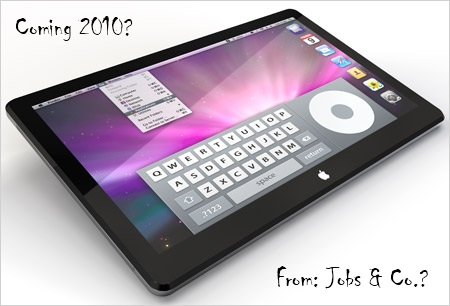
The writing is already on the wall already for Microsoft and smartphones, as spelled out in a previous post and as documented in shrinking market share numbers.

That's not to say that Microsoft, Compaq (later Hewlett-Packard), and Intel didn't have a chance. Remember the Compaq iPAQ PDA that debuted way back in 2000, powered by an Intel StrongARM chip running an early version of Windows Mobile?

That device had a lot of potential. The operative word being "potential." An iPAQ could have been an iPhone. Or at the very least an iPod. And everybody could be drooling over iPAQs today instead of iPhones. Or using iPAQs instead of BlackBerrys. But of course things didn't turn out that way.

Fast forward to 2010 (January?). Apple announces a tablet and suddenly everyone wants a tablet.

And what have Microsoft, Intel, HP, and others been offering in the interim years when they had every opportunity to come out with a blockbuster tablet? Unattractive, bulky, half-baked convertible laptops that, let's put it this way, have not taken the PC market by storm.

So, here's the $64,000 question, uh, make that the $64 billion question. Why can't the combined R&D smarts, market clout, and overall technological resources of Microsoft-Intel-HP-Dell come up with a thin, sexy compelling tablet and/or media pad that will turn heads and convince the unbelievers (the average why-would-I-need-something-like-that consumer) that a tablet is a must-have product?

Answer: Because Apple will.

Here's a not unlikely scenario. Apple brings out the tablet/media pad, wows U.S. (and world?) consumers, sells a ton of units, Microsoft-Intel-HP-Dell follow suit with slavishly copied devices that don't sell very well comparatively.

That's how the market for successful newfangled devices works these days. Apple creates the market and everyone else follows in a panic.

Then there's the Intel factor. Intel also wants to be a player in this space. But Intel and its coterie of PC makers can't get off the traditional-design laptop gravy train. Plus, as formidable a chipmaker as Intel is, it is still behind the Qualcomms and Texas Instruments of the world in building the power-efficient system-on-a-chip silicon that goes into smartphones and will likely go into tablets.

So, here's my question for Intel et al: How many people will be buying Netbooks or Intel-based MIDs (mobile Internet devices) in 2011 if Apple has a more compelling alternative? Answer: a lot less if the Apple tablet exists.

And add Asia-based device makers offering tablets using an Nvidia Tegra 2 chip to that. A number of these tablets are expected too in 2010. In fact, Nvidia is already doing what Intel should have finished doing a long time ago: make a competitive system-on-a-chip that powers small devices. Intel had the chance to make XScale (what StrongARM eventually became) into something big for small devices six years ago. But it didn't. And now Intel is trying to reinvent the wheel by squeezing the upcoming "Moorestown" Atom chip into smartphones.

Intel, I'm sure you think Moorestown is a great idea, but it's a little late. Apple beat you to it by about three years.
Read More

Apple owns iSlate.com--the mystery deepens

The widely rumored Apple tablet, a riddle wrapped in a mystery inside an enigma, has just gotten a little more interesting.

Thanks to some crack reporting, MacRumors.com discovered that Apple purchased the domain for "islate.com" back in 2007.

What we know: islate.com was registered to Apple in 2007, through an intermediary (to disguise its true owner). At the moment, that domain doesn't seem to lead anywhere--and there are a few possible explanations. First, Apple bought it as a protective measure, to stop anyone else from using that "i" prefix with that particular word. Second, Apple had or has plans for either a product or a project by that name. Third, it's the tablet. Or fourth, it's Apple's take on Slate.com.

Maybe we'll find out just what that means in January, when the tablet is rumored to be announced.
Read More

Friday, December 25, 2009

Apple iSlate – Irrefutable evidence that’s the name of the new tablet

Yes, it’s Christmas but this Apple rumor is too juicy to wait. It’s true; Apple’s tablet may indeed be called iSlate! MacRumors discovered via historical evidence that Apple purchased the domain name iSlate.com from Data Docket, Inc. in 2007. Mark Monitor manages domain names for many companies, including Apple. Even though the true identity of the domain name was set to private, there was a small window where Apple’s ownership info was exposed and then changed back a few weeks later. iSlate.com doesn’t point anywhere for now, but there are lots of speculations of Apple announcing a tablet early 2010.


TechCrunch dug a lot deeper and found other iSlate domain names registered around the world. The United Kingdom is a big market for Apple – Mark Monitor also manages the iSlate domain name islate.co.uk. It’s the same company that also manages the iSlate domain names iSlate.jp and iSlate.cn, while in France iSlate.fr is managed by a Paris-based IP property attorney firm called Wilson & Berthelot. This company named Mark Monitor as the technical contact for the islate.fr domain name.

The plot thickens with the iSlate trademark here in the United States. Back on November 21, 2006 a company called Slate Computing filed for a US word mark for ‘ISLATE’. Interestingly, it’s roughly the same time frame of when the last three islate-related domain names were registered.

Computers; computer software, namely, database management software, electronic mail and messaging software, Internet browser software, paging software, database synchronization software, software for accessing, browsing and searching online databases, software for creating spreadsheets, tables, graphs and charts, software for organizing and analyzing data, software for word processing, software for creation and display of presentations including text and graphics, software used for image editing, image processing, image acquisition, image file management, image viewing, image sharing, and the creation of documents incorporating images, software for use in developing websites, software to help users create, edit, organize, search, transfer, publish and subscribe to weblogs, blogs, podcasts, web broadcasts and news and information feeds on global and/or local computer and telecommunications networks, software for use in authoring, downloading, transmitting, receiving, editing, extracting, encoding, decoding, playing, storing and organizing audio, video and still images, software for authoring digital content, software for personal information management, software for DVD authoring, software for the electronic storage and retrieval of electronic calendar files, software with clock and alarm clock functionality, telephony management software, character recognition software, application development tool software for personal and handheld computers, software for the redirection of messages, Internet e-mail, and/or other data to one or more electronic handheld devices from a data store on or associated with a personal computer or a server, and software for the synchronization of data between a remote station or device and a fixed or remote station or device; computer operating system software; computer utility software; computer peripherals. notebook computers; laptop computers; tablet computers; computer servers; handheld computers; mobile computers; hard drives; audio speakers; speakers for computers; radios; cameras; video cameras; telephones; mobile telephones; personal digital assistants; electronic personal organizers; electronic notepads; blank magnetic data carriers; computer gaming machines; microprocessors; memory boards; computer monitors; keyboards; computer input devices, namely, touch screens, styluses, mice, trackballs and shuttle dials; computer cables; modems; printers; computer accessories, namely, computer battery chargers, battery packs, docking stations, adaptors, computer wired and wireless remote controls, audio headphones and earphones, and replacement parts for all the aforesaid goods.

Everything is pointing to an Apple iSlate. If rumors are true, the announcement could come as early as January 26th, 2010.
Read More