Showing posts with label HTML5. Show all posts

Tuesday, February 09, 2010

Some Good News, and Some Bad News, About Adobe Flash 10.1


The good news first: Adobe's promising Flash 10.1 is going to hit smartphones—Android, WebOS, Windows Mobile—and desktops in the "first half" of this year, a slightly less squishy date. And it'll come over the air. The bad part?

Well it's bad for Android, anyway: You're gonna need Android 2.1. At least. Because it provides some access Adobe needs to make the Flash magic happen. So, sorry everything but the Droid and Nexus One, at least for the moment. The "over the air" thing is also kind of "up in the air" as to what that means: It could come from your carrier, it could come from your phonemaker, or failing all else, it could come from Adobe. Which means, Flash isn't necessarily going to hit your phone at the same time as everybody else's. Depends on your phone. But, they're betting that over half of smartphones—53 percent—will have Flash Player by 2012. Not surprisingly, Adobe says Flash 10.1 is going to be all over some tablets, too, with accelerated performance on Nvidia's Tegra 2, Qualcomm's Snapdragon (like what's in the Nexus One), and Freescale's i.MX515.

Lastly, Adobe would like you to know that this whole Adobe vs. HTML5 thing is silly, since they totally support HTML5, like all web standards. They love them some web standards, they say. But! They would also like you to note that HTML5 standardization is years away, and Flash works right now. And the reason you notice crappier performance on the Mac is sorta the Mac's fault, they say, because they need more access to APIs and they get half-assed crash reports. Plus, Adobe claims, apps tend to run faster in Windows than OS X generally, because performance is about 20 percent worse using OS X's GCC compiler, not to mention performance varies even within an OS, since Flash runs 20 percent faster in IE8 than Firefox, for instance. Either way, performance will be better on Mac with Flash 10.1, since it's shifting over to using CoreAnimation.

Okay, you can resume your "death to Flash!" chants now (even though it's not going anywhere for a while, people!).

[Adobe]
Read More

Friday, February 05, 2010

The Future of Web Content – HTML5, Flash & Mobile Apps

The recent introduction of the new Apple iPad has stirred the discussion over the future of web content and application runtime formats, and shone light onto the political and business battles emerging between Apple, Adobe and Google. These discussion are often highly polarized and irrational. My hope in this post is to help provide some balance and clarity onto this discussion.

I have a particularly unique perspective, stake and role in this discussion. My first company (Allaire) was born during the advent of the Web, with the idea that a browser and HTML could form the basis for creating content-rich, interactive software applications, ones that didn’t require native code and could be platform and operating system independent. We built ColdFusion as a way to realize this vision. We later became deeply committed to the world of HTML as a developer format, acquiring and building HomeSite, what was the world’s dominant Windows-based HTML authoring application.

In 2000, it became clear to me that web applications and runtimes were not advancing fast enough, and that with the emerging world of broadband internet connectivity that an entirely new realm of rich internet applications would be possible. We (Allaire and Macromedia) merged our companies with the vision that a new class of browser-based applications would emerge, and that we could evolve Macromedia Flash Player from its origins as an animation and motion-graphics engine into a real application platform and rich client runtime that fused media (text, audio, images, video), communications (web services, real-time APIs) and interactivity (rich client-side object model and UI component framework). In March of 2002 we launched the Macromedia MX Platform, anchored around the new Flash runtime, and realized this vision for the transformation of the Web experience and enabling a new class of rich, browser-based applications.

For several years, the Flash Platform was unique in its ability to create highly interactive browser based applications. Around 2003-2004 HTML/JavaScript (Ajax) started to meaningfully emerge as a competing approach to building apps on the Web. Meanwhile, as new Flash Players shipped, it’s ubiquity ensured that the birth of the online video industry would be largely built on Flash. This gave birth to everything from YouTube and Brightcove and Hulu, to hundreds of other online video companies.

Today, my company sits at the center of these new battles over the future of web content and app formats and runtimes. We work with thousands of media publishers who aim to maximize the distribution, reach and user opportunities with their content. This new re-fracturing of web content runtimes is creating challenges (and opportunities) for us and our peers.

A Battle for the Hearts and Minds of Developers (and Audiences!)

I think it’s critical to first frame and understand this discussion with the broader political economy of Internet software platforms. Most of the debate and discussion over HTML5 vs. Flash vs. Native Apps has little to do with what is the right technical approach, or whether something is open or closed, it has to do with the expressions of power and control that drive the businesses of the Internet’s dominant platform companies — Apple, Adobe, Google and Microsoft.

Each of these companies seeks to create unique runtimes and APIs that provide a strategic wedge that can drive other aspects of their business. At one level this is a battle for the hearts and minds of developers and ISVs, but these developers are merely a means to an end. Gaining broad adoption for their runtime platforms translates into their ability to create massive derivative value through downstream products and services. For Apple, this is hardware and paid media (content and apps) sales. For Google, this is about creating massive reach for their advertising platforms and products. For Adobe, this about creating major new applications businesses based on their platform. For Microsoft, it is about driving unit sales of their core OS and business applications.

Web Apps and Content

I’m often asked “Will HTML5 replace Flash?” on the Web. The quick answer is no. However, there is a lot of nuance here and it’s helpful to make the distinction between two broad classes of content applications that are deployed in browsers.

First, there are what I would call Web Productivity Apps. These kinds of applications require responsive, cross-platform, desktop like and highly interactive experiences. They often require seamless integration with existing web content and data. For several years, the Flash Platform was the best platform for creating these types of applications (per above). However, in the past several years, HTML+JavaScript (Ajax) and now HTML5 have created a highly compelling framework to build these applications, and for a large number of web productivity apps, the HTML5 approach will become the preferred model. The best examples are Google Apps, Salesforce.com, and even Microsoft’s forthcoming Office Online. There are also a class of Web Productivity Apps where Flash is the preferred runtime, especially those that involve working with and manipulating media such as images, audio and video. We, like many companies, are pragmatic and use both Flash and HTML as the technology needs require. Other examples of this include rich data visualization applications, where Flash has gained prominence inside of enterprises because of its rich data and visualization features.

The second broad class of applications are what I would call Rich Media Apps. These kinds of applications include largely consumer-facing, audience and media centric experiences. In particular, this includes online video, rich media advertising and marketing, and online games (casual games). All of these kinds of applications are highly focused on having a great and immersive experience that just works, and the creators of these apps are very focused on audience reach — anything that impedes 100% consumer acceptance is a significant concern. Here, Flash is dominant. The unique runtime characteristics of Flash, combined with its incredible reach, has led these types of apps to become highly dependent on Flash, and massive amounts of the broadband economy are dependent on it. It seems unlikely that HTML5 would be at all positioned to replace Flash for these categories, though it is clearly worth watching how consistent rich media runtimes find their way into the HTML5+ standard. Right now, it is a non starter.

The Handheld Disruption

Much of the above classes of content applications are in reference to the PC/Browser-based Web. The explosive growth in hand-held computing has introduced an entirely new dynamic into the content and app run-time battles which in turn will have a cascading impact on the PC Web. Hand-held computing includes smartphones (iPhone, Android, Nokia, et. al), portable music/entertainment devices and tablet computing devices (iPad and Android devices).

In many respects, the successful launch and growth of these devices has created an entirely new and largely blank canvas for content and applications. First, these devices offer new native services and OS-specific features (location, multi-touch UI, local media, wireless networking APIs, cameras, offline) that are giving birth to a massive new class of non-Web Apps that are built using proprietary native-code APIs and runtimes. Because of always-on broadband connectivity and easy to discovery App Stores, there has been rapid adoption of these new “disposable content apps”.

Hand-held platforms create a new opportunity for platform vendors to disrupt runtime hegemony from platforms that have seen ascendance on the PC/Web, and controlling these new run-times and developer adoption of these runtimes has a direct impact on these platform vendors ability to own audience relationships and monetization opportunities. For example, a web-centric, HTML5-centric handheld world favors Google because it can leverage it’s existing dominance in search and web advertising. A proprietary App-centric universe favors Apple because it can become the primary gatekeeper to reaching the mobile audience and already has a pole position in integrating payments and advertising into content applications.

In the case of hand-held platforms, however, it seems quite apparent that it is not a zero-sum game. Three runtime platforms will gain adoption and often even inter-mingle — HTML5 content and apps, Native Apps (that may contain Flash and HTML content), and HTML5 apps that contain and leverage Flash Player. There is a rich pallet of capabilities emerging, and each developer will need to consider what will be appropriate for their specific audience or application. It is also clear that the adoption of these diverse run-time platforms has the real potential to reconstitute fundamental relationships to audiences and monetization systems.

Video as a Cornerstone Issue

I’m also often asked “Will HTML5 Video replace Flash Video?”. Posited as a winner-take-all, absolute, the answer is clearly no. But like the nuance of HTML5 vs. Flash on the Web, there is also a very nuanced and complex evolving landscape in the video format world.

On the PC/Web, video has gained enormous momentum as a fundamental media type for all content on the Web. This has largely been driven by the adoption of Flash Video, which has approximately 75% market-share for online video. For most web and content app developers, this is fine, it is a great run-time and offers an excellent user experience and Adobe has done a very good job keeping the platform contemporary with the most demanding needs of video delivery and quality.

It is the rapid emergence of hand-held devices, however, that is bringing this issue to the forefront. With massive growth in hand-held web browsing from smartphones, iTouch devices and the pending iPad product, this has raised a deeper issue for media publishers who are eager to have their content be accessible to end-users. In particular, it is the show-down between Apple, Google and Adobe over who can control video formats on these devices that is creating challenges. Again, this is not about “what is the right technical solution”, it is about the political economy of who controls the formats that in turn lead to owning downstream audience and monetization opportunities.

The basic idea behind HTML5 video is that there would be a common video format that could be placed and rendered into any compatible web browser, conceptually replacing the need for the Flash run-time to render video in browsers. But there are enormous challenges with this, some political, some technical and some based on audience behavior.

First, right now, there is a lack of common approach among browser makers on what format to use for the HTML video object. This lack of agreement represents a proxy for broader political battles. Apple promotes MPEG-4/H.264, which it uses for it’s device platforms. Microsoft promotes VC-1, it’s own standard video codec. Google has yet to fully weigh-in on what format to support, which leads me to speculate that they will soon introduce a new format, based on On2 VP8, but under a broad open source license to the format and technology. Firefox, with 24% share of the browser market, proposes to use the open source Ogg Vorbis codec. What few people realize is that while H.264 appears to be an open and free standard, in actuality it is not. It is a standard provided by the MPEG-LA consortsia, and is governed by commercial and IP restrictions, which will in 2014 impose a royalty and license requirement on all users of the technology. How can the open Web adopt a format that has such restrictions? It can’t. Google will make an end-run on this by launching an open format with an open source license for the technology, which according to industry experts delivers almost all of the same technical benefits as H.264. All of this is a long way of saying that there is still significant format tension and that it will take a long time for it to be resolved in next-gen browsers.

Second, but related, is the raw reality of browser adoption and churn cycles, and the fact that online video publishers will only adopt standards that have extremely broad adoption. Until penetration rates consistently reach 80%, it will be hard for publishers to switch and adopt a single, new solution. It is more likely that HTML5 Video adoption will reach that critical mass on hand-held devices before it does on the PC/Web.

Third, and equally important, is the more practical issue of the massive industry-wide ecosystem support for Flash Video. From advertising formats, to business logic for the interaction of video with ads and analytics, hundreds of 3rd party technology companies who have built solutions around online video that are built on Flash, not to mention high quality design and authoring tools that sit at the center of a large labor market for Flash design and development; all of this creates inertia for Flash and a relatively high industry-wide switching cost.

But stepping back and looking at this specifically in the context of hand-held computing, where Apple is politically motivated to block the Flash runtime, it is apparent video publishers will be driven to build and operate solutions that leverage HTML5 Video on mobile and iPad browsing environments.

It’s All About Reach

Whether on the supply side of content and applications, or on the distribution and run-time side of the equation, what is abundantly clear is that reach is still king. For platform makers, these battles will continue as they all seek to drive sufficient reach for their open and proprietary standards such that they can exploit this distribution for their core commercial goals. Likewise, and more important, whatever standards and models deliver the broadest reach will ultimately drive what is adopted by publishers, developers and ISVs.

While it is easy to take a binary position in the future of content applications and run-times, it is evident that the competing interests of platform vendors, consumers and app and content publishers will ensure that this remains a fragmented and competitive environment for many years to come.

[Jeremy Allaire, TechCrunch]
Read More

Wednesday, February 03, 2010

HTML vs. Flash: Can a turf war be avoided?

A difference of opinion among developers has become a high-profile debate over the future of the Web: should programmers continue using Adobe Systems' Flash or embrace newer Web technology instead?

The debate has gone on for years, but last week's debut of Apple's iPad--which like the iPhone doesn't support Flash--turned up the heat. Before that, Adobe had been saying with some restraint that it's happy to bring Flash to the iPhone when Apple gives the go-ahead.

But Chief Technology Officer Kevin Lynch took the gloves off Tuesday with a blog post that said Apple's reluctance to include Flash on its "magical device" means iPad buyers will effectively see a crippled Web. And he played the Google Nexus One card, too.

"We are now on the verge of delivering Flash Player 10.1 for smartphones with all but one of the top manufacturers," Lynch said, specifically mentioning the Nexus One as one such device and adding that the software also works on tablets, Netbooks, and Net-enabled TVs. "Flash in the browser provides a competitive advantage to these devices because it will enable their customers to browse the whole Web...We are ready to enable Flash in the browser on these devices if and when Apple chooses to allow that for its users, but to date we have not had the required cooperation from Apple to make this happen."

Flash has indeed spread to near-ubiquity on computers, with better than 98 percent penetration, according to Adobe's statistics. Its roots lay with graphical animations, but its success was cemented by providing an easy streaming video mechanism to a Web that had been plagued with obstreperous and incompatible technology from Microsoft, Apple, and Real.

But a collection of new technologies--including a rejuvenated HTML (Hypertext Markup Language) standard used to write Web pages--are aiming to reproduce some of what Flash offers.

Bruce Lawson, Web standards evangelist for browser maker Opera Software, believes HTML and the other technologies inevitably will replace Flash and already collectively are "very close" to reproducing today's Flash abilities.

"The Web (including video, games, animation) is too vital a platform for business, communication, and society to be in the hands of any single vendor," Lawson said. "But it'll be a while; there is a huge body of existing content that uses Flash."

It's not just a matter of the installed base of Flash on the Web, though. Although HTML5 and its associated technologies are maturing rapidly, and because they evolve concurrently with browser support, they're arriving and relevant now even though incomplete. But many developers are likely to sit on the sidelines until things settle down in 2010 and perhaps beyond.

Open Web allies

After years of HTML standardization disarray, browser makers Apple, Opera, Mozilla, and most recently Google now are hammering out new directions for Web standards.

Perhaps the most visible HTML5 aspect is built-in support for audio and video, but there are other HTML abilities under way: storing data on a computer for use by an application, Web Sockets for periodically pushing updates to a browser, Web Workers for letting Web programs perform multiple tasks at once, and Canvas for better two-dimensional graphics.

At the same time, these allies marching under the "Open Web" banner also are creating new standards such as WebGL for accelerated 3D graphics on the Web, enabling better typography through CSS (Cascading Style Sheets) and Web fonts, beefing up support for others including SVG (Scalable Vector Graphics), and improving the power of JavaScript for writing Web-based programs.

Even Microsoft, despite sitting out much of the last decade's browser development activity and having a Flash rival called Silverlight to promote, is getting involved. It pledges interest in Web standards and in recent months engaged in HTML and SVG development. "The positive response has been overwhelming," said Patrick Dengler, a senior program manager on the IE team, in a blog post Monday about SVG Microsoft's SVG involvement.

In addition to some philosophical opposition to Adobe's proprietary Flash software, there's a practical complaint, too: crashes. It's a major reason Mozilla is rushing out a new "Lorentz" version of Firefox that isolates plug-ins into a separate computing process so problems don't bring down the whole browser.

Here's one new example in action: a browser application that lets people drag an image onto the browser, which stores it locally on the computer, enables various editing abilities, resizes it to a small size, and uploads it to TwitPic using Twitter login credentials. And some more: a Star Wars imperial walker animated in CSS, Windows 3.1 reconstructed in JavaScript, and a first-person gifter game using Canvas.

But there are real-world sites, too, that forsake Flash. For example, the iPhone Google Voice application runs in the browser.

Flash advantages

It's far from game-over for Flash, though.

The Open Web work is chaotic, fluid, and scattered, and browser support for its various elements is inconsistent when it exists at all. Flash is a single browser plug-in that provides consistency from one computer to the next. And unlike with browsers, where Microsoft's 2001-era Internet Explorer 6 has only recently been dethroned as the most-used browser, most people upgrade to new Flash versions relatively rapidly.

Formal standardization proceeds slowly. HTML5 editor and Google employee Ian Hickson opened the last call for HTML5 comments in October for WHATWG (Web Hypertext Application Technology Working Group), which has been working on HTML5 for years. But that group works jointly with the more straight-laced W3C (World Wide Web Consortium) to come up with the standard.

So today, if you're publishing The New York Times' graphical tour of the federal budget proposal, Flash is the obvious choice.

The difficulties of HTML5 video is a good illustration of difficulty of matching Flash. Flash video can use a variety of "codecs" for encoding an decoding video as it's sent from server to viewer. Viewers don't need to know anything beyond how to click a video's "play" button, a contrast to Net video's incompatibility-fraught early days.

But with HTML5, though, there are two prevailing codecs right now: H.264, supported by Apple's Safari and Google's Chrome, and Ogg Theora, supported by Firefox, Chrome, and, according to plan, Opera. IE, the dominant browser, doesn't support any at HTML5 video at present.

What's a video streamer to do? If a Web site supports HTML5 video at all--YouTube just started experimenting with it--it's safest to include Flash as a fallback for the vast number of people whose browsers today can't use HTML5 yet.

Another thing: the Open Web allies may be close to reproducing what Flash has today--but not necessarily what it's getting tomorrow. Adobe's Lynch last year pledged to advance Flash, keeping it "a leading agent in terms of exploring what's possible in the Web."

Finally, programming tools aren't as mature for the hodgepodge of Open Web tools.

One reason for that immaturity is that HTML5 and related technologies aren't finalized yet, Lawson said. Another: "You're relying on browsers interoperating--which historically has never been the cleverest bet, although as the specs become final there's a better chance," he said.

Cooler heads

HTML vs. Flash has the potential to become a religious war. As long as there have been programming languages, there have been arguments about which tool is the best for getting the job done, and this issue has some extra elements that add some emotion to the mix.

There are plenty of Firefox-using open-source fans who chafe at proprietary plug-ins, and they're accustomed to making their opinions heard. Another group enjoys bashing Flash as a conduit for in-your-face online advertising. Add a little Apple iPad love-hate invective into the mix, and you've got great potential for Flash bashing.

"People want a certain 'killer' narrative: Good guys vs. bad guys, open vs. proprietary, blah blah," said John Nack, Adobe's Photoshop principal product manager but also a defender of Flash in his spare time.

Indeed, it's probably wiser to take a deep breath and accept that both technologies will prevail and neither will conquer the other any time soon.

Perhaps the gulf isn't as wide as it appears. Don't forget that Adobe has HTML authoring tools as well, and its AIR (Adobe Integrated Runtime) software foundation includes not just a Flash player, but also the WebKit HTML-handling engine that's also in Safari and Chrome. Adobe has a big investment in Flash, but count on its HTML interest increasing as that technology matures.

In the big picture, Adobe sees a place for both but not a day when the Web can dispense with Flash.

"Longer term, some point to HTML as eventually supplanting the need for Flash, particularly with the more recent developments coming in HTML with version 5," Lynch said. "I don't see this as one replacing the other, certainly not today nor even in the foreseeable future."
Read More

Tuesday, February 02, 2010

Adobe CTO Kevin Lynch Defends Flash, Warns HTML5 Will Throw The Web “Back To The Dark Ages Of Video”

Adobe’s Flash technology has been taking a beating lately. Apple still won’t support it on its upcoming iPad or its iPhone. Steve Jobs calls it buggy and crash-prone and dismisses Adobe as being lazy. Adobe is trying to fight the negative vibes emanating from Cupertino and elsewhere. It has already pointed out that it will be easy to convert Flash apps into iPad apps, and now CTO Kevin Lynch is weighing in to defend Flash.

In a blog post today, Lynch addresses the two major threats to Flash: Apple’s refusal to support it on mobile touchscreen devices and the rise of HTML5 as a new, open standard which may one day replace Flash. On Apple, Lynch says Adobe is ready and able to put Flash on the iPhone, the iPad or anything else Apple can throw its way. But, as has been the case for more than a year, the ball is in Apple’s court:

We are ready to enable Flash in the browser on these devices if and when Apple chooses to allow that for its users, but to date we have not had the required cooperation from Apple to make this happen.

Lynch points out that the next version of Flash for smartphones, 10.1, is about to become available and that practically all other smartphones will support it, including Android, Blackberry, Nokia, and Palm Pre. If they can handle it, why can’t an iPhone?

But the bigger long-term threat to Flash is HTML5, especially for rendering video. Lynch says that 75 percent of video on the Web currently is shown in a Flash player. That number could decline if HTML5 video starts to take off. Google (via YouTube, Chrome, and other products) and others are pushing HTML5 hard. Lynch tries to pretend that HTML5 is not a threat, saying in the same breadth that Adobe supports HTML5, but its incompatibilities across browsers spells doom for the Web. He writes:

Adobe supports HTML and its evolution and we look forward to adding more capabilities to our software around HTML as it evolves. If HTML could reliably do everything Flash does that would certainly save us a lot of effort, but that does not appear to be coming to pass. Even in the case of video, where Flash is enabling over 75% of video on the Web today, the coming HTML video implementations cannot agree on a common format across browsers, so users and content creators would be thrown back to the dark ages of video on the Web with incompatibility issues.

HTML5 is still a young technology, and those incompatibility issues can be solved over time. Flash is still a more capable technology when it comes to rendering video, but HTML5 is advancing faster and as a native Web standard it has many other advantages which may help it win over time.

Adobe is in a battle for developers, who buy its Creative Suite software to make Flash apps. As long as Flash is the de facto standard for video and animation on the Web, those sales will not be threatened. But if Flash developers migrate to other technologies to build better apps for the Web and mobile devices such as the iPhone and iPad, Adobe’s competitive position will be weakened. It will defend Flash to the death.
Read More

Monday, January 25, 2010

Mozilla takes on YouTube video choice

A disagreement between Google and Mozilla is making a once-obscure debate into a real issue for those who watch Web video or host it on their own sites.

Last week, Google's YouTube announced early support for HTML5 video, which can be built directly into Web pages and viewed with browsers without relying on a plug-in such as Adobe Systems' Flash, Microsoft's Silverlight, or Apple's QuickTime. Another Web video site, Vimeo, followed suit.

Native video on a Web page sounds nice, and many Web companies support the effort broadly. But there's one big devil in its detail: the HTML5 specification, still under development, doesn't say which "codec" technology should be used to encode and decode video, and different browsers and Web sites support different standards.

YouTube, which delivers vastly more video streams over the Web than any competitor, has come down on one side of the divide, supporting the H.264 codec for HTML5 video on its TestTube site. But after Google made the move, several involved in developing Mozilla's Firefox browser began preaching a royalty-free alternative called Ogg Theora.

Mozilla grew to its present status of second-place browser in large measure by the power of word of mouth, and there's evidence the Mozilla community has begun making itself heard. After an Ogg Theora petition request on a Mozilla mailing list, requests for Ogg Theora support are on both on the YouTube product top ideas and hot ideas list.

Google wouldn't comment on whether it plans to add Ogg Theora support or what it would take to convince it to do so. However, it did leave the door open.

"Support for HTML5 is just a TestTube experiment at this time and a starting point. We can't comment specifically on what codecs we intend to support, but we're open to supporting more of them over time. At the very least we hope to help further this active and ongoing discussion," the company said in a statement.

$5 million licensing fee

Mozilla would have to pay $5 million to license the H.264 codec from MPEG-LA, the industry group that oversees the technology, said Mike Shaver, Mozilla's vice president of engineering in a blog post, and that doing so wouldn't grant rights of those such as Linux operating system companies who build products employing Mozilla's browser.

"These license fees affect not only browser developers and distributors, but also represent a toll booth on anyone who wishes to produce video content. And if H.264 becomes an accepted part of the standardized Web, those fees are a barrier to entry for developers of new browsers, those bringing the Web to new devices or platforms, and those who would build tools to help content and application development," Shaver said.

Nothing requires only one video technology to prevail. After all, different graphics formats including JPEG, GIF, and PNG are in wide use today on the Web, and today's widely used Flash technology for video will remain a fixture for years.

But supporting multiple standards takes developer time and makes Web sites more complicated. So, in the absence of a prevailing standard, Web site developers are more likely to sit on the sidelines.

A long-running issue

The difficulties have been brewing for months behind the scenes in the HTML5 standardization process. The standard's editor, Google employee Ian Hickson, decided last year against specifying a video codec in the HTML5 standard. "After an inordinate amount of discussions, both in public and privately, on the situation regarding codecs for video and audio in HTML5, I have reluctantly come to the conclusion that there is no suitable codec that all vendors are willing to implement and ship," he said in a blog post.

HTML5 video support is just arriving in Web browsers. Firefox of course supports Ogg Theora, and Opera is working on it. Apple's Safari, though, supports H.264. Internet Explorer supports neither, and Google's Chrome supports both.

YouTube and Vimeo support H.264, but not all have gone that route. Dailymotion and Wikipedia embraced Ogg Theora

Most Web sites will have to protect users from this confusion by checking what browser they're using and delivering an appropriately formatted Web page. If a desired HTML5 video format isn't supported, the Web page can fall back to Flash.

But HTML5 video offers some mechanisms for tighter integration with the Web page than Flash. To take advantage of that, developers would have to offer substantially different versions of their Web pages--one with the integration and one without it.

'Something very dangerous'

Mozilla's reflex to steer clear of patent-encumbered technology isn't academic. Unisys started seeking licensing revenue for the GIF format based on compression patents it held, but didn't start until 1999, years after the format grew popular.

"Most people don't understand that something very dangerous is taking place behind the scenes," said Chris Blizzard, who leads developer relations for Mozilla. "Unisys was asking some Web site owners $5,000 to $7,500 to able to use GIFs on their sites...We're looking at the same situation with H.264, except at a far larger scale."

And YouTube's move is a big step toward cementing H.264's position in HTML5 video, he argued.

"Their choice for H.264 had an immediate effect. It's a signal to the market that it's OK to start using H.264 as the main codec for HTML5 video," Blizzard said.

The prevailing wisdom is that H.264 offers superior quality over Ogg Theora. But Blizzard argues that Mozilla has helped the Xiph project from which the Ogg Theora format came is better, and the Ogg Vorbis audio-only codec is superior to MP3: "On the quality side what we've been able to do at Mozilla, with the help of the rest of the Xiph community, is to show that even though Theora is based on older, royalty-free technology, it does at least as well as H.264 in practice (although not always in theory.)"

Mozilla programmer Robert O'Callahan raised another issue: H.264 licensing fees could increase.

"Currently providing H.264 content on the Internet is zero-cost, but after 2010 that will almost certainly change," O'Callahan said. "We won't know much about the terms until the end of this month. The key issue is not exactly how much it will cost, but that if you want to publish H.264 you will probably have to hire lawyers and negotiate a license with the MPEG-LA.

Cutting the Gordian Knot

If this situation seems insufficiently complicated, there's another wrinkle that could come from Google.

But this one has the potential to simplify things.

That's because Google is trying to acquire On2 Technologies, the company whose earlier codec work underlies the Ogg formats. In Google's announcement of the planned acquisition, Sundar Picahai, Google's vice president of product management, had this tantalizing rationale to offer: "Today video is an essential part of the Web experience, and we believe high-quality video compression technology should be a part of the Web platform."

Of course, Google first must convince the On2 shareholders to agree, and it's had to sweeten the offer already. After that, it would have to convince browser companies and others involved in HTML standardization to go along with the idea--and it should be noted that browser makers Microsoft and Apple have patents covered by H.264.

But Apple has a growing media business through iTunes--and its Lala acquisition shows it has some interest in streaming media, too. Microsoft, meanwhile, has begun professing enthusiasm for Web standards.

So while the Web is guaranteed years of changes in Web video--if indeed it ever fully settles down--there is potential here for reconciliation.
Read More

Thursday, January 21, 2010

First YouTube, Now Vimeo: How HTML5 Could Finally Kill Flash Video

Flash powers almost all the video on the web nowadays, so it's obviously good enough. But is there a better way? YouTube, and now Vimeo, who're both giddily jumping into bed with HTML, sure seem to think so.


Vimeo's new HTML5 system is just like YouTube's, in both execution and technical details, in that it'll only work with a few browsers—Safari and Chrome, for now—and that it's compatible with most, but not all, of the company's video libraries. It's something that most people won't bother to try at this point, and if they do, they're probably be underwhelmed, since HTML5 video playback is almost indistinguishable from Flash video playback. (Moving pictures!)

But it's primed to be something that everyone ends up using, and that would be a Very Good Thing. Flash video performs terribly on Mac OS X and Linux, and on the few mobile devices that do support it, playback is uniformly terrible. And generally speaking, it's a plug-in. We whine about having to install Silverlight to use Bing Maps or watch some kinds of video, but it's a plugin the same way that Flash is.

HTML5 allows certain types of video to be rendered in the browser natively, like JPEGs or GIFs are now. It's an objectively simpler, more efficient solution, and disregarding the massive infrastructure built up around Flash video, it would be the obvious choice.

Luckily, YouTube accounts for a hefty chunk of said architecture, their catalog is rendered in HTML5-friendly h.264 format already—that's how you watch in on the iPhone and Android, by the way—and with help from smaller sites like Vimeo, they could actually get the ball rolling on, you know, murdering Flash video. In a world where everybody's browser fully supports h.264 HTML5 video—a world that's a few years away, at least—we wouldn't have to wait years for Flash support in our new phones, wouldn't have to settle of chugging video playback on near-new machines, and we wouldn't have to put up overladen, poorly-designed proprietary Flash players getting in the way of our content. We'd just have...video.

[CNET]
Read More

Meet The New YouTube: Less Clutter, Easier Search, And No More Stars

YouTube is on a roll. Last night, the world’s largest video site rolled out HTML5 support, its first video rentals, and even a nifty music feature called Disco. Today, it’s making an even bigger change: the site is launching a new ‘Watch’ page, stripping it down to its most key elements and ensuring that nothing is drawing your attention away from the video on the screen. To most people, this Watch page is really the heart of the YouTube experience — it’s where you view clips and browse for the next thing you want to watch, so any significant changes are a big deal. The new streamlined page is opt-in for now, and you can activate it here.

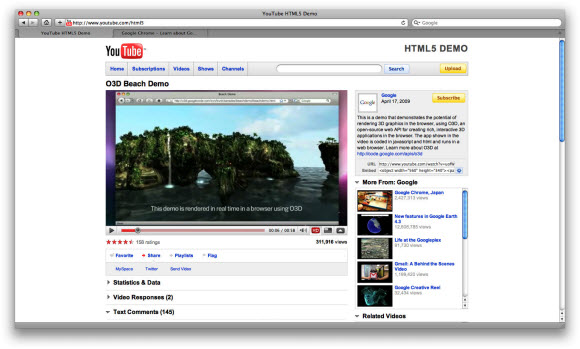
Many of the changes are aesthetic. You’ll find that YouTube has removed nearly all labels and extraneous text, resulting in a much cleaner feel (and one that feels more Googleish). The logo has even dropped the “Broadcast Yourself” tagline, though YouTube hasn’t committed to dropping that entirely. Things like the video description have been moved around, the all-important view counter is bigger, and nearly all ‘advanced’ information has been collapsed (you can hit buttons to reveal it again).

But there are also some changes that may affect how you use the site. First, YouTube has ditched the five star rating system it has employed for years in favor of a binary “Love It” or “Thumbs Down” system. The company has been talking about how useless its rating system is for some time now, so the move doesn’t come as a surprise. YouTube says that any rating your video currently has in the old system will somehow be transitioned to the new one, though the details haven’t been worked out.

The other major functional changes are related to navigation. The right side of the screen features a list of videos that you might be interested in watching next (just as YouTube has always done). But now it’s contextual. Say, for example, I ran a search for “Avatar”. Clicking on a result would bring up the video as usual, but instead of just showing Related Videos on the right hand side of the screen, YouTube will now show other search results from that query, making it much easier to jump between different results. You’ll also find that you no longer have to scroll within a widget to browse these additional videos, which was one of my gripes with the old design.

YouTube has also implemented a very slick feature for when you’re actually running a search. In the “old” YouTube, when you run a query you leave the video you’re watching and are taken to a results page. Now when you run a query, the currently playing video will slide to the left side of the screen while results populate the right-hand side, allowing you to queue up your next videos without having to stop the one you’re watching.

Other changes include new controls that let you specify what video resolution you want to view a movie in (YouTube will serve the “ideal quality” as the default).


Here’s a shot of the old site:


Read More

Google's HTML5 YouTube Videos Don't Need Flash


Up until now, talk around HTML5 has largely focused on its promise, without many major sites actually implementing HTML5-specific features as anything more than tech demos. Today, YouTube is taking steps to let users work it into their everyday browsing experience: you’ll now be able to watch some of the site’s videos without a plugin, using the video and audio playback support included with HTML5. No, you certainly won’t need HTML5 to watch any videos, but if you’d like to try viewing the site’s videos without Flash, you now have the option. You can activate the feature in the YouTube TestTube. To get the new player to work, you’ll have to be using Chrome, Safari, or ChromeFrame on IE. Note that YouTube is currently pushing the feature out, so it may be an hour or two before you can turn it on.

Unfortunately, this isn’t being rolled out to all videos. You can only watch videos that aren’t being monetized and that haven’t been annotated (obviously YouTube hasn’t implemented overlays in its HTML5 player). Still, this is a big deal — YouTube is probably the most popular Flash-reliant site on the web. The switch isn’t surprising at all given Google’s support for open standards, but it’s clear they’re moving at a fast pace.

Of course, HTML5 doesn’t really make much of a difference once you’re actually watching the video. In fact, you might not even be able to tell that the video you’re watching is being rendered without Flash (you can right-click and look for the telltale “About Flash Player…” menu item if you want to check). I’m running the dev build of Chrome on a Mac and the player is mostly working, though the Fullscreen button and volume slider are quirky.
Read More

Friday, November 20, 2009

Internet Explorer 9 to sport GPU acceleration and HTML5 support


Even if you don't have a favored fighter in the browser wars, you have to admit Microsoft's Internet Explorer has been looking mighty unfit over the last few years. Younger and fitter contenders like Mozilla's Firefox and Google's Chrome have arguably overtaken the old stalwart, and now Microsoft is making some much-needed noise about fighting back. The software giant has been giving developers and curious journalists a very early peek into its IE 9 progress at PDC, with its stated ambitions including faster Javascript (see table above), HTML5 support, and hardware acceleration for web content. By harnessing DirectX and your graphics processor, the new browser will offer improvements in text readability and video performance, as well as taking some of the load off the CPU. Development has only just got under way, mind you, so there's still plenty of time to screw it all up. Or make it awesome.
Read More