Showing posts with label YouTube. Show all posts

Monday, January 25, 2010

Mozilla takes on YouTube video choice

A disagreement between Google and Mozilla is making a once-obscure debate into a real issue for those who watch Web video or host it on their own sites.

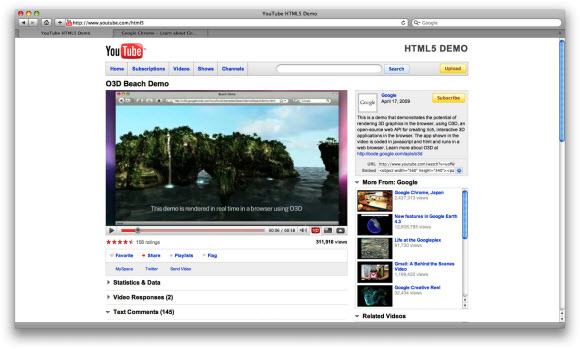
Last week, Google's YouTube announced early support for HTML5 video, which can be built directly into Web pages and viewed with browsers without relying on a plug-in such as Adobe Systems' Flash, Microsoft's Silverlight, or Apple's QuickTime. Another Web video site, Vimeo, followed suit.

Native video on a Web page sounds nice, and many Web companies support the effort broadly. But there's one big devil in its detail: the HTML5 specification, still under development, doesn't say which "codec" technology should be used to encode and decode video, and different browsers and Web sites support different standards.

YouTube, which delivers vastly more video streams over the Web than any competitor, has come down on one side of the divide, supporting the H.264 codec for HTML5 video on its TestTube site. But after Google made the move, several involved in developing Mozilla's Firefox browser began preaching a royalty-free alternative called Ogg Theora.

Mozilla grew to its present status of second-place browser in large measure by the power of word of mouth, and there's evidence the Mozilla community has begun making itself heard. After an Ogg Theora petition request on a Mozilla mailing list, requests for Ogg Theora support are on both on the YouTube product top ideas and hot ideas list.

Google wouldn't comment on whether it plans to add Ogg Theora support or what it would take to convince it to do so. However, it did leave the door open.

"Support for HTML5 is just a TestTube experiment at this time and a starting point. We can't comment specifically on what codecs we intend to support, but we're open to supporting more of them over time. At the very least we hope to help further this active and ongoing discussion," the company said in a statement.

$5 million licensing fee

Mozilla would have to pay $5 million to license the H.264 codec from MPEG-LA, the industry group that oversees the technology, said Mike Shaver, Mozilla's vice president of engineering in a blog post, and that doing so wouldn't grant rights of those such as Linux operating system companies who build products employing Mozilla's browser.

"These license fees affect not only browser developers and distributors, but also represent a toll booth on anyone who wishes to produce video content. And if H.264 becomes an accepted part of the standardized Web, those fees are a barrier to entry for developers of new browsers, those bringing the Web to new devices or platforms, and those who would build tools to help content and application development," Shaver said.

Nothing requires only one video technology to prevail. After all, different graphics formats including JPEG, GIF, and PNG are in wide use today on the Web, and today's widely used Flash technology for video will remain a fixture for years.

But supporting multiple standards takes developer time and makes Web sites more complicated. So, in the absence of a prevailing standard, Web site developers are more likely to sit on the sidelines.

A long-running issue

The difficulties have been brewing for months behind the scenes in the HTML5 standardization process. The standard's editor, Google employee Ian Hickson, decided last year against specifying a video codec in the HTML5 standard. "After an inordinate amount of discussions, both in public and privately, on the situation regarding codecs for video and audio in HTML5, I have reluctantly come to the conclusion that there is no suitable codec that all vendors are willing to implement and ship," he said in a blog post.

HTML5 video support is just arriving in Web browsers. Firefox of course supports Ogg Theora, and Opera is working on it. Apple's Safari, though, supports H.264. Internet Explorer supports neither, and Google's Chrome supports both.

YouTube and Vimeo support H.264, but not all have gone that route. Dailymotion and Wikipedia embraced Ogg Theora

Most Web sites will have to protect users from this confusion by checking what browser they're using and delivering an appropriately formatted Web page. If a desired HTML5 video format isn't supported, the Web page can fall back to Flash.

But HTML5 video offers some mechanisms for tighter integration with the Web page than Flash. To take advantage of that, developers would have to offer substantially different versions of their Web pages--one with the integration and one without it.

'Something very dangerous'

Mozilla's reflex to steer clear of patent-encumbered technology isn't academic. Unisys started seeking licensing revenue for the GIF format based on compression patents it held, but didn't start until 1999, years after the format grew popular.

"Most people don't understand that something very dangerous is taking place behind the scenes," said Chris Blizzard, who leads developer relations for Mozilla. "Unisys was asking some Web site owners $5,000 to $7,500 to able to use GIFs on their sites...We're looking at the same situation with H.264, except at a far larger scale."

And YouTube's move is a big step toward cementing H.264's position in HTML5 video, he argued.

"Their choice for H.264 had an immediate effect. It's a signal to the market that it's OK to start using H.264 as the main codec for HTML5 video," Blizzard said.

The prevailing wisdom is that H.264 offers superior quality over Ogg Theora. But Blizzard argues that Mozilla has helped the Xiph project from which the Ogg Theora format came is better, and the Ogg Vorbis audio-only codec is superior to MP3: "On the quality side what we've been able to do at Mozilla, with the help of the rest of the Xiph community, is to show that even though Theora is based on older, royalty-free technology, it does at least as well as H.264 in practice (although not always in theory.)"

Mozilla programmer Robert O'Callahan raised another issue: H.264 licensing fees could increase.

"Currently providing H.264 content on the Internet is zero-cost, but after 2010 that will almost certainly change," O'Callahan said. "We won't know much about the terms until the end of this month. The key issue is not exactly how much it will cost, but that if you want to publish H.264 you will probably have to hire lawyers and negotiate a license with the MPEG-LA.

Cutting the Gordian Knot

If this situation seems insufficiently complicated, there's another wrinkle that could come from Google.

But this one has the potential to simplify things.

That's because Google is trying to acquire On2 Technologies, the company whose earlier codec work underlies the Ogg formats. In Google's announcement of the planned acquisition, Sundar Picahai, Google's vice president of product management, had this tantalizing rationale to offer: "Today video is an essential part of the Web experience, and we believe high-quality video compression technology should be a part of the Web platform."

Of course, Google first must convince the On2 shareholders to agree, and it's had to sweeten the offer already. After that, it would have to convince browser companies and others involved in HTML standardization to go along with the idea--and it should be noted that browser makers Microsoft and Apple have patents covered by H.264.

But Apple has a growing media business through iTunes--and its Lala acquisition shows it has some interest in streaming media, too. Microsoft, meanwhile, has begun professing enthusiasm for Web standards.

So while the Web is guaranteed years of changes in Web video--if indeed it ever fully settles down--there is potential here for reconciliation.
Read More

Thursday, January 21, 2010

First YouTube, Now Vimeo: How HTML5 Could Finally Kill Flash Video

Flash powers almost all the video on the web nowadays, so it's obviously good enough. But is there a better way? YouTube, and now Vimeo, who're both giddily jumping into bed with HTML, sure seem to think so.


Vimeo's new HTML5 system is just like YouTube's, in both execution and technical details, in that it'll only work with a few browsers—Safari and Chrome, for now—and that it's compatible with most, but not all, of the company's video libraries. It's something that most people won't bother to try at this point, and if they do, they're probably be underwhelmed, since HTML5 video playback is almost indistinguishable from Flash video playback. (Moving pictures!)

But it's primed to be something that everyone ends up using, and that would be a Very Good Thing. Flash video performs terribly on Mac OS X and Linux, and on the few mobile devices that do support it, playback is uniformly terrible. And generally speaking, it's a plug-in. We whine about having to install Silverlight to use Bing Maps or watch some kinds of video, but it's a plugin the same way that Flash is.

HTML5 allows certain types of video to be rendered in the browser natively, like JPEGs or GIFs are now. It's an objectively simpler, more efficient solution, and disregarding the massive infrastructure built up around Flash video, it would be the obvious choice.

Luckily, YouTube accounts for a hefty chunk of said architecture, their catalog is rendered in HTML5-friendly h.264 format already—that's how you watch in on the iPhone and Android, by the way—and with help from smaller sites like Vimeo, they could actually get the ball rolling on, you know, murdering Flash video. In a world where everybody's browser fully supports h.264 HTML5 video—a world that's a few years away, at least—we wouldn't have to wait years for Flash support in our new phones, wouldn't have to settle of chugging video playback on near-new machines, and we wouldn't have to put up overladen, poorly-designed proprietary Flash players getting in the way of our content. We'd just have...video.

[CNET]
Read More

Meet The New YouTube: Less Clutter, Easier Search, And No More Stars

YouTube is on a roll. Last night, the world’s largest video site rolled out HTML5 support, its first video rentals, and even a nifty music feature called Disco. Today, it’s making an even bigger change: the site is launching a new ‘Watch’ page, stripping it down to its most key elements and ensuring that nothing is drawing your attention away from the video on the screen. To most people, this Watch page is really the heart of the YouTube experience — it’s where you view clips and browse for the next thing you want to watch, so any significant changes are a big deal. The new streamlined page is opt-in for now, and you can activate it here.

Many of the changes are aesthetic. You’ll find that YouTube has removed nearly all labels and extraneous text, resulting in a much cleaner feel (and one that feels more Googleish). The logo has even dropped the “Broadcast Yourself” tagline, though YouTube hasn’t committed to dropping that entirely. Things like the video description have been moved around, the all-important view counter is bigger, and nearly all ‘advanced’ information has been collapsed (you can hit buttons to reveal it again).

But there are also some changes that may affect how you use the site. First, YouTube has ditched the five star rating system it has employed for years in favor of a binary “Love It” or “Thumbs Down” system. The company has been talking about how useless its rating system is for some time now, so the move doesn’t come as a surprise. YouTube says that any rating your video currently has in the old system will somehow be transitioned to the new one, though the details haven’t been worked out.

The other major functional changes are related to navigation. The right side of the screen features a list of videos that you might be interested in watching next (just as YouTube has always done). But now it’s contextual. Say, for example, I ran a search for “Avatar”. Clicking on a result would bring up the video as usual, but instead of just showing Related Videos on the right hand side of the screen, YouTube will now show other search results from that query, making it much easier to jump between different results. You’ll also find that you no longer have to scroll within a widget to browse these additional videos, which was one of my gripes with the old design.

YouTube has also implemented a very slick feature for when you’re actually running a search. In the “old” YouTube, when you run a query you leave the video you’re watching and are taken to a results page. Now when you run a query, the currently playing video will slide to the left side of the screen while results populate the right-hand side, allowing you to queue up your next videos without having to stop the one you’re watching.

Other changes include new controls that let you specify what video resolution you want to view a movie in (YouTube will serve the “ideal quality” as the default).


Here’s a shot of the old site:


Read More

Google's HTML5 YouTube Videos Don't Need Flash


Up until now, talk around HTML5 has largely focused on its promise, without many major sites actually implementing HTML5-specific features as anything more than tech demos. Today, YouTube is taking steps to let users work it into their everyday browsing experience: you’ll now be able to watch some of the site’s videos without a plugin, using the video and audio playback support included with HTML5. No, you certainly won’t need HTML5 to watch any videos, but if you’d like to try viewing the site’s videos without Flash, you now have the option. You can activate the feature in the YouTube TestTube. To get the new player to work, you’ll have to be using Chrome, Safari, or ChromeFrame on IE. Note that YouTube is currently pushing the feature out, so it may be an hour or two before you can turn it on.

Unfortunately, this isn’t being rolled out to all videos. You can only watch videos that aren’t being monetized and that haven’t been annotated (obviously YouTube hasn’t implemented overlays in its HTML5 player). Still, this is a big deal — YouTube is probably the most popular Flash-reliant site on the web. The switch isn’t surprising at all given Google’s support for open standards, but it’s clear they’re moving at a fast pace.

Of course, HTML5 doesn’t really make much of a difference once you’re actually watching the video. In fact, you might not even be able to tell that the video you’re watching is being rendered without Flash (you can right-click and look for the telltale “About Flash Player…” menu item if you want to check). I’m running the dev build of Chrome on a Mac and the player is mostly working, though the Fullscreen button and volume slider are quirky.
Read More

Monday, December 21, 2009

YouTube Gets Its Own Short URLs. Except They’re Still Pretty Long.

Looks like Google is really going full steam ahead with its shortened URLs. Only a week after the search giant launched its own Goo.gl short URLs, its subsidiary YouTube is launching its own short URL service: youtu.be.

In a blog post announcing the new feature, YouTube writes that the short URL will be used exclusively for YouTube videos (which means it isn’t as useful to spammers for misdirection). The post also notes that because all youtu.be shortlinks include the YouTube video ID, developers can use that information to surface thumbnails and track how a video is spreading.

Unfortunately, embedding a video ID has a downside: they’re relatively long. Whereas your typical bit.ly link weighs in at around 20 characters, a youtu.be link comes out to 27 characters, primarily because YouTube IDs are a beefy 11 characters long. That may not sound like much, but those extra 7 characters represent 5% of your maximum tweet length. Hopefully the features that video IDs enable for developers will outweigh that cost.

Any videos shared through YouTube’s autosharing features to Facebook, Twitter, and Google Reader will take advantage of the new short URLs automatically. You can also create the link yourself in this format:

To use youtu.be manually, simply take a URL like http://www.youtube.com/watch?v=FdeioVndUhs and replace the “http://www.youtube.com/watch?v=” with “http://youtu.be/” to get: http://youtu.be/FdeioVndUhs Plug that shorter URL into a browser, and you’ll see it redirects to that video.

Read More

Thursday, December 03, 2009

YouTube begins testing lighter 'feather' version

In a nod to efficiency, YouTube on Thursday began testing a more lightweight version of its video player pages called "feather."

Feather pages do a number of things to speed up the video-playing process, from defaulting to the standard quality version (instead of high quality or high definition), to removing various on-page features such as being able to control the size and coloring of an embed. The idea is to get the video playing as soon as possible with fewer on-page distractions.

Other efficiencies include limiting the number of loaded comments to just 10, which users are now unable to vote on or respond to. Video replies, real-time sharing, and auto-suggest from YouTube's search bar have also been cut. However, related videos remain--albeit at a more limited 5 videos compared to YouTube's usual offering of 21.

Users who want to try out the new interface can do so by opting in to it on YouTube's TestTube page, which houses experimental, or otherwise not-so-ready-for-primetime features. These include YouTube's visual warp browser, its live streams product, and comment search tool. Once it's enabled, it can quickly be disabled from any video page with a little green box that sits on the bottom right-hand corner of the screen.

It's worth noting the feature does not yet appear to work on all videos just yet. We had the best luck on popular videos, including those from YouTube's featured section. Also, if you're a YouTube power user who regularly makes use of things such as video replies and user comments, it's worth staying on the standard version of the service.

Below you can see a before and after of feather mode on the same video.


Read More

Friday, November 20, 2009

YouTube pulls a Hulu -- yanking API access from Popcorn Hour (Update: Google responds)

Hope you weren't enjoying watching YouTube on the television screen via Popcorn Hour and other set-top boxes, as they have been given notice by the newly 1080p and network TV-friendly website that they are no longer welcome to access its content. The new Hulu-ish Terms of Service (section II, item 10) restricts API clients from the ability to "use the YouTube API in connection with any API Client created for use on television set top boxes, television game consoles, or video screens packaged and marketed as television sets;" according to Popcorn Hour COO Alex Limberis this applies to all with the exception of "a few strategic partner's Google has singled out" -- PlayStation 3, Wii, TiVo, Panasonic, Samsung and other licensed hardware is safe.

Update: After speaking with Alex we've got a better view of the situation -- as is clear from the TOS, manufacturers streaming directly via the API as Popcorn Hour did are no longer welcome without cutting a seven figure check to license access. Google did offer to allow continued access via its YouTube XL interface, but for devices like theirs not built around Flash, that possible solution proved to be technologically unfeasible. Obviously these changes apply to all, but as of yet we're not aware of anyone other than Popcorn Hour that has been contacted directly about it.

Update v2: After the break is Google's response, stating Popcorn Hour and the like have been in violation of the above TOS for over a year, from its perspective, this is a simple matter of defending its rights from "video scraping technology." As we mentioned above that means most are in no danger of losing access, but fans of these media streamers will have to live without it, until either YouTube can control the experience or the manufacturer pays up.
Google's statement:

Since July of 2008, YouTube's Terms of Service has restricted implementations for televisions based on our APIs. YouTube has been in active discussions with various developers on how best to implement YouTube on set top boxes and TVs. There are several companies, however, that have deployed solutions, like video scraping technology, to circumvent the rules and violate YouTube's Terms of Service. Companies that have negotiated agreements to use our APIs, like TiVo, Sony, Panasonic and PS3 are not impacted.
Read More