Showing posts with label Samsung. Show all posts

Sunday, February 14, 2010

Samsung Wave S8500 specs and photos show up

Samsung Wave S8500, the South Korean company’s first Bada OS smartphone, has just appeared in lots of live photos – ahead of its official announcement at MWC 2010.


As it turns out, the Samsung Wave S8500 is only 10.9mm thick and features about everything you’d want from a modern smartphone.

The Wave S8500 looks really nice, too, and its body is made out of aluminum, while its display is covered with tempered glass (anti-scratching).


And here are the known specs of Samsung Wave S8500:

* 3.3 inch AMOLED touchscreen display
* Bada OS with TouchWiz 3.0
* HSDPA
* Wi-Fi b/g/n
* 3.5mm headset jack
* DivX player
* 5MP autofocus camera with flash and 720p video recording
* 1GHz CPU (probably Snapdragon)
* 2GB of internal memory
* MicroSD card slot
* 1500 mAh battery

GPS is probably somewhere in there, too.

Details about the price and release date of Samsung S8500 Wave are not known at the moment, but we’ll probably know them tomorrow or on Monday.

Via DailyMobile
Read More

Saturday, February 13, 2010

Samsung Wave Bada phone spotted already

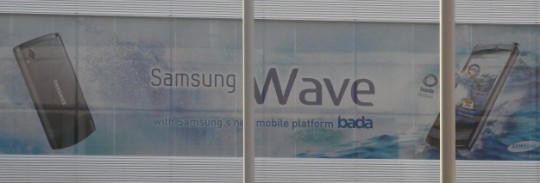
If you want to keep your upcoming cellphone quiet until its triumphant MWC 2010 debut, it’s probably a bad idea to put up a huge banner showing it in all its glory. Unfortunately Samsung didn’t appear to get that memo, and so we have the first official shots of the Samsung Wave, running their new Bada platform.


the:unwired’s Arne Hess is already on the ground at MWC and the above photo showed up in his photo stream. Of course beyond the name and what we can glean from the images there’s no telling what the Wave’s full specifications might be; it’s obviously a full touchscreen device with a camera (and what looks like an LED flash) on the back, but we’ll have to wait until Samsung’s press conference to find out exact functionality.

As for Bada, we’re still not quite sure whether the cellphone market really needs a new platform. Samsung are positioning Bada as a smartphone OS for the everyman, bringing high-end features down to a hitherto featurephone price point, and they’re counting on their sales figures to make it a success.

[via Cellular Mania]
Read More

Tuesday, February 09, 2010

Motorola still leading the US mobile market, followed by LG and Samsung

Although Motorola is struggling for market share in Europe and Asia, it’s still the number one phone maker in the US.


According to comScore, which ranked handset makers “according to their share of current mobile subscribers age 13 and older,” Motorola had 23.5% phone market share in the US between September and December 2009, while LG and Samsung came second and third, with 21.9% and 21.2% market share, respectively. Nokia was in the fourth place (9.2% market share), while RIM’s 7.0% share put the company in the fifth place.

If we talk about smartphones, things are quite different.

RIM led the US smartphone market with 41.6% share. Apple came in second, with 25.3, followed by Microsoft (and its Windows Mobile platform) with 18.0%, and Palm with 6.1%. Google’s Android ranked only fifth, with 5.2% – but its market share almost doubled over the previous month.

Other interesting findings: about 234 million people age 13 and older used mobile phones in the US in December last year. 63.1% of them used text messaging on their phones, 27.5% browsed the web, while 21.6% played games.


Read More

Samsung Monte S5620 gets official

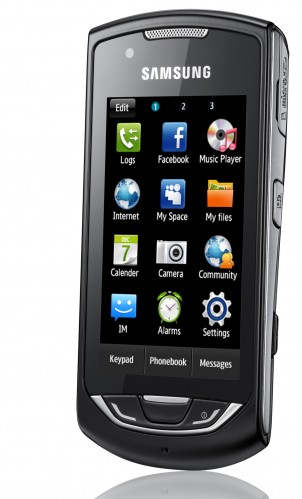
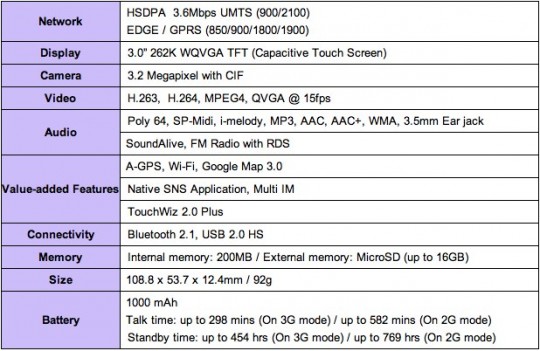
A little over a week since we saw it leak into the wild, the Samsung Monte S5620 has been officially launched. A 3-inch capacitive touchscreen featurephone, the Monte S5620 packs UMTS/HSDPA (900/2100, 3.6Mbps) along with quadband GSM, WiFi, A-GPS and Bluetooth 2.1. The Monte also has a 3.2-megapixel camera with smile-shot and face detection.

While the Monte isn’t a smartphone – in fact it runs Samsung’s own TouchWiz 2.0 Plus platform – Samsung reckon it has much of the functionality of one. They’re particularly proud of the handset’s browsing abilities, which support full HTML and both landscape and portrait modes, and its social networking: there are Facebook and MySpace apps, as well as Twitter and Bebo widgets and a multi-platform IM client.

You also get Exchange ActiveSync support, an FM radio with RDS and Google Maps 3.0. Memory is 200MB internal with a microSD slot (up to 16GB cards supported) and the 1,000mAh battery is rated for up to 298 minutes 3G talktime or 454hrs 3G standby.

No word on how much the Samsung Monte will cost, nor which markets it will ship in, but the company apparently plan to have it at Mobile World Congress 2010 next week.


Read More

Monday, February 08, 2010

Samsung to announce Super AMOLED phone at MWC, maybe Bada-based?

We already know that Samsung will announce its first Bada phone at MWC 2010, and now it looks like the South Korean company has yet another surprise prepared for the show that’s set to debut next week.


SamsungHub has it that a Samsung phone with a Super AMOLED touchscreen display (possibly WVGA) will be unveiled at MWC. Reportedly, Super AMOLED displays integrate a touch sensor, have better direct sunlight visibility, and are five times more vivid than AMOLED screens currently on the market.

There’s no image of the Super AMOLED Samsung phone yet, but I think this is the same handset that appeared at GSM Arena next to an iPhone. The supposed Samsung device is on the left (both displays have been set at maximum brightness):


Of course, the Super AMOLED phone could run Bada OS, so then Samsung might announce just one new handset at MWC. In fact, Samsung officially says that it has only one “new mobile” ready for MWC – although we can’t be sure of anything until the show actually debuts.
Read More

Friday, February 05, 2010

Samsung plans to overtake HTC in smartphone sales this year

We already know that Samsung hopes to sell 270 million phones this year, 100 million of which may be touchscreen devices.


But Samsung’s ambitions don’t stop here. The South Korean company also plans to increase smartphone production and overtake HTC – currently the world’s fourth largest smartphone maker (after Nokia, RIM and Apple).

At the moment, Samsung is the world’s fifth smartphone manufacturer with a 3% market share. The company intends to sell about 18 million smartphones by the end of 2010 – up from 6 million in 2009.

Most of this year’s Samsung smartphones will be based on Android, although handsets with Windows Mobile and the company’s own Bada OS will also be introduced.

HTC is a smartphone maker by default (although it recently announced its first featurephone, the Brew-based HTC Smart), so it will be hard for Samsung to take its place in the smartphone market – especially since HTC will (probably) also increase Android handset production.
Read More

Samsung's transparent OLED laptop could hit retail, IceTouch PMP will get the ball rolling


So um, remember this crazy 14-inch transparent OLED display Samsung was showing off perched atop a laptop at CES? Yea, that might be in the shops within the next 12 months. If that doesn't get you tingling with excitement, we don't know what will. Samsung will start its big push toward translucency with the IceTouch PMP, which we found to have a gorgeous 2-inch display in our earlier hands-on, but it's already working away in the labs on turning the prototype above into a concrete retail product. The IceTouch is slated to make its US arrival early in the first half of this year, priced at around $332. European availability is as yet uncomfirmed, but the Korean's company is being very ambitious about its technology, suggesting that windscreen-mounted SatNav units could be next on the agenda and ruling nothing out as it strives to bring its transparent AMOLED displays into the mainstream.
Read More

Monday, February 01, 2010

Samsung’s Bada OS gets good response from carriers, Bada phone coming at MWC

Samsung has reportedly presented its newly-announced Bada operating system to mobile carriers around the globe and, according to Kim Hyung-do (Samsung’s vice president for strategic planning), the company has received good response from carriers.

And speaking of carriers, Samsung has just announced that its first Bada phone (Bada S8200, maybe?) will be showcased at MWC 2010 (15-18 February), which means that it might be available starting this spring.

Unsurprisingly, Bada OS will include the latest version of Samsung’s TouchWiz UI, which comes with “chic touch interaction and components to increase its simplicity and ease of use.”

Bada OS aside, Samsung plans to launch an Android 2.1 smartphone in the first half of this year. As for Windows Mobile, it looks like Samsung will further reduce its dependency on it – as we’ve previously reported.
Read More

Friday, January 29, 2010

Samsung sold 227 million phones in 2009

Just like Nokia, Samsung had a pretty good Q4 in 2009.


The South Korean company sold 69 million phones in the quarter, 9 million more than in Q3 2009 and 16% more than in Q4 2008. This allowed Samsung to exceed its target for 2009 and sell more than 200 million handsets – 227 million, to be exact (as we previously reported, about 40 million of those are touchscreen phones).

Samsung’s Mobile Unit reported revenue of 11.57 trillion won ($9.9 billion) and an operating profit of 0.99 trillion won ($852 million).

The company (currently the world’s second largest phone maker) estimates that its global market share exceeded 20% in 2009, helped by a steady growth in North America, Europe and emerging markets.

For 2010, Samsung wants to focus “on mid- and high-end touch screen handsets and smart phones in developed markets, while streamlining its lineup and offering specialized products for emerging markets.”

Samsung might sell over 270 million phones in 2010, 100 million of which could be touchscreen handsets.
Read More

Thursday, January 21, 2010

Samsung files for “Vita OS” trademark – another mobile OS?

Samsung is yet to show us what its newly-announced Bada OS is all about. Until we see any Bada phones, though, we have to mention that Samsung could be readying another mobile OS called Vita OS – or maybe that’s just an alternative name for Bada, we can’t know for sure.


What we do know is that Samsung filed for a “Samsung Vita OS” trademark on October 22, 2009, with the United States Patent and Trademark Office (USPTO) – one day after it filed for the Bada OS trademark.

Like the Bada OS trademark, the Vita OS one is related to “mobile phones; mobile phone operating system software installed in mobile phones”, so it’s obvious that Samsung wanted or still wants to use this name for its mobile platform.

On December 23 last year, Samsung has also registered samsungvita.com, although there’s nothing to see there at the moment.


Launching two different mobile OSes wouldn’t really make sense, so the Vita name (vita means life in Italian, by the way) may be just a cover in case the Bada naming would somehow fail. How could it fail? Well, someone posted a comment at SamsungHub, saying that this may have “something to do with a trademark problem that could affect the European trademark of bada. There is a company in Germany that could block the German and EU registration of Samsung’s bada trademark ‘cause it’s using an almost identical looking trademark in the same category.”

Said company’s website is this one – but I can’t see any Bada references there.

We’ll bring more details about Samsung’s Vita OS as soon as new relevant info shows up.
Read More

Thursday, January 07, 2010

Samsung's 14-inch transparent OLED laptop (video)


If you thought the XPERIA Pureness was wild with its meager 1.8-inch transparent screen, wait'll you get a hold of Samsung Mobile Display's prototype 14-inch notebook -- complete with what's being touted as the world's first and largest transparent OLED prototype. When the thing is off, the panel is up to 40 percent transparent (as opposed to the industry average of below twenty-five percent). Not much more to say about it (we'll let you know as soon as our friends from Korea tell us more), but there is plenty to see: so get a load of the video after the break.


Read More

Monday, December 21, 2009

Samsung M5650 Lindy officially announced

First spotted a few weeks ago, the Samsung M5650 Lindy has been officially announced by Samsung, coming as some sort of a successor to the Corby S3650.


Samsung says that the M5650 Lindy is a music phone, and given the touch sensitive music dedicated keys on the front, we have to agree with that. The phone also seems to have a 3.5mm headset jack.

Its other features include: 2.8 inch QVGA display, HSDPA connectivity, Wi-Fi, FM radio, 3MP camera, 50MB of internal memory and MicroSD card support.


As we previously said, Samsung M5650 Lindy is already available in Portugal (priced at €159). It will soon be launched in other European countries, as well as in India, China, Southeast Asia, the Middle East and Africa.
Read More

Tuesday, December 15, 2009

Nokia and Samsung invest millions in Swype’s touchscreen typing technology

Swype, a Seattle-based company that develops a new way of typing on touchscreen displays, has secured a $5.6 million funding from Nokia and Samsung (via the companies’ subsidiaries Nokia Growth Partners and Samsung Ventures, respectively).


Reportedly, Swype allows users to write “over 40 words per minute on touchscreen devices” by intelligently guessing the words you want to type, and the new funding will further help it improve its technology.

For the moment, only one handset features Swype’s technology (Verizon’s Omnia II), but Swype plans to offer it to several other WM and Android smartphones next year – and maybe to Nokia’s touchscreen handsets, too.

What’s interesting is that Samsung has recently announced a partnership with Nuance, another provider of predictive text input software, saying that its phones (touchscreen ones included) will be shipped with the T9 and XT9 products.
Read More

Sunday, December 13, 2009

Can Nokia Recapture Its Glory Days?

IF there’s anywhere left in the world where it’s still impolite to flash a BlackBerry or an iPhone, it’s Nokia’s annual analyst meeting.

But earlier this month, as executives talked up the company’s plans for 2010, the optimistic message from the stage was belied by the behavior of the audience. In the back of the room, one money manager after another distractedly toyed with a competing device, typically a BlackBerry, even as cheery PowerPoint slides promoted Nokia’s latest offerings.

Francois Meunier, an analyst with Cazenove in London, whispered doubts about the presentation as he tried to catch the eye of one of the floor managers handing out microphones for the question-and-answer session. Finally, it was Mr. Meunier’s turn, but before he could ask an actual question, he couldn’t resist declaring publicly what he’d been muttering all afternoon.

“I don’t think anyone in this room is expecting an improvement in earnings next year,” he told the assembled executives, before asking whether Nokia’s 4 percent dividend is sustainable.

Mr. Meunier’s downbeat assessment of the once-mighty mobile phone maker’s prospects in 2010 comes after an equally gloomy 2009, a year the company would just as soon forget.

Although Nokia, based near Helsinki in Espoo, still commands 37 percent of the world’s handset market, it’s facing bruising competition in the lucrative high end of the industry, where Apple’s iPhone and Research in Motion’s BlackBerry have grabbed the cool factor in smartphones that can surf the Web and handle e-mail.

“The whole user experience is a nightmare,” moans Nick Jones, a senior analyst with Gartner, which tracks the technology sector. “It’s just not in any sense a competitive experience with iPhone.”

Olli-Pekka Kallasvuo, the company’s taciturn chief executive, admits the mood out there is gloomy, especially on Wall Street. “We are not getting the benefit of the doubt,” he said in an interview the day after the analysts’ meeting. “We need to change that.”

Nokia’s problems are especially acute in North America, where its hold on smartphones equals a barely visible 3.9 percent, compared with 51 percent for Research in Motion and 29.5 percent for Apple, according to Gartner. As if to underscore its problems in the United States, Nokia announced Thursday that it would shutter its flagship stores in New York and Chicago.

“We made wrong decisions in the American market,” says Kai Oistamo, executive vice president for devices. For example, Nokia was slow to make the change to so-called clamshell phones, sticking with “monoblock” models even as consumers abandoned them.

And while Nokia first offered touch-screen technology in 2004 — three years before the debut of the iPhone — Apple’s models quickly made Nokia’s competing products look stodgy. Most of Nokia’s touch-screen phones can’t quickly transform their screen with the jab of a finger, which is among the factors that make the iPhone seem so much more slick.

Until recently, according to both Nokia executives and industry experts, the company didn’t want to produce phones specifically tailored for American consumer tastes, and it resisted demands from the major carriers to come up with phones based around their brands and individual specifications.

“The market in the U.S. has always been dominated by the carriers, so they call the shots,” says Carolina Milanesi of Gartner. “And Nokia has had a difficult relationship with the carriers.”

Nokia has also been hobbled by its traditional weakness in phones employing C.D.M.A., the wireless technology offered by Sprint and Verizon Wireless that’s used by about 50 percent of American consumers. (Sprint’s current lineup does not include any Nokia models.) Nokia focuses instead on G.S.M. phones for AT&T and T-Mobile. However, AT&T’s exclusive deal with Apple has hurt Nokia in the high-end smartphone market.

And though Nokia sells a lot of smartphones elsewhere in the world, its share of the global smartphone market has fallen to 39.3 percent, down from 42.3 percent a year ago. Even in Nokia’s home base of Europe, the iPhone is rapidly gaining in popularity.

Nokia is finally responding — its lithe, BlackBerry-like E72 appeared in the United States on Tuesday — but it is facing looming threats in other segments.

Google is offering Android, a rival to Nokia’s own operating system, which has been picked up by competitors like HTC, Motorola and Dell, while Asian manufacturers are turning up the heat with low-priced handsets in emerging economies where Nokia has long enjoyed outsize market share. Meanwhile, Apple and Nokia are locked in a legal battle over patents.

“Nokia faces competition everywhere,” says Sherief Bakr, a Citigroup analyst. “At the high end from Apple, in the midrange by Research in Motion, and by the Koreans and the Chinese in the low end.”

ALL in all, it’s enough to make the mood as grim as a December day in Helsinki, where the sun struggles to get above the horizon by 9 a.m and night falls at 4 p.m.

Once a stock market darling, Nokia shares have fallen 20 percent since September even as the broader market has rallied. The company reported its first quarterly loss in more than a decade in October after a $1.3 billion write-down in its equipment business.

Here in Finland, Nokia’s problems are felt especially keenly. Nokia accounts for 25 percent of the Helsinki stock exchange’s capitalization and one-third of Finland’s total research and development spending, according to Jyrki Ali-Yrkko, of the private Research Institute of the Finnish Economy.

Deeper than the numbers, however, has been the damage to Nokia’s role as a wellspring of pride in a country historically known for exporting wood and paper products, not high tech.

Nokia’s roots go back to 1865, and as recently as the 1980s, its products included not only cable and telecom equipment but also rubber boots and toilet paper. But in the early 1990s, many businesses were spun off in favor of the growing cellphone sector. By the mid-1990s, under its former chief executive and current chairman, Jorma Ollila, the profits were rolling in.

Nokia quickly became one of Europe’s rare technology success stories, an exception in an industry dominated by American and Japanese giants. And in a traditional, social-democratic Nordic country where ostentatious displays of wealth are frowned upon, hundreds of long-time employees became Nokia millionaires, says Mr. Ali-Yrkko.

“Nokia has been the flagship of Finland in terms of a company succeeding on a global scale,” he says. “But that sense of glory we had has disappeared, or at least diminished.”

The problems have reached all the way to Finland’s national coffers. In 2007, Nokia paid 18 percent of Finland’s overall corporate taxes, but that dropped to 9 percent last year, and the contribution is expected to be even lower in 2009. The Finnish government may have to increase borrowing to make up for the shortfall, warns Mr. Ali-Yrkko.

A lawyer by training, the C.E.O. Mr. Kallasvuo is a much more cautious leader than his predecessor, the charismatic Mr. Ollila, who some Finns thought might go into politics after he stepped down as chief executive in 2006. At times, Mr. Kallasvuo seems uneasy when pressed for his vision of Nokia’s future, and repeated earnings disappointments have led many analysts to question whether his dour style is what’s needed as new competitors circle.

“The market believes this is a management team that can’t and won’t execute,” says Mr. Bakr. “There is a large element of investors who are not convinced that Kallasvuo is the man who can make this transition and compete with the likes of Steve Jobs.”

Despite the pessimism outside, Mr. Kallasvuo insists spirits are still high inside the company. “Competition is nothing new; we’ve been attacked by many players,” he says. And while last quarter’s performance “was difficult for me and the C.F.O., it wasn’t a difficult moment for an excited Nokia engineer who wants to change the world.”

IF Olli-Pekka Kallasvuo seems to have stepped off the set of an Ingmar Bergman movie, then Anssi Vanjoki’s charisma and sculpted features recall Michael Douglas. An 18-year veteran of Nokia, he is the executive vice president for markets as well as something of a standout in Nokia’s geeky culture. In a country where speeding tickets are directly tied to income on a sliding scale, he racked up a 116,000 euro ($170,000) fine racing his motorcycle through Helsinki, although he was able to negotiate that figure down somewhat.

Much more feisty than Mr. Kallasvuo, he is unwilling to admit Nokia has lost any of its competitive edge. “We have not lost our ability to innovate; we have not lost our ability to truly understand the consumer and make intuitive solutions for them,” Mr. Vanjoki says.

Indeed, for all the new competition in smartphones, Nokia remains the dominant player in conventional handsets, selling roughly 15 phones a second worldwide, according to the company, including the Nokia 1201, a basic model that is its best seller. Analysts project revenue in 2010 will top $60 billion, while profit is expected to equal $3.5 billion next year as the overall phone market grows 10 percent.

And while market share might be minuscule in North America, the company commands a whopping 62.3 percent of the market in the Middle East and Africa, as well as 48.5 percent in Eastern Europe and 41.8 percent in Asia. “We are the incumbent behemoth of the mobile arena,” Mr. Vanjoki boasts.

What’s more, Nokia has been written off before.

Citing past crises in 1998 (the advent of smaller phones), 2001 (the bursting of the tech bubble) and 2004 (the sudden popularity of flip phones), Mr. Vanjoki says. “we’ve always had points where technology hit a plateau and had to be reconfigured.”

SO why didn’t Nokia move more quickly to counter Apple and Research in Motion in smartphones? “We didn’t execute; we were aiming at too geeky a community,” he says. “Apple is made for the common man. It’s more for Joe Six-Pack than techno-geeks. But we understand Joe Six-Pack too.”

The coming 12 months will show whether Mr. Vanjoki’s confidence is warranted, and he better be right as far as shareholders are concerned, since smartphones are where the growth is.

By 2013, Gartner predicts smart device sales will represent 82.5 percent of the mobile phone business in Western Europe, and 58.2 percent of sales in North America and 18.2 percent in Asia. Nokia generated $5.6 billion in sales from conventional phones in the third quarter worldwide, compared to $4.6 billion for smartphones.

Nokia executives say new offerings like the N900, which is as much a mobile computer as it is a phone, or the N97 Mini, which combines touch-screen technology with a qwerty keyboard, will win back buzz from Apple and BlackBerry while appealing to the company’s 1.1 billion customers. Then there’s the X6, out this month, which includes Nokia’s Comes With Music plan, allowing users to choose from millions of songs they can download free from Nokia’s Music Store.

Another crucial development in 2010, according to Mr. Kallasvuo, will be a bigger push for North American market share, as Nokia works more closely with carriers and brings out more smartphones. “We have not invested enough there,” he says. “It’s a necessity for us.”

Although it’s still secret, Nokia executives are also promising a smartphone for next year that will update the company’s aging Symbian operating system, combining the touch-screen coolness of the iPhone with a BlackBerry-like e-mail solution. “We intend to give R.I.M. a run for their money,” says Mr. Kallasvuo.

And though Nokia’s flagship outlets in the United States may be folding, the Finnish giant is still trying to compete directly with Apple online, opening Ovi (“door” in Finnish) in May to compete with Apple’s hugely successful Apps Store.

Looking out further, Nokia’s engineers are promising nifty new features like the ability to simply point your phone at a friend to connect to the person’s Facebook page.

For all of Nokia’s mistakes, Citigroup’s Mr. Bakr says the company can bounce back yet again. “Sitting in London or New York, you don’t appreciate the dynamics of Nokia’s huge market share, especially in emerging markets,” he says. “I think they know what they’ve done wrong and what they need to do right. It’s just a question of whether they can execute in time.”
Read More

Tuesday, December 08, 2009

Samsung teases Bada at event, questions still outnumber answers


We've just come back from the Samsung Bada mobile platform launch event in London, and frankly the presentation was no more than an app developer and investor magnet -- no hands-on opportunity and no direct answers regarding the hardware. The only mention of a Bada phone is that something's coming out in the first half of 2010. That said, today Samsung did bring in representatives of five strong Bada app partners: Twitter, Capcom, EA, Gameloft and Blockbuster. Needless to say mobile gaming is high up on Bada's agenda, but the brief presence of Twitter's Head of Mobile, Kevin Thau, solidified Samsung's dedication for integrating SNS (social networking services) sites on mobile handsets. Yes, just like many fish in the sea. Read on to see how Bada aims to be "an ocean of endless enjoyment."


Open platform
Despite the presentation leaving us scratching heads as to what Bada really is, we had the chance to sit down with the platform's Principal Engineer, Dr. Justin Hong, who nicely broke it down for us. Bada's objective is to be "an easy-to-integrate platform" to tickle the interest of developers, but at the same time being able to cover a wide range of device specifications (although Hong admitted there's no plan to implement Bada on old hardware). For now Bada will work on top of Samsung's proprietary SHP (Samsung Handset Platform, which was also led by Hong) OS as found on the Samsung Jet, and will feature the forthcoming TouchWiz 3.0 UI as the icing on the cake. When asked about Symbian Hong simply said there's no decision to support it for Bada, but they'll continue to support multiple OSes -- as promised before -- as the market "always need different OSes" to maintain high customer satisfaction. Frankly, it's just money talk on that last part, as Hong then went on about how they also need to customize their phones to fit the carriers' requirements. What's for sure is that Samsung's committed to provide greater support to Bada developers.


Bada is optimized for developing SNS apps. For example, carriers can easily code in location-based SNS features using just a few lines from a large set of API supporting popular sites like Twitter and Facebook. Another main feature is that Bada will exclusively support multitouch -- or 'multipoint touch', as they like to call it -- phones, and interestingly Hong told us that it will work on both resistive and capacitive touchscreens. Combining both of these features we expect some pretty sweet games. The hardware requirements for Bada are yet to be finalized, but Hong reassured us that Bada's not bound by chipsets, and that the cheapest Bada handset will definitely be cheaper than Android's counterpart. This goes along with Samsung's "Smartphone for Everyone" strategy which, on top of Bada's in-app (and over-the-air) purchasing, equates to greater revenue for the developers if all goes well. Oh, and Bada supports Flash-based apps too -- check out the fancy Chelsea Football Club app simulation toward the end of the video below.


Bada applications
As mentioned earlier, Samsung has several big name studios producing games for the Bada platform. While there were no live demoes, we're already digging Capcom's "Resident Evil: Degeneration", but the rep's constant mentioning of "Street Fighters" is also looking hopeful. Another interesting app is "My Friends" made by Onycom, which essentially aggregates all your social networking contacts -- very much like Palm's Synergy and Motorola's MOTOBLUR. We're not sure if these two will be preloaded on all Bada phones, but what's for sure is that they will have a map app -- "Where to go" by deCarta. We were most impressed by Blockbuster's vision: CIO Neil Davis spoke of offering a seamless media experience where you can stop half way through a Blu-ray disc at home, and then "walk to your car and finish it up on a Bada handset." We queried Samsung about this possibility and sadly its VP of Global Marketing, Younghee Lee, wasn't so optimistic. Spoilsport.


Wrap-up
While what Bada's trying to achieve is not totally new, we're impressed by Samsung's success in convincing a handful of high-profile companies to develop apps for this new platform. We're most looking forward to the support of Flash apps as well as what the game developers will offer. If Samsung sticks to its promise about the affordability of Bada phones, then 2010 is going to be an interesting year for the smartphone market.
Read More

Monday, November 16, 2009

Samsung unveils Android-equipped Galaxy Spica i5700


The long-rumored little brother to the Galaxy, the i5700, has finally been made official by Samsung -- and sure enough, it'll go by the trade name "Galaxy Spica." Sammy's latest Android-powered set clocks in at 13.2mm thick and comes equipped with a 3.5mm jack (which, frankly, every smartphone in the world should be including at this point), an 800MHz core (presumably the same as the Moment's), and an Android first: built-in DivX support. This one appears to be a no-frills Google Experience device considering the number of times that "Google" is mentioned in Samsung's press release, but for some Android connoisseurs, the purest, unskinned look and feel is preferred. Sammy says it's already out in Europe and the CIS and will be coming to the Middle East and Asia shortly.
Read More

Saturday, November 14, 2009

Samsung to make 100 million touchscreen phones in 2010, 65% of them with capacitive screens

We recently told you that Samsung plans to sell about 270 million phones in 2010, and it looks like 100 million of those will be touchscreen handsets.

According to Telecoms Korea and a Shinhan Investment report, Samsung should ship about 57 million touhcscreen phones by the end of 2009, and it plans to almost double this number in 2010 to reach the aforementioned 100 million mark.

65% of Samsung’s touchscreen phones sold in 2010 should have capacitive displays, notes the report.

LG also intends to ship more touchscreen handsets next year, but only 20% of them will have capacitive screens.

Both Samsung and LG have touchscreen phones that were sold at record paces this year: the Samsung Star, pictured above (10 million units until now), and the LG Cookie (more than 5 million units). Interestingly, both the Star and the Cookie have resistive touchscreen displays, not capacitive.
Read More