Showing posts with label Netbook. Show all posts

Monday, December 28, 2009

Google’s Chrome OS netbook specs revealed

Back when a Google-branded Chrome OS netbook was tipped for late 2010, we were still in the dark regarding potential specifications for the web-centric ultraportable. Now IBTimes is claiming to have the official spec sheet, and as speculated there’s both an ARM-based CPU and NVIDIA’s Tegra chipset among the components. There’s also a 10.1-inch display with multitouch-capable touchscreen mentioned, able to display HD – likely 720p – video, together with a 64GB SSD and 2GB of RAM.

Connectivity is believed to include WiFi, Bluetooth and 3G, together with ethernet, audio in/out and a multiformat memory card reader, and there’s a webcam too.

A sub-$300 price tag is tipped, thanks to both Google and carrier subsidies, and the search giant are expected to preload their usual batch of applications including Google Maps, Google Voice and Google Docs. The only unusual element is the relatively large amount of local storage; Google have previously said that cloud storage will be primarily used.
Read More

Thursday, December 17, 2009

Get Ready For The Google Branded Chrome OS Netbook

Most of the tech world now considers it a given that Google will be selling its own unlocked phone, called the Nexus One, to customers directly early in 2010. A few stragglers are still debating the finer points of the difference between Google working with handset manufacturers and carriers on a good Android experience v. them dictating the hardware specs and selling it directly to users. While they work that out for themselves we’re off to the next story – the Google Chrome OS Netbook (although we think Google has a few surprises left around the Nexus One, too).

Google has said from the beginning that they plan on working with select manufacturers to ensure a good Chrome OS experience for users when devices first hit the market next year. From an early FAQ: “The Google Chrome OS team is currently working with a number of technology companies to design and build devices that deliver an extraordinary end user experience. Among others, these companies include Acer, Adobe, ASUS, Freescale, Hewlett-Packard, Lenovo, Qualcomm, Texas Instruments, and Toshiba.”

Most people assume that “working with” around Chrome OS means the same thing as “working with” around Android – lots of meetings to make sure the devices and software work together as well as possible. But sometimes those pesky hardware guys just don’t do things quite right. And when you’re competing against Apple, everything most definitely needs to be quite right.

That may explain why Google has, according to multiple sources, been talking to at least one hardware manufacturer about building a netbook for Google directly. As in Google gave the company a RFP with quite detailed technical specifications and has begun discussions on building it.

They’re not in any particular hurry and seem to be aiming for the 2010 holiday season, a full year from now. Our understanding is that Google intends to have the devices built, branded with Google, and then sell them directly to consumers. The only firm tech spec we’ve heard is that they’ll be mobile enabled, and likely tied to one or more carriers with a subsidy.

I’m dying to get my hands on that RFP and have been feverishly calling our contacts in Taiwan and China to see if we can get someone to quietly hand it over to us. In particular I want to know whether Google is going with an Intel Atom processor, the current leader in netbooks, or may be considering an ARM CPU. I’d be willing to bet one of our writers’ right hands that it’s ARM. And I’d even go out on a limb and suggest that they may very well be targeting Nvidia’s Tegra line. Those chips are outperforming Atom in every way, say some of the hardware guys we know. HD Flash video no problem (something the Atom can’t do), and at a fraction of the power usage.

What does that mean? It means next Christmas you may be getting a high performance Google branded netbook running Chrome OS for next to nothing. And if it’s running ARM, Intel is going to be freaking the hell out about it.

As an aside, if you need a netbook now, I’d recommend the Nokia Booklet 3G. It’s amazing, and you can get it for $300 with a 2 year AT&T data plan. Nokia may not be able to make phones anyone gets excited about any more, but that netbook is cool.
Read More

Sunday, November 22, 2009

Will Chrome OS Lead to More Powerful Win7 Netbooks?

Netbooks running Windows 7 could perform better, but Microsoft won't let them. With Chrome OS coming, Redmond may lose its ability to cripple low-cost portables.

Chrome OS may lead to higher-performance netbooks, but many of them will not be running Google's next-generation operating system.

Why? Because Chrome OS could force Microsoft to stop crippling netbooks to avoid competition with more expensive notebooks.

Blame Microsoft for all those 10.1-inch screens, underpowered Atom processors, skimpy 1GB of memory, 160GB hard drives, and the not-very-good user experience on netbooks running Windows XP.

On newer netbooks, blame Redmond for Windows 7 Starter Edition. It will neither play a DVD nor join a domain. Starter Edition users also cannot customize their desktops, which lack the Aero look-and-feel. And the crippling 1GB memory limit remains.

Starter Edition has already been criticized as "too wimpy" for netbooks and a survey finds potential users do not want it on their new machines. Barely introduced, Starter Edition has already started to smell like Windows ME, which itself bears a stinch much like Windows Vista. See a pattern of much-hated operating systems here?

Microsoft has used its power to force netbook manufacturers to cripple their netbooks. This worked when Microsoft was the only game in town, but with Chrome OS due to arrive in about a year, Microsoft needs a new game plan.

Microsoft very much wants to keep netbooks from being used in corporate accounts. If it can force you and I to opt for a more expensive notebook or at least an $80 upgrade to Windows 7 Home Premium, that is a win for Redmond, too.

However, by next Thanksgiving, I will be able to choose a blazing fast--to hear Google describe it--netbook running Chrome OS. It will not be able to do everything Win7 does, but it will compare favorably with Starter Edition, and would seem to be friendlier for online media.

The reason this matters to both Microsoft and users is simple: Money.

Selling a netbook for $300 does not allow manufacturers to pay Microsoft as much for the operating system the sale of a $1,000 notebook does. Thus, Microsoft has an interest in limiting netbook performance so customers will instead buy more expensive notebooks.

Users, of course, want inexpensive, powerful computers. Netbooks are popular for just that reason, but could be more popular if they weren't intentionally held back, performance-wise.

By continuing to limit netbook performance, Microsoft will force Windows 7 netbooks, essentially, to take on Google Chrome OS from a self-imposed position of weakness.

Microsoft's should allow manufacturers to create the very best Windows 7 netbooks they can, ahead of Chrome OS' arrival.

If Redmond improves netbook performance, potential Chrome customers may realize that a fully functional operating system ultimately beats one that may be fast, but is also brain dead (as in unable to run the apps users want or need).

Microsoft's limit on netbook performance is bad news for customers. If the company fails to change, Microsoft deserves whatever punishment Chrome OS can deliver. I'm betting change is in the wind.
Read More

Tuesday, November 17, 2009

Can Anything Replace Windows XP As the Best Netbook Operating System?

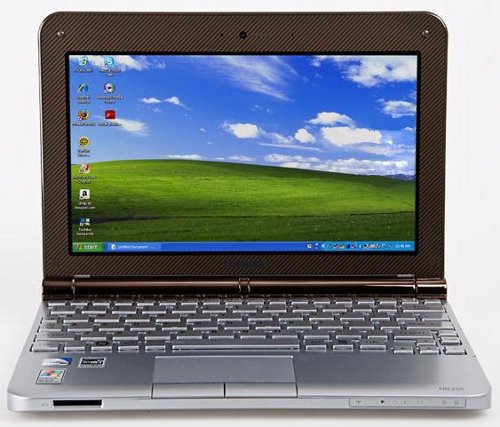
As someone who has been running Windows XP as a primary operating system for the past eight years and has seen more netbooks with the dated OS in the last year or so, I was probably more excited about the arrival of Windows 7 than Twilight fans are about the upcoming release of the vampire packed New Moon movie. However, the last two netbooks I have gotten my hands on run the lower-end and feature-missing Windows 7 Starter edition. Although it pains me to admit it, I miss the rolling green mountains and blue skies of Windows XP.

Netbook manufacturers, including ASUS, HP and Toshiba, have chosen to put Windows 7 Starter on the newest crop of netbooks and, without a doubt, did so with a push from Microsoft. (Don’t forget about the higher profit margins on Windows 7 netbooks.) In fact, Retrevo.com, which is similarly evidencing dissatisfaction with Win 7 Starter, reports that 23 of the 28 netbooks on sale at Amazon.com right now are preloaded with Starter edition. And it doesn’t surprise me that Retrevo’s survey on netbooks with Windows 7 Starter found that 54 percent of consumers would be unsatisfied with a new netbook equipped with Windows 7 Starter Edition because of limitations in the OS. I am, without a doubt, in the same camp as that 54 percent.

Though Microsoft lifted the three-application limit before releasing the slimmed-down version of its operating system in October, it managed to include a number of restrictions including lack of support for DVD playback and the graphical Aero Peek interface. My major gripes, however, lie with the following shortcomings of the OS, which are far greater than dealing with the aging Windows XP.

Locked desktop background – You cannot change the desktop background on any Windows 7 Starter system. That’s simply ridiculous. I have been changing backgrounds in Windows since my very first desktop that ran Windows 95! Can I live with a blue Windows logo on my netbook’s desktop? Sure, but why should I? Yes, Windows 7 may be more aesthetically appealing than Windows XP, but who wants to look at a blue shaded Windows logo forever?

No multi-monitor support – Last week I discovered the hard way that the Nokia Booklet running Windows 7 Starter wouldn’t let me extend its 10-inch desktop to an external monitor. Since you can only clone the desktop in Windows 7 Starter, don’t plan on keeping an email client open on the 10-inch display and your browser open on a larger monitor. (Yes, that’s my netbook setup and it’s too good to part with.)

Subpar battery life – According to reports from LAPTOP Magazine and Liliputing, Windows 7 Starter edition is getting an average of 40 minutes less battery life than netbooks running Windows XP. That is quite a bit of wasted juice. Given that battery life is one of the best selling points of netbooks, I’d prefer to get some extra run time and sacrifice some of Windows 7’s features.

Don’t get me wrong; there are a number of things better about Windows 7 Starter than Windows XP, like the ability to connect to multiple networks and connect quickly. But, as I’ve said before, I’d rather have function over form and losing the core functionality of an operating system just rubs me the wrong way. While I am aware that most of my complaints can be solved by paying $80 and upgrading to Windows 7 Home Premium, adding 80 bucks to a netbook isn’t an insignificant cost and, in some cases, that’s as much as a quarter of the cost of the system itself.

So, big deal that Windows XP looks outdated, it provides me and other netbook users with the right price along with the essentials — the ability to change the wallpaper to an image of choice, longer battery life and the capability to extend the desktop to another monitor. Of course, word is that Microsoft could be finally pulling the life support on Windows XP before the end of the year on netbooks. Maybe the threat of Google’s Chrome OS, which is supposed to be shown in an early beta form this week, will be a viable alternative or perhaps scare Microsoft from pushing Starter onto netbooks. Until then, I am continuing to name Windows XP my netbook operating system of choice.
Read More